
Your team has built a specialized 'IT Helpdesk' Copilot Studio agent in a development environment. You want to reference this agent as a child agent from a new 'Company Portal' agent in the same production environment. What is the prerequisite for the Company Portal agent to invoke the IT Helpdesk agent?
Select an answer to reveal the explanation.
Short Explanation
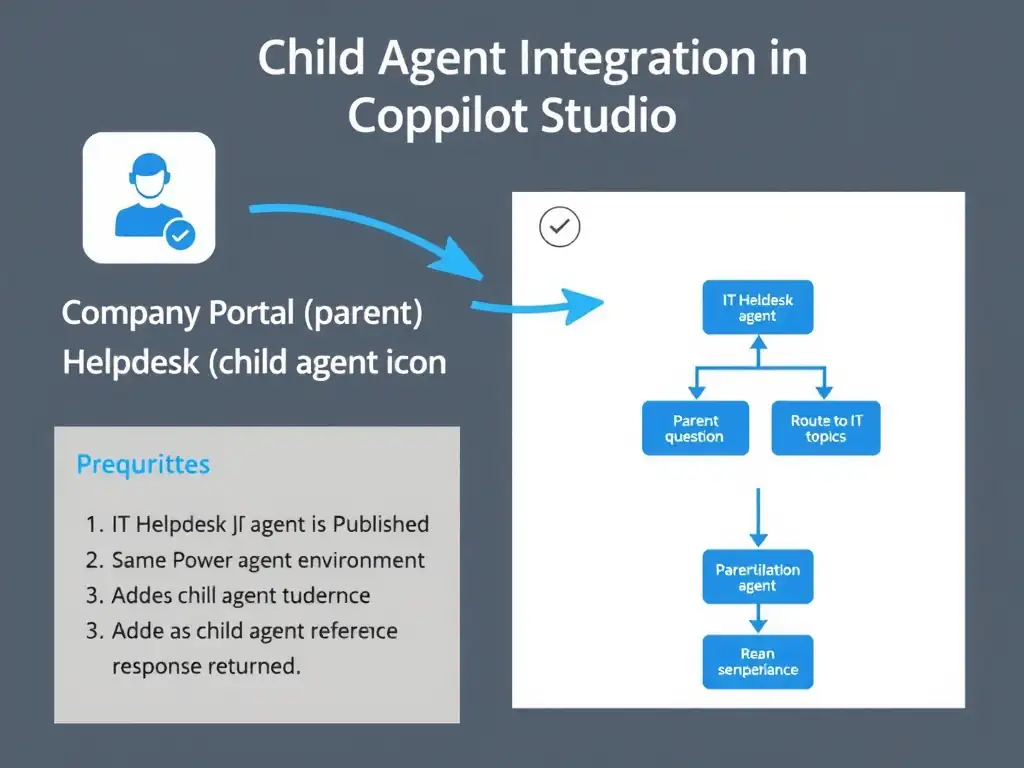
You can't invoke a child agent that's still in draft or sitting in another environment. Publish the IT Helpdesk agent in the same Power Platform environment, then add it as a child agent in the Company Portal agent's configuration.
Full Explanation
Copilot Studio supports multi-agent architectures where a parent (orchestrator) agent can route conversations to specialized child agents. To invoke a child agent, the child must be published (not in draft state), present in the same Power Platform environment as the parent agent, and added to the parent agent's configuration as a child agent reference.
When the parent agent uses generative orchestration, it can automatically detect when a user's request matches the child agent's purpose and route the conversation there. Alternatively, explicit topic actions can invoke child agents.
The requirement that both agents use the same Copilot Studio topic template has no bearing on agent communication — templates are starting points for authoring, not runtime communication prerequisites.
The requirement that the child agent be exported to a ZIP file and imported into the parent agent as an embedded component is not how child agent references work. Child agents remain separate, independently deployed agents — they are referenced by connection, not embedded.
The requirement that both agents share the same Microsoft Teams channel configuration is also wrong — child agent invocation is an internal agent-to-agent capability; it doesn't depend on channel configuration. The parent agent's channel handles the user-facing communication.
Key exam steps: publish the child agent → in the parent agent configuration, add the child agent reference → generative orchestration routes to the child when appropriate. Both agents must be in the same environment.