
You are configuring a Copilot Studio agent to answer employee questions using your company's SharePoint intranet. After adding the SharePoint site as a knowledge source, employees report that the agent sometimes returns information from pages they should not have access to. What is the correct approach to resolve this security issue?
Select an answer to reveal the explanation.
Short Explanation
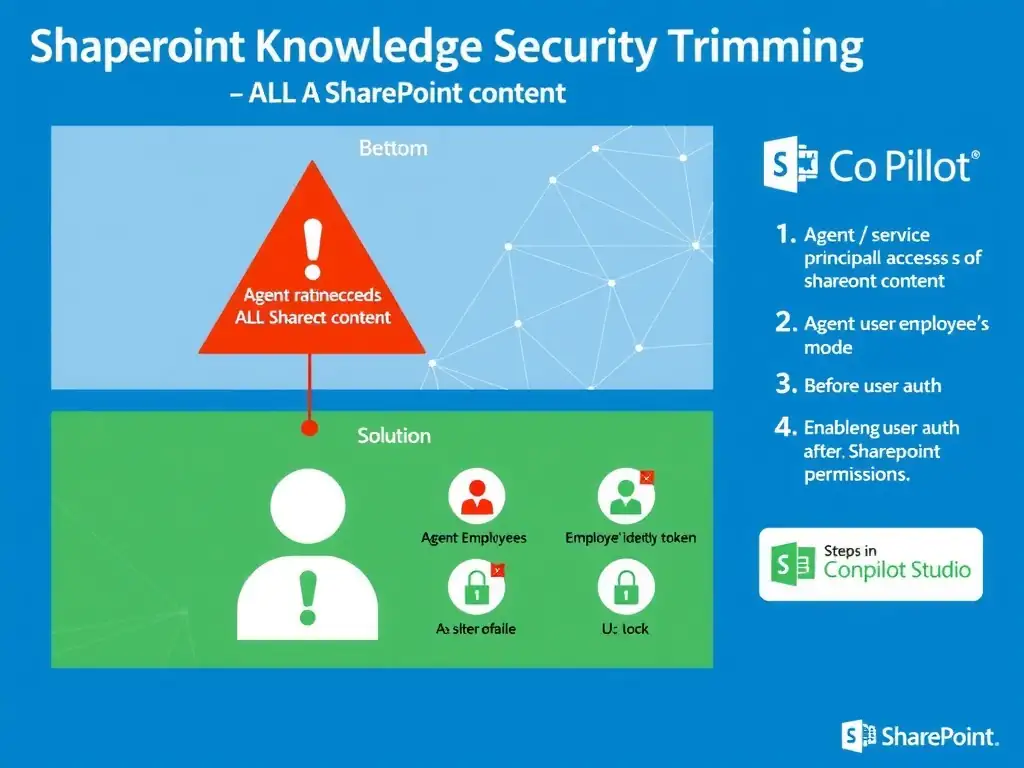
When agent uses its own system identity to fetch SharePoint content, it sees everything — like manager's badge unlocking every door. Switch to user authentication mode; agent borrows employee's own badge, so SharePoint's existing permissions automatically limit what agent can retrieve.
Full Explanation
Copilot Studio knowledge sources connecting to SharePoint can operate in two authentication modes: service principal (agent's own identity) or user authentication (end user's identity via OAuth). When knowledge source uses agent's service principal, it may have broad read access to entire SharePoint site, bypassing user-level permissions already configured in SharePoint. Correct fix is enabling user authentication on agent channel and configuring SharePoint knowledge source to use user delegation. This means when user asks question, Copilot Studio retrieves SharePoint content on behalf of that user using their token — so SharePoint's own permission inheritance and item-level permissions apply naturally. Removing SharePoint knowledge source and replacing it with static FAQ document is workaround that eliminates problem by eliminating feature — not acceptable governance solution. Manually curating list of approved SharePoint URLs and adding each page individually to knowledge source is impractical at scale, doesn't address permission leakage problem, and becomes maintenance burden as content moves. Applying sensitivity label to SharePoint site to prevent unauthorized agent access adds classification metadata but does not restrict which identity agent uses to retrieve content — agent's service principal would still have broad access. Critical exam point: SharePoint knowledge source plus user authentication mode equals content trimmed to user's actual SharePoint permissions. This is called security trimming and it's enterprise-correct answer for this scenario.