
A development team is planning an agent that needs to store customer ticket data collected during conversations and allow other Power Apps to read that data. Which storage solution should they use to align with Power Platform best practices?
Select an answer to reveal the explanation.
Short Explanation
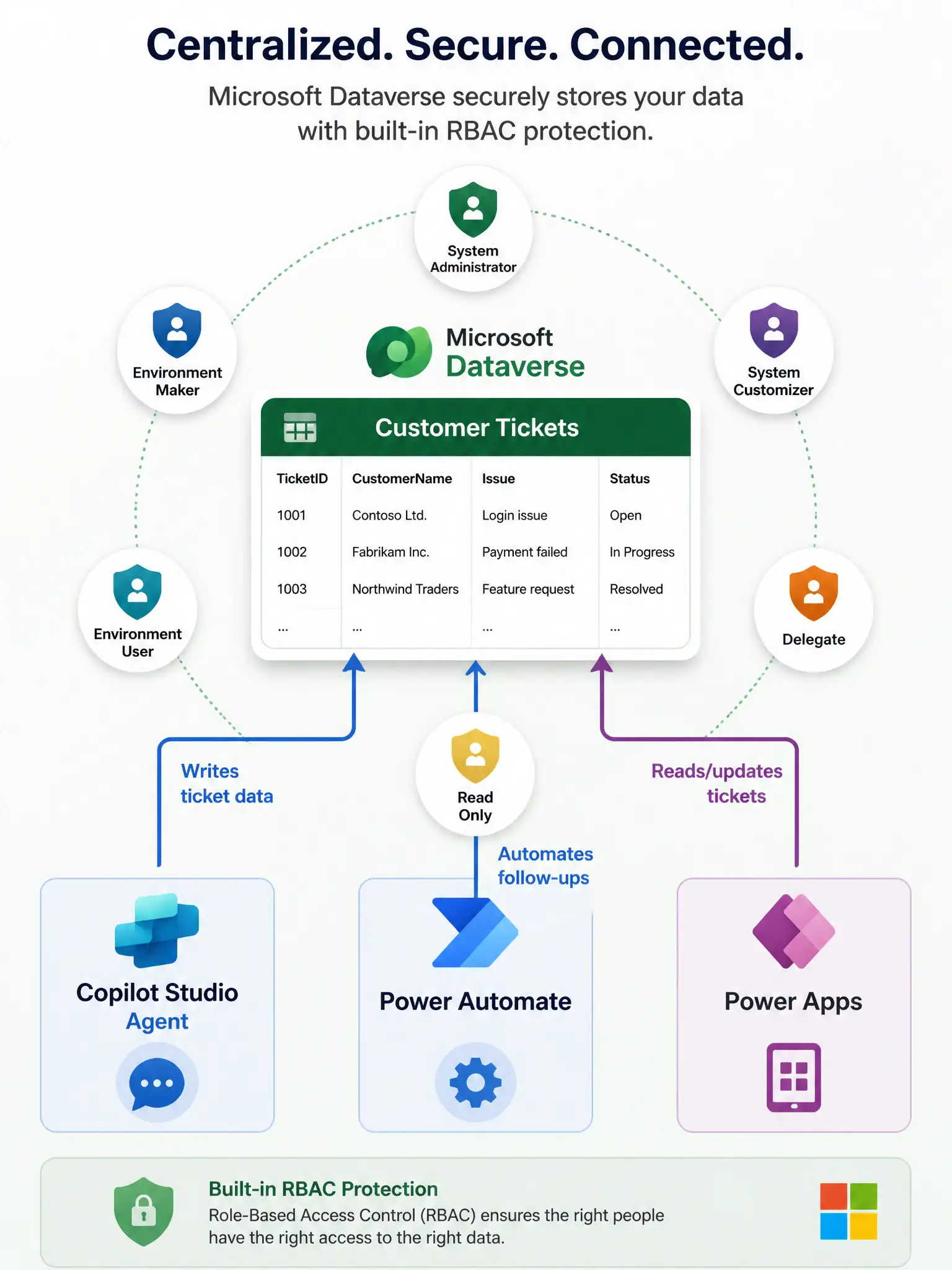
You want Microsoft Dataverse because it's the native data backbone for Power Platform. It gives you built-in security roles, relationships, and direct integration with Power Apps, Power Automate, and Copilot Studio without custom connectors.
Full Explanation
Microsoft Dataverse is the recommended data store for Power Platform solutions because it integrates natively with all Power Platform components without custom connectors or middleware. The correct choice is the option that stores data in Microsoft Dataverse, which is the native data platform for Power Platform and provides security roles, relationships, and integration with other Power Platform components. Dataverse provides role-based access control via security roles that integrate with Entra ID, table relationships that the agent can traverse, native connectors in Power Automate and Power Apps with no custom connector required, and auditing or change history out of the box. Copilot Studio actions can write to and read from Dataverse directly using the Dataverse connector in Power Automate.
The option that writes collected data to a SharePoint list via Power Automate because SharePoint is familiar to most Microsoft 365 organizations is incorrect. While SharePoint lists work for simple scenarios, they have limitations: 5,000-item view thresholds, limited relationship modeling, no proper row-level security comparable to Dataverse, and poor support for complex data structures. For ticket management data that other apps need to read, SharePoint is the wrong tool.
The option that uses Azure Blob Storage to persist conversation data and provide a REST API for Power Apps to read the data is incorrect. Azure Blob Storage is appropriate for file or binary data, not structured relational data like customer tickets. Building a REST API wrapper for Power Apps to read blob storage adds significant complexity that Dataverse eliminates.
The option that uses a SQL Server database with a Power Automate flow to write records and a custom connector for Power Apps to read them is incorrect. SQL Server with a custom connector is viable but adds unnecessary infrastructure, licensing costs for SQL Server, and custom connector maintenance. Dataverse provides equivalent capability natively within the Power Platform tenant.