
Bridget is a Power Platform architect at Clearview Financial advising her team on which Power Automate trigger type to use for three different agent scenarios: (1) A flow that the Copilot Studio agent calls immediately when a user requests a loan pre-qualification; (2) A flow that automatically fires when a new loan application record is created in Dataverse; (3) A flow that runs nightly at midnight to archive closed loan cases. Which trigger matches each scenario correctly?
Select an answer to reveal the explanation.
Short Explanation
You’ve got three trigger types and three jobs: agent-called flows use Instant with 'Run a flow from Copilot', event-driven flows use Automated, and time-based jobs use Scheduled. Pick the mapping that matches each scenario exactly.
Full Explanation
Power Automate's three primary trigger categories map directly to different execution models and use cases:
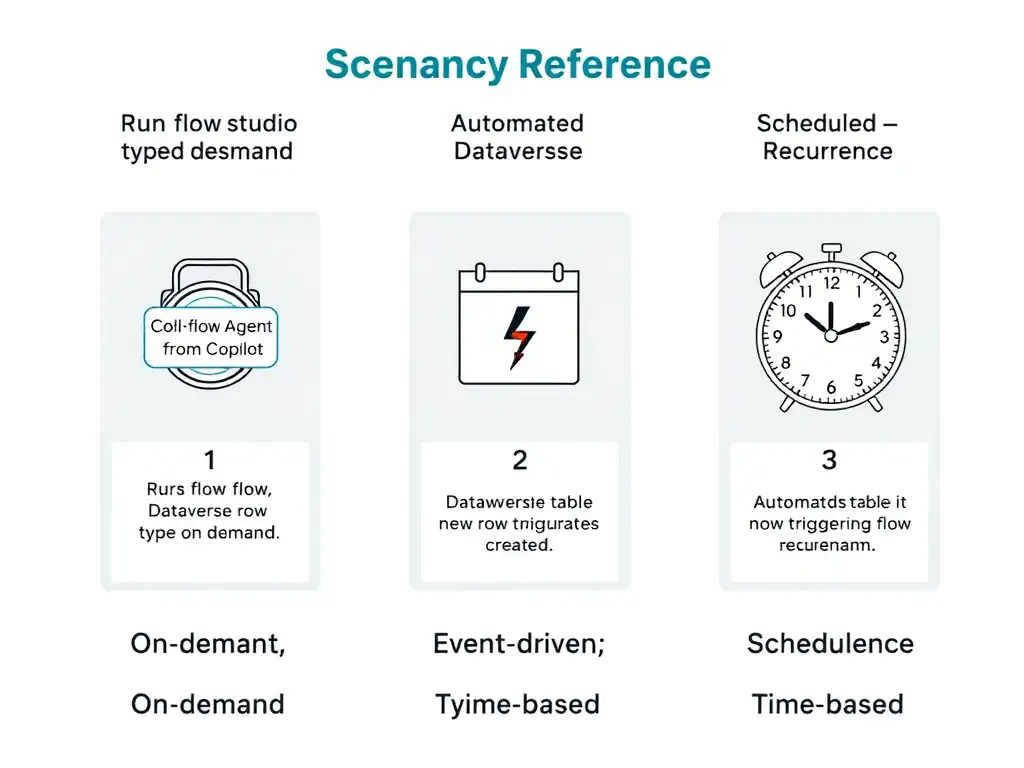
Instant triggers execute on demand when explicitly invoked. The 'Run a flow from Copilot' trigger (previously 'When a Power Virtual Agents topic calls a flow') is the specific instant trigger designed for Copilot Studio integration. It allows the agent to call the flow with typed input parameters and receive typed outputs in return. Scenario 1 — the loan pre-qualification flow called by the agent — is a perfect match.
Automated triggers fire in response to events in connected systems. The Dataverse 'When a row is added, modified, or deleted' trigger fires immediately when the specified data event occurs, without any manual or scheduled intervention. Scenario 2 — processing a new loan application — is a classic automated trigger pattern.
Scheduled triggers use a Recurrence trigger to execute flows at defined time intervals or specific times. Scenario 3 — a nightly archive job at midnight — is the canonical scheduled trigger use case.
The correct mapping is the one that pairs scenario 1 with 'Run a flow from Copilot' (Instant), scenario 2 with Automated (Dataverse row created), and scenario 3 with Scheduled (Recurrence).
The mapping that uses an HTTP webhook for the agent-called flow, an instant manual trigger for the Dataverse row-created flow, and Scheduled (Recurrence) for the nightly job is incorrect. An HTTP webhook trigger is a specialized automated trigger, not an instant trigger. An instant manual trigger has a 'Manually trigger a flow' starting point — it doesn't receive Dataverse events.
The mapping that uses Scheduled every 1 second to simulate real-time for the agent-called flow, Automated (Dataverse row created) for the new application, and an instant trigger manually run by an administrator at midnight for the nightly archive is incorrect. Running a scheduled flow every 1 second to simulate real-time is an anti-pattern that wastes API calls and violates connector throttling limits. Instant triggers exist specifically to avoid this polling approach.
The mapping that uses 'Run a flow from Copilot' (Instant) for the agent-called flow, Scheduled every 5 minutes to poll Dataverse for new records, and an automated trigger fired by a Dataverse table update at midnight for the nightly archive is incorrect. Using a scheduled flow to poll Dataverse every 5 minutes is inefficient when the Automated Dataverse trigger can fire the flow immediately on row creation — without polling delays or wasted runs.
Exam tip: The AB-620 exam frequently tests trigger type selection. Key rule: agent-initiated = Instant (Run a flow from Copilot); event-driven = Automated; time-based = Scheduled. Never use Scheduled to simulate Automated or Instant.