
Nikolai is the AI lead at Greenfield Pharma. He is designing the knowledge retrieval strategy for a Copilot Studio agent that answers researcher questions about drug interaction studies. Researchers often phrase questions conceptually — for example, 'What happens when a patient stops taking a beta blocker suddenly?' — and the indexed documents use clinical terminology like 'abrupt beta-blocker discontinuation syndrome'. Keyword search frequently returns zero results because the query terms don't match document terms. Which retrieval approach should Nikolai implement, and why?
Select an answer to reveal the explanation.
Short Explanation
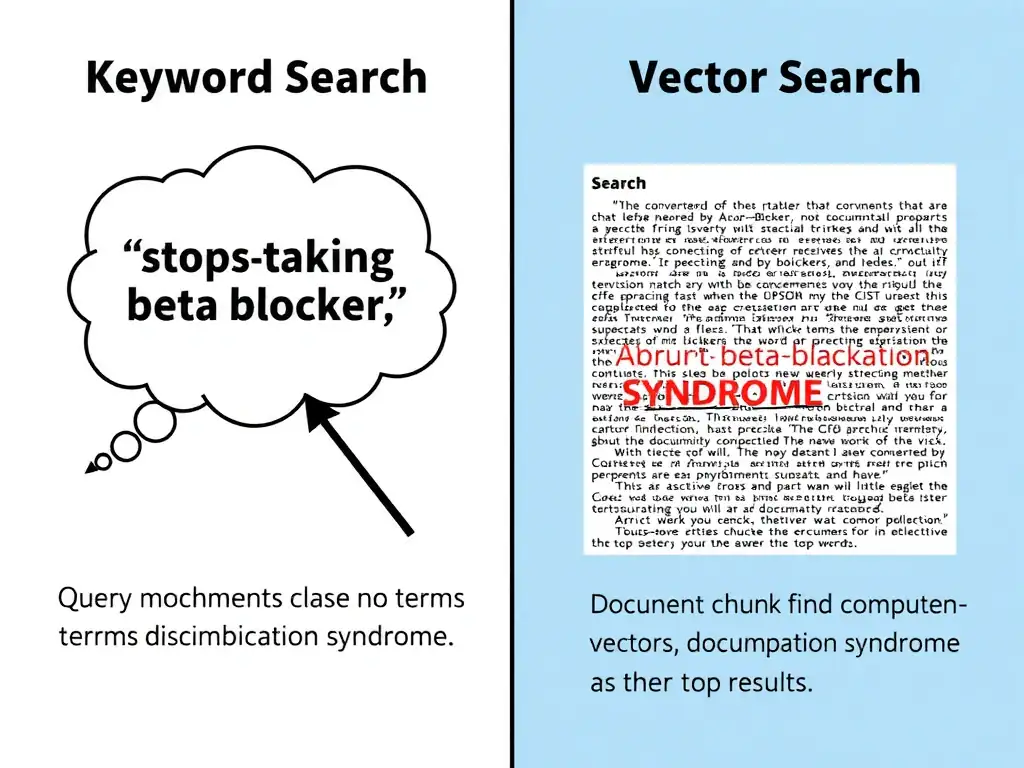
When a researcher says 'stops taking' but the document says 'discontinuation syndrome', keyword search misses because the words don't match. Vector embeddings turn both the question and the documents into meaning-based vectors, so Copilot Studio can retrieve the right study even when the terms differ.
Full Explanation
The fundamental limitation of keyword (BM25) search is its dependence on lexical overlap — the query must share exact or closely related terms with the document for a match to occur. When domain-specific jargon and natural language phrasing describe the same concept using completely different words, keyword search fails regardless of tuning.
The vector-search approach using embeddings generated by an Azure OpenAI model is correct. Vector search converts text into dense numerical representations (embeddings) using a language model trained to encode semantic meaning. Azure AI Search supports vector indexing using embeddings generated by models such as Azure OpenAI's text-embedding-ada-002 or text-embedding-3-large. At index time, each document chunk is embedded and stored as a vector field. At query time, the researcher's natural language question is also embedded, and the search engine returns documents whose vectors are most cosine-similar to the query vector — capturing conceptual relevance even when no terms are shared. This makes vector search ideal for natural-language queries against domain-specific technical corpora.
The fuzzy keyword search approach with a high edit distance tolerance is incorrect. Fuzzy keyword search allows for typographical variations by tolerating small edit distances (e.g., 'pharmaceutical' matching 'pharmaceuticl'). It does not bridge the gap between semantically related but lexically unrelated terms like 'stops taking' and 'discontinuation'. Fuzzy search is for spelling errors, not semantic differences.
The synonym-map approach in Azure AI Search is incorrect. Synonym maps are a valuable keyword search enhancement that expands query terms at search time. However, they require manual curation of every synonym pair. In a pharmaceutical context with thousands of clinical terms and their colloquial equivalents, maintaining a comprehensive synonym map is impractical and still cannot handle novel phrasings that weren't anticipated when the map was written.
The Bing-powered web search knowledge source approach is incorrect. Switching to Bing web search exposes internal research documents to public internet search, which is inappropriate for proprietary pharmaceutical data. Internal documents must remain indexed in a controlled knowledge source.
Exam caveat: The keyword vs. vector search distinction is a high-priority exam topic. Use keyword search when query terms reliably match document terms. Use vector search when users describe concepts in natural language that differs from document terminology. Hybrid search (combining both) is the most robust production approach.