
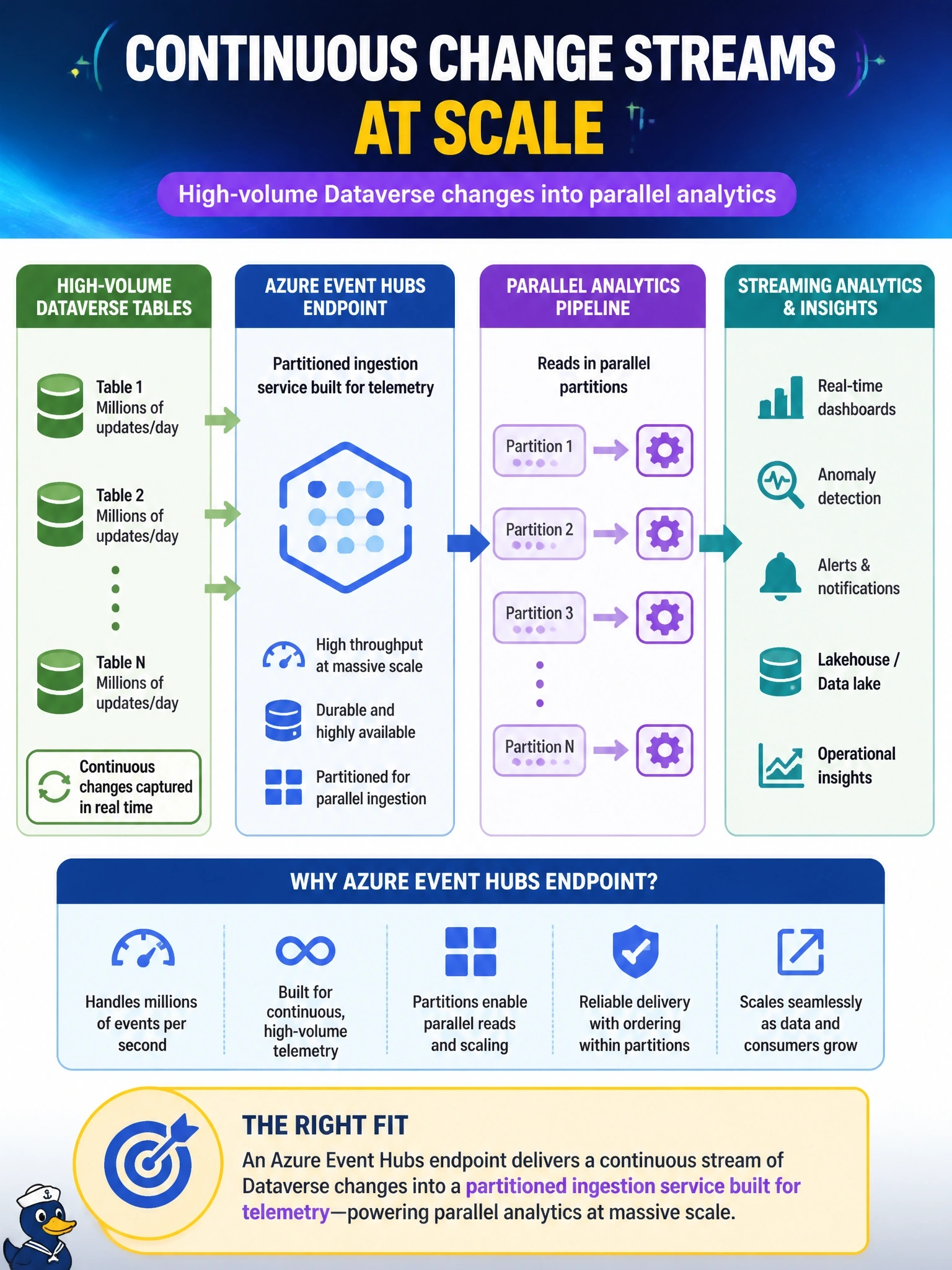
An analytics team wants a continuous stream of changes from several high-volume Dataverse tables, millions of updates a day, fed into a streaming analytics pipeline that reads in parallel partitions. Which service endpoint type best fits this requirement?
Select an answer to reveal the explanation.
Short Explanation
Event Hubs is a firehose built for big streams; Service Bus is a careful mail room for business messages. When analytics wants millions of changes read in parallel, you reach for the firehose. Two-way contracts and sessions solve problems this team doesn't have.
Full Explanation
Dataverse supports an Event Hubs contract for service endpoints, which posts the execution context to an Azure Event Hubs instance. Event Hubs is designed for high-throughput event ingestion and stores events in partitions that many readers can consume in parallel, each tracking its own position, which matches a streaming analytics pipeline. A webhook posts each event as an HTTP request to one receiver; at this volume the analytics API would need to absorb every call itself, and it offers no buffering or partitioned replay. Service Bus queues with sessions provide ordered, locked processing for business workflows; locking one message at a time works against parallel high-volume analytics. A two-way contract returns a string to the plug-in that initiated the post and requires an active listener; per-change acknowledgments add latency and buy nothing for analytics. Exam caveat: for a full analytical copy of Dataverse tables rather than an event stream, Microsoft also offers Azure Synapse Link for Dataverse; this question asks for a stream of change events. Operational check: register the Event Hubs endpoint and steps, run a burst of updates in a test environment, and confirm events arrive across partitions and the analytics job keeps up.