
A company wants one employee assistant that answers HR, IT and finance questions. Each department already owns a published Copilot Studio agent and must keep releasing it on its own schedule. Developers will build the assistant in Microsoft Foundry and need one entry point for employees. Which design meets the requirements?
Select an answer to reveal the explanation.
Short Explanation
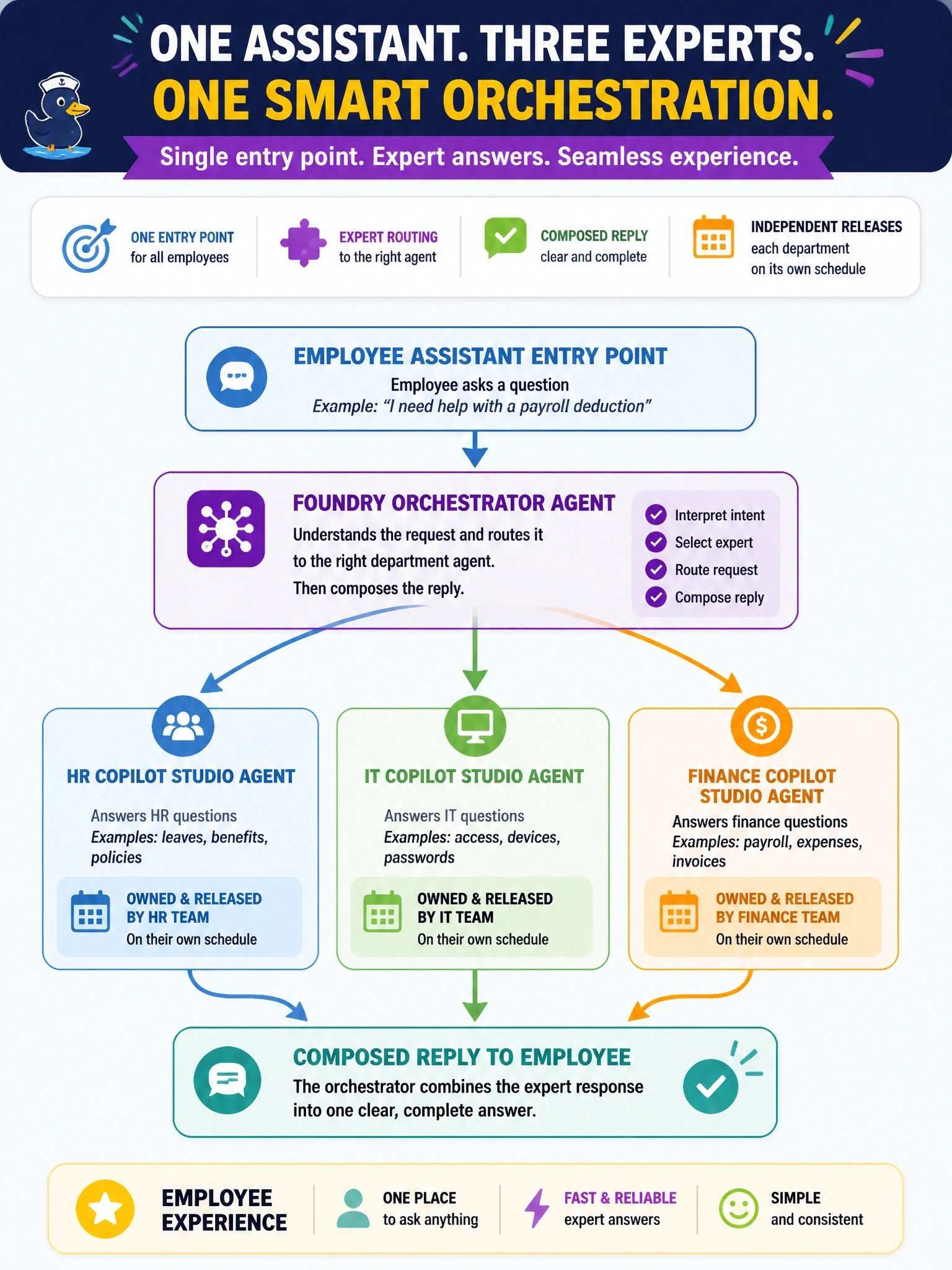
Think of a hospital front desk: one person greets you, then sends you to cardiology or radiology, and each department runs itself. The orchestrator is that front desk and the department agents stay specialists. Merging them or copying their knowledge breaks the 'release on your own schedule' rule.
Full Explanation
A multi-agent design puts an orchestrator in front of specialist agents. The Foundry agent receives the employee's request, decides which domain it belongs to, calls the corresponding published Copilot Studio agent, and combines or relays the response. Each department keeps editing and publishing its own agent independently, and employees still have a single entry point. Merging all topics and knowledge into one Copilot Studio agent gives one entry point but couples every department to a shared release cycle and a shared owner, which violates the independence requirement. Copying each department's knowledge into the others multiplies the content, guarantees drift, and still leaves three entry points. Publishing three Teams channels keeps independence but abandons the single entry point and pushes routing onto employees, who often cannot tell whether a question is HR or finance. Exam caveat: orchestration does not mean the orchestrator must answer anything itself; its job is routing and composition, while authority stays with the specialists. Operational check: send one question from each domain through the orchestrator and confirm in each Copilot Studio agent's activity that it received and answered only its own requests.