
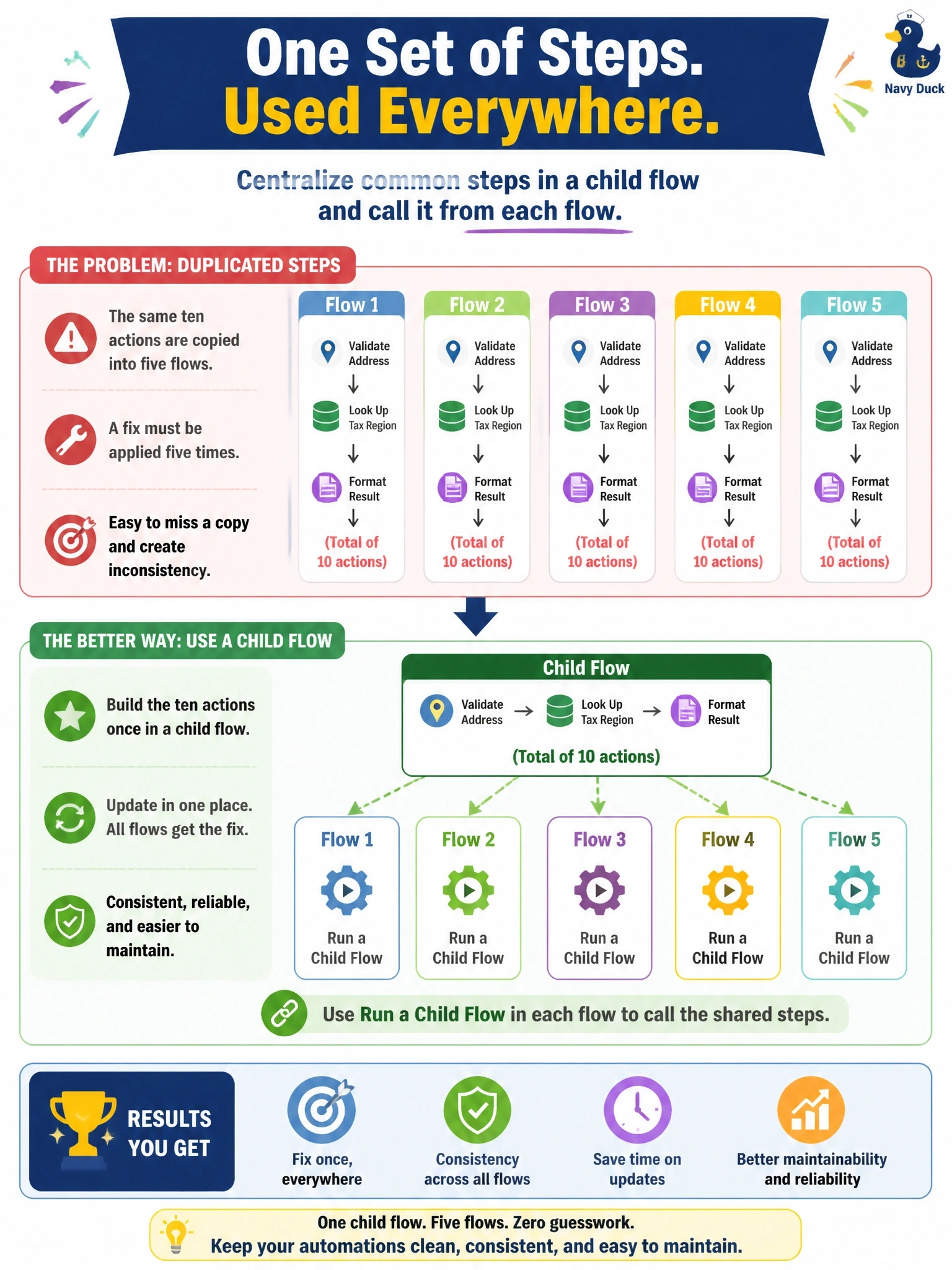
A team notices that the same ten actions, which validate an address, look up a tax region in Dataverse, and format the result, are copied into five different cloud flows. A recent fix had to be applied five times, and one copy was missed. All flows live in one solution. Which change best addresses this?
Select an answer to reveal the explanation.
Short Explanation
If you're fixing the same bug in five places, the bug isn't the problem; the copies are. Put the logic in one child flow and call it from all five, and the next fix happens once. Scopes and layers sound like sharing, but they don't link anything together.
Full Explanation
A child flow centralizes reusable logic in one flow that other flows call with the Run a Child Flow action. The ten actions move into the child flow behind a Manually trigger a flow trigger with inputs such as the address, and a response action returns the formatted result and tax region. Each parent flow replaces its copy with a single call, so a future fix is made once and every caller picks it up on its next run. Because all flows are in one solution, the child flow deploys with the parents and stays linked across environments. Copying and pasting actions is still duplication; it speeds up editing but leaves five independent copies that can drift, which is how the missed fix happened. A Scope groups actions inside one flow for organization and error handling; scopes are not shared objects, so changing one scope does not affect another flow. Solution layers describe how managed and unmanaged customizations stack on a component; they do not merge actions from one flow into others or provide inheritance between separate flows. Exam caveat: calling a child flow adds a run and some latency, so very small or performance-critical snippets may not justify extraction. Operational check: after refactoring, change the formatting logic in the child flow and confirm all five parent flows return the updated format.