
A team is building a .NET 8 worker service that performs thousands of Dataverse operations per hour. One developer proposes hand-writing HttpClient calls to the Web API, while another proposes the Dataverse ServiceClient from the SDK for .NET. The team wants less custom plumbing for authentication, token refresh, and throttling. Which reasoning supports choosing the SDK?
Select an answer to reveal the explanation.
Short Explanation
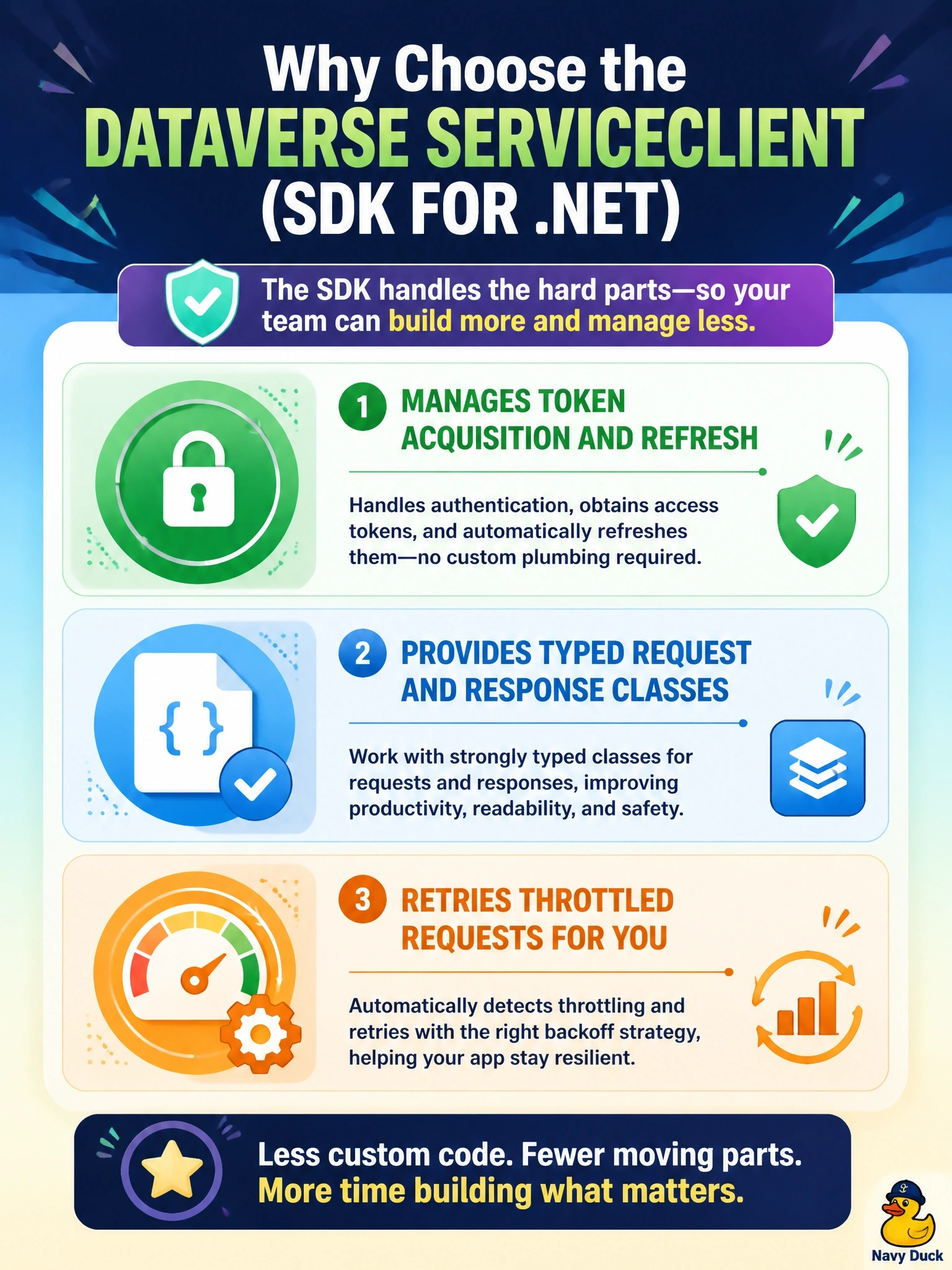
Think of the SDK as a car with power steering versus building your own steering rack. ServiceClient handles tokens, typed messages and throttling retries so you write business code, not plumbing. But don't fall for the myth that it dodges API limits; every client plays by the same rules.
Full Explanation
The Dataverse ServiceClient in the SDK for .NET is designed to reduce boilerplate for .NET applications. It acquires and refreshes access tokens through supported authentication options, exposes typed request and response classes for Dataverse messages, supports early-bound entity classes, and includes built-in retry behavior for service protection responses so throttled calls wait and retry rather than failing immediately. Hand-built HttpClient code can do all of this, but the team would have to implement token caching, error parsing, and Retry-After handling itself. Service protection API limits are evaluated per user and per web server for every caller; SDK traffic is not exempt and is not counted separately, so choosing an SDK never bypasses throttling. ServiceClient does not hold a database transaction open across separate calls; transactional grouping exists only within a single request such as ExecuteTransaction, and the Web API offers the equivalent through change sets in a batch request. Both the SDK and the Web API communicate with Dataverse over HTTPS; neither connects directly to the underlying database. Exam caveat: the Web API remains the choice for non-.NET languages and for lightweight clients where the SDK is not available. Operational check: load-test the worker and confirm that 429 responses are retried after the indicated delay rather than surfacing as failures.