
A .NET plug-in project has grown to dozens of tables, and late-bound Entity code keeps breaking from misspelled logical names that only fail at run time. The team wants strongly typed classes for its tables, columns, and choices generated from the environment's metadata. Which Power Platform CLI command should the developer use?
Select an answer to reveal the explanation.
Short Explanation
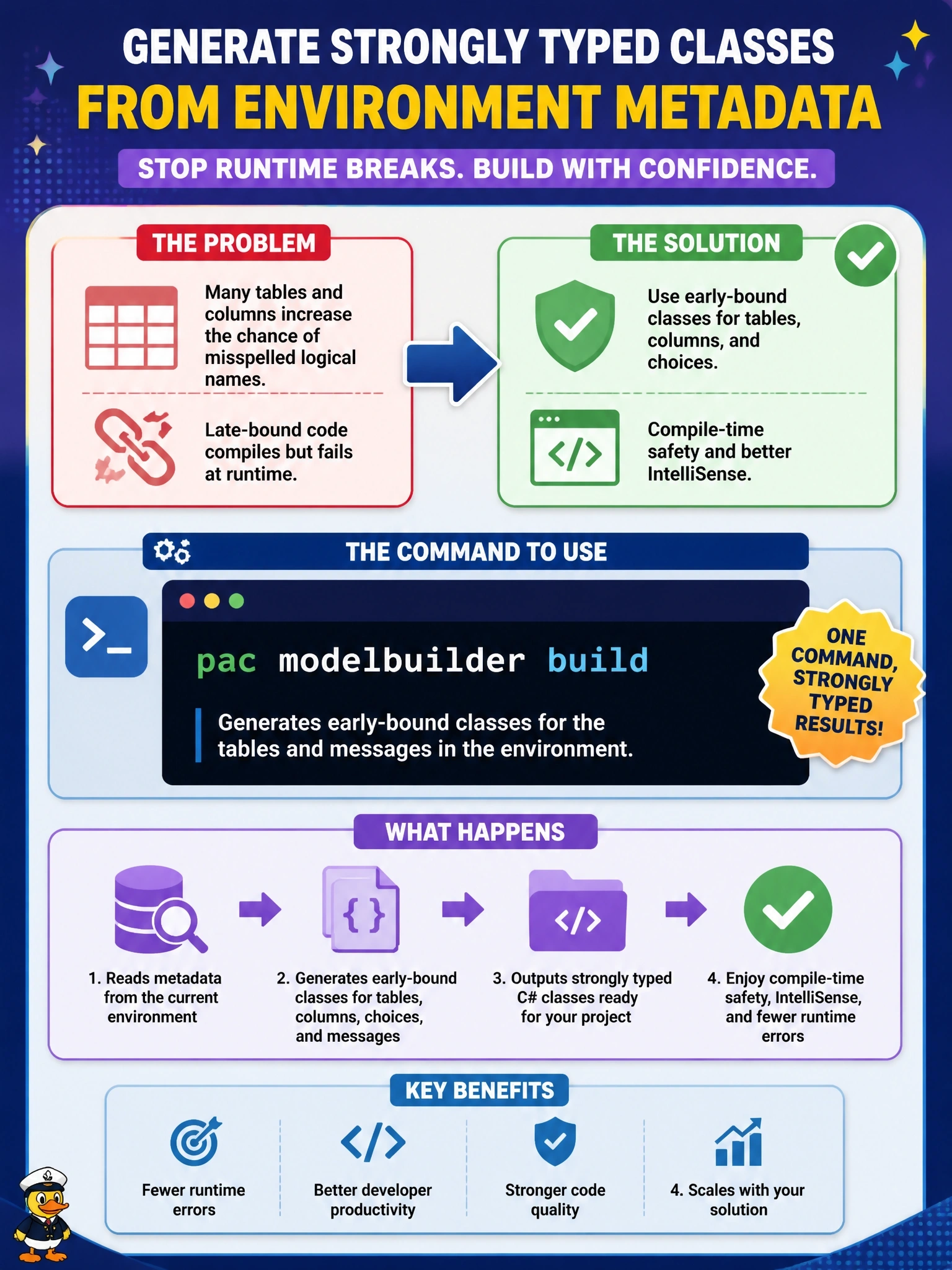
Early-bound classes are like spell-check for your table and column names: the compiler catches the typo before your users do. pac modelbuilder build reads the metadata and writes those classes for you. The other commands are real, but each builds something else entirely.
Full Explanation
Early-bound programming uses generated classes that represent each table, its columns, and its choice values as typed members, so the compiler catches misspelled names and type mismatches that late-bound Entity code only reveals at run time. The Power Platform CLI provides pac modelbuilder build to connect to an environment, read its metadata, and generate those classes, and it can be filtered to the tables and messages a project needs so the output stays manageable. The generated code is added to the plug-in or client project and regenerated when schema changes. pac solution clone retrieves an existing solution as a source project for ALM; it produces solution component files, not .NET entity classes. pac plugin init scaffolds a new plug-in project with a starting class and project file but does not read table metadata to generate types. pac pcf init scaffolds a Power Apps component framework project with a manifest and TypeScript template; it has no role in generating .NET entity classes. Exam caveat: early-bound classes add assembly size and must be regenerated after schema changes, so teams often limit generation to the tables they actually use. Operational check: run the generation against a development environment, compile the project, and confirm that a deliberately misspelled column property now fails at build time instead of at run time.