
A data science team works entirely in Python notebooks. They need to read Dataverse rows into pandas DataFrames, write cleaned values back, and occasionally create a custom table, without learning C# or hand-building OData requests. Which option should the developer recommend?
Select an answer to reveal the explanation.
Short Explanation
If your team thinks in Python, give them a Python front door. The Dataverse SDK for Python handles auth, CRUD, bulk work and even DataFrames, so nobody's hand-rolling OData or learning C#. The traps are tools that technically touch Dataverse but were never built for a notebook.
Full Explanation
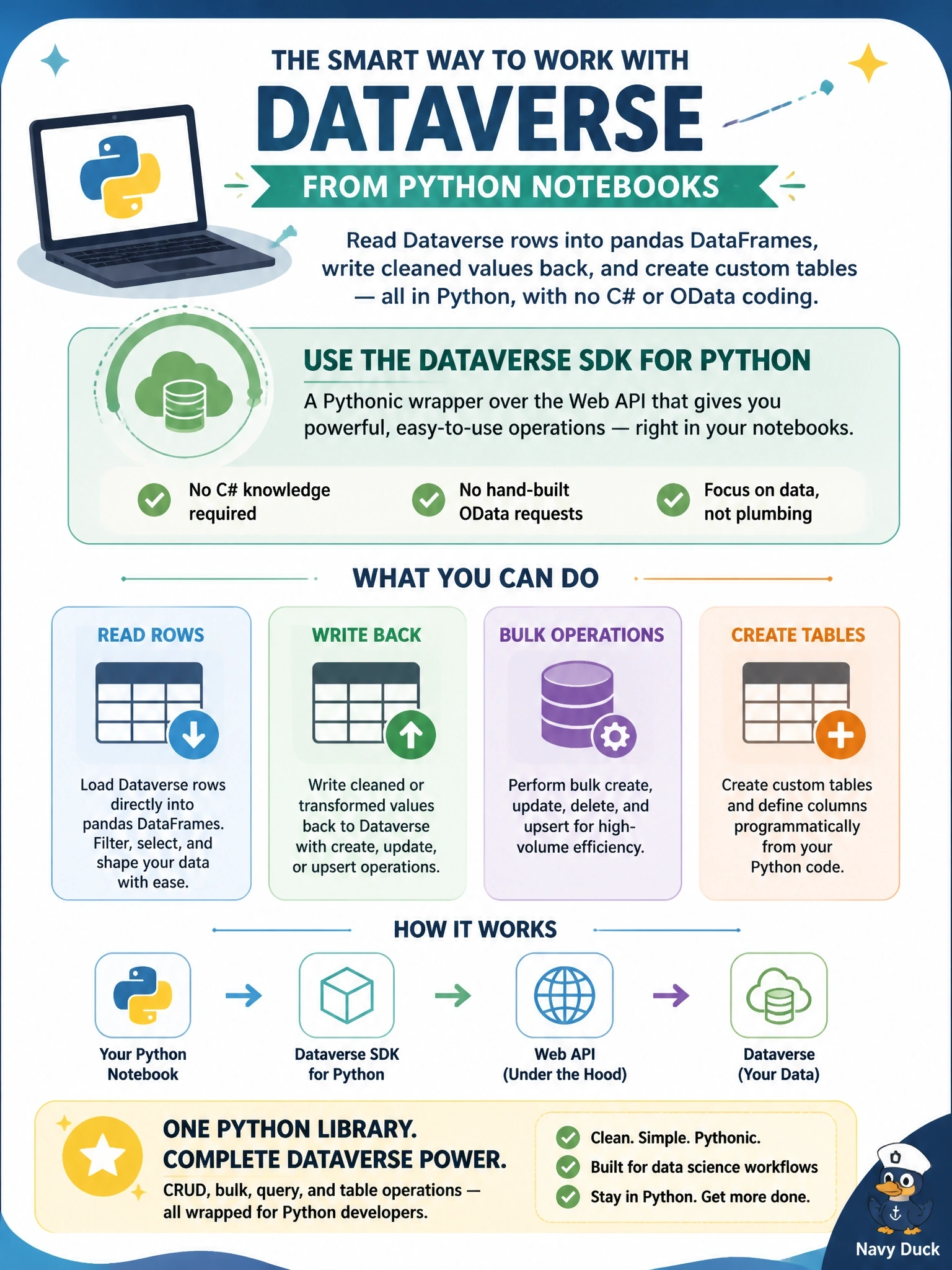
Microsoft publishes an open-source Dataverse SDK for Python for developers and data scientists who want to work with Dataverse without .NET. It authenticates with Azure identity credential objects and exposes create, retrieve, update, and delete operations, bulk operations that use Dataverse's native CreateMultiple, UpdateMultiple, and UpsertMultiple messages, OData-based queries with paging, read-only SQL SELECT queries, automatic retries for transient failures and throttling, pandas DataFrame wrappers, file column uploads, and create, update, and delete of custom tables and columns. That set covers the team's reads, writes, and occasional table creation directly in notebooks. Hosting the .NET SDK through an interop bridge adds a runtime dependency and C# concepts the team wants to avoid, and nothing in the platform supports that as a pattern. The Power Platform CLI is a developer and ALM tool for solutions, components, and environments; it is not a data access library, and scraping its console output is fragile. The Copilot Studio client library lets code converse with a Copilot Studio agent; it does not provide table-level data access. Exam caveat: the Python SDK still calls the Web API, so service protection limits and security roles apply exactly as they do for any client. Operational check: run a simple retrieve with a credential from azure-identity and confirm the rows returned match a Web API query.