
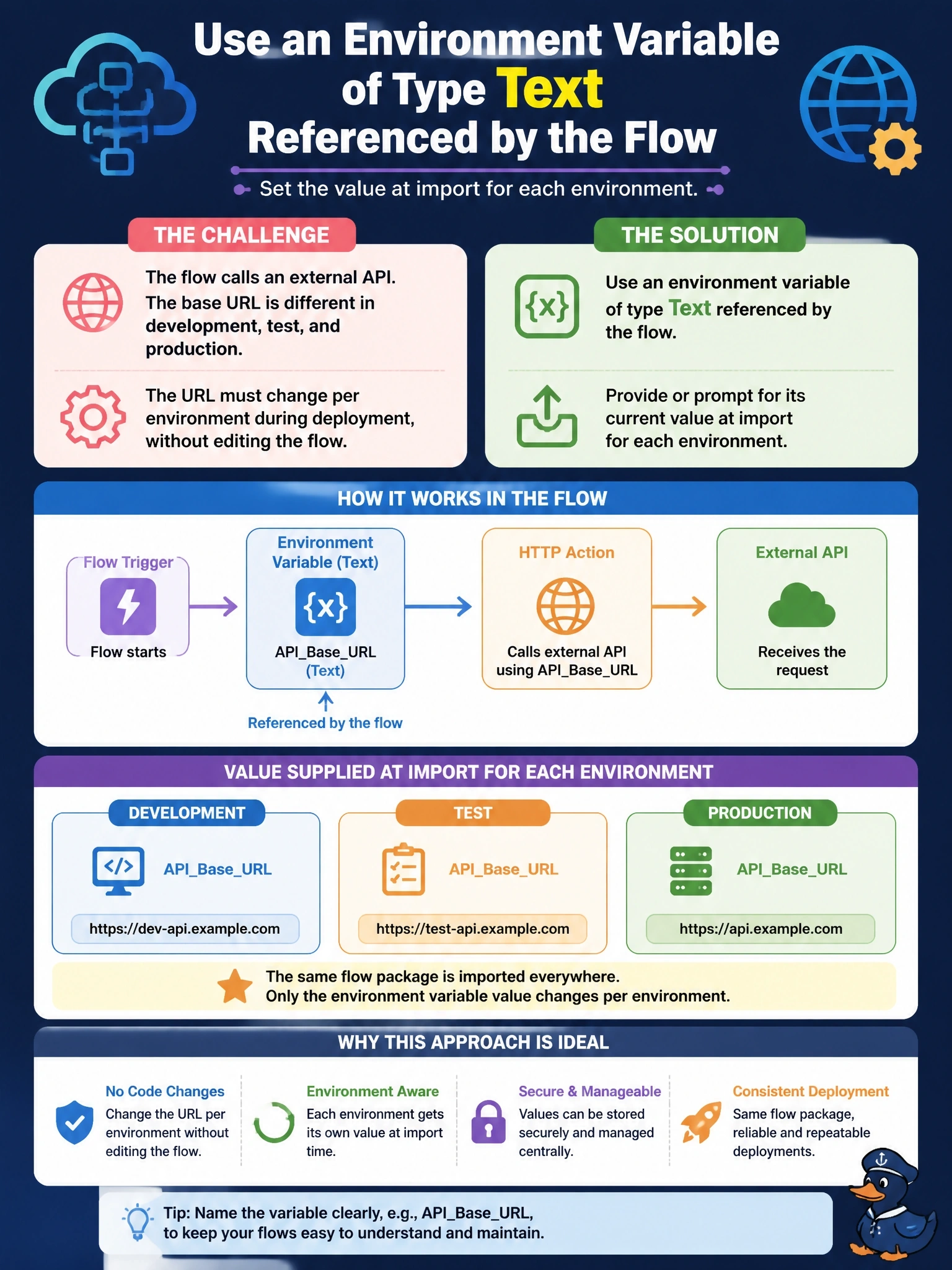
A solution cloud flow calls an external API whose base URL is different in development, test and production. The URL must change per environment during deployment, without editing the flow, and the deployment tooling should prompt for or supply the value at import. What should the developer use?
Select an answer to reveal the explanation.
Short Explanation
Think of an environment variable as a slot on the dashboard where you drop in the right address for each city you drive to. The flow reads the slot, and you fill it in when you deploy. The trap is the connection reference, which picks which connection to use, not configuration values.
Full Explanation
Environment variables are solution components that hold configuration values, such as text, numbers, JSON or data source references, with a default value in the definition and an optional current value per environment. A flow references the variable instead of a literal, and when the managed solution is imported, deployment tooling such as the import experience, pipelines or a deployment settings file supplies the current value for that environment. The flow itself never changes between environments, which keeps the managed solution identical across dev, test and production. A Compose action with hardcoded URLs and a condition embeds environment knowledge in the flow, so adding or changing an environment means editing and redeploying the flow. Connection references let solution components use connections that are mapped at deployment; they identify which connection to use for a connector, not arbitrary configuration values like a base URL for an HTTP action. A personal option setting on a user record is not a supported configuration mechanism for flows and would tie the value to one person. Exam caveat: avoid exporting a current value in the solution, because a current value travels with it and can override what the target needs. Operational check: import into test with the deployment settings file, then confirm the flow's run inputs show the test URL.