
Account changes in Dataverse must be delivered to three independent Azure consumers: a billing service, a data warehouse loader and an audit service. Each consumer must receive every change, even if it is offline for several hours, without slowing users' saves. Which outbound integration design meets this?
Select an answer to reveal the explanation.
Short Explanation
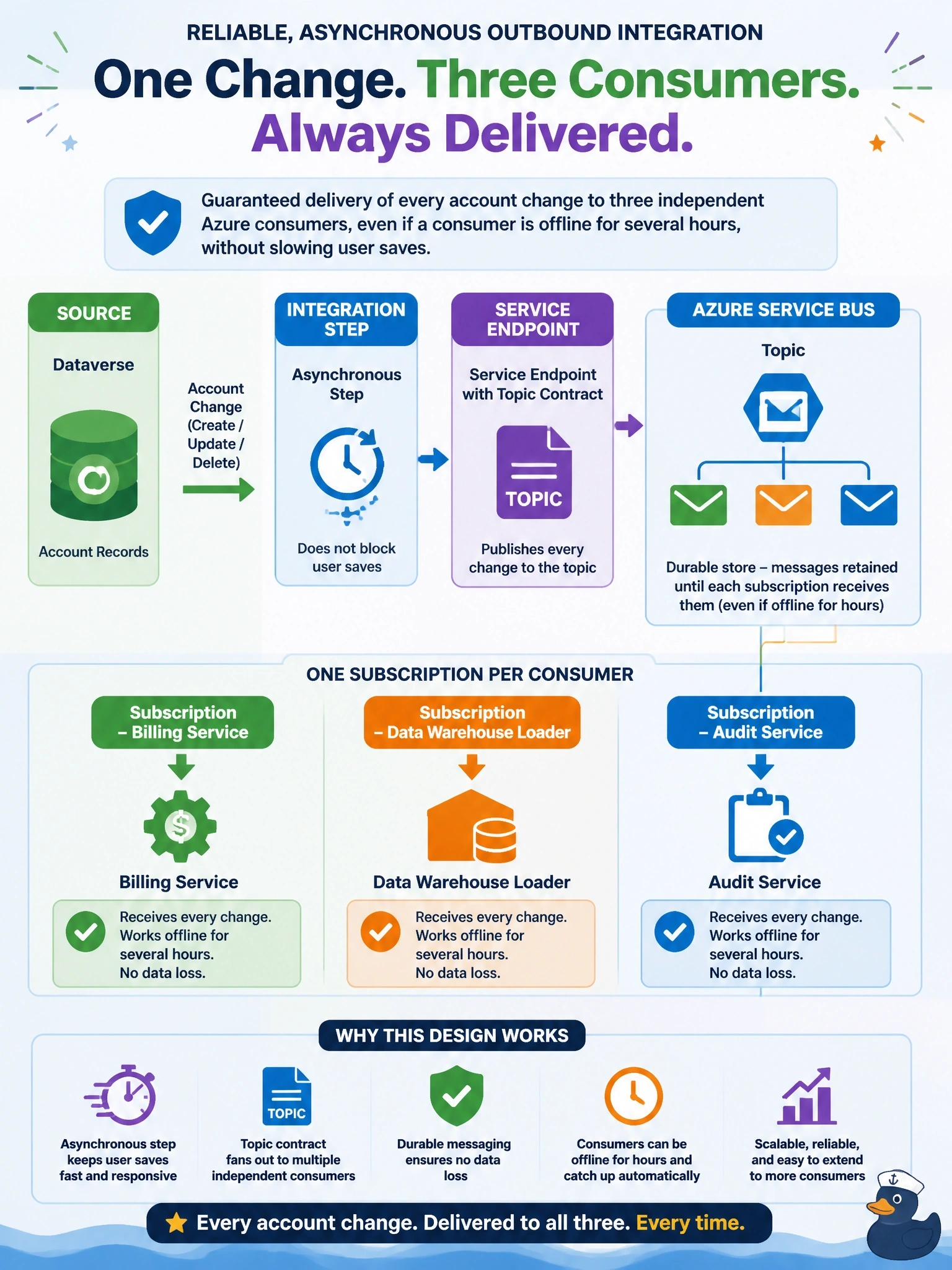
Think of a Service Bus topic as a newsletter with three subscribers: each one gets its own copy and it waits in their mailbox until they're back. A queue is a single mailbox where whoever grabs the letter first takes it away. The trap is the synchronous step, which makes your users wait on Azure.
Full Explanation
Dataverse can post execution context to Azure through service endpoints registered with the Plug-in Registration Tool. With the Topic contract, messages go to an Azure Service Bus topic, and each consumer reads from its own subscription, so every consumer receives every message and Service Bus retains them durably until the consumer reads them, even after hours offline. Registering the step as asynchronous means the post happens after the save completes, so users are not slowed and a Service Bus outage does not block transactions. With the Queue contract, consumers compete for messages: each message is delivered to only one reader, so three services sharing a queue would each see only part of the changes. Webhooks post directly to an HTTP endpoint and depend on that endpoint being available; a consumer that is offline for hours misses changes once retries are exhausted, and there is no durable per-consumer buffer. A synchronous registration posts inside the operation, so latency or failure at Service Bus slows users or fails their saves. Exam caveat: Event Hubs suits high-volume streaming, while Service Bus topics suit reliable fan-out of business messages. Operational check: take one consumer offline, update several accounts, then confirm its subscription's message count grows and drains when it reconnects.