
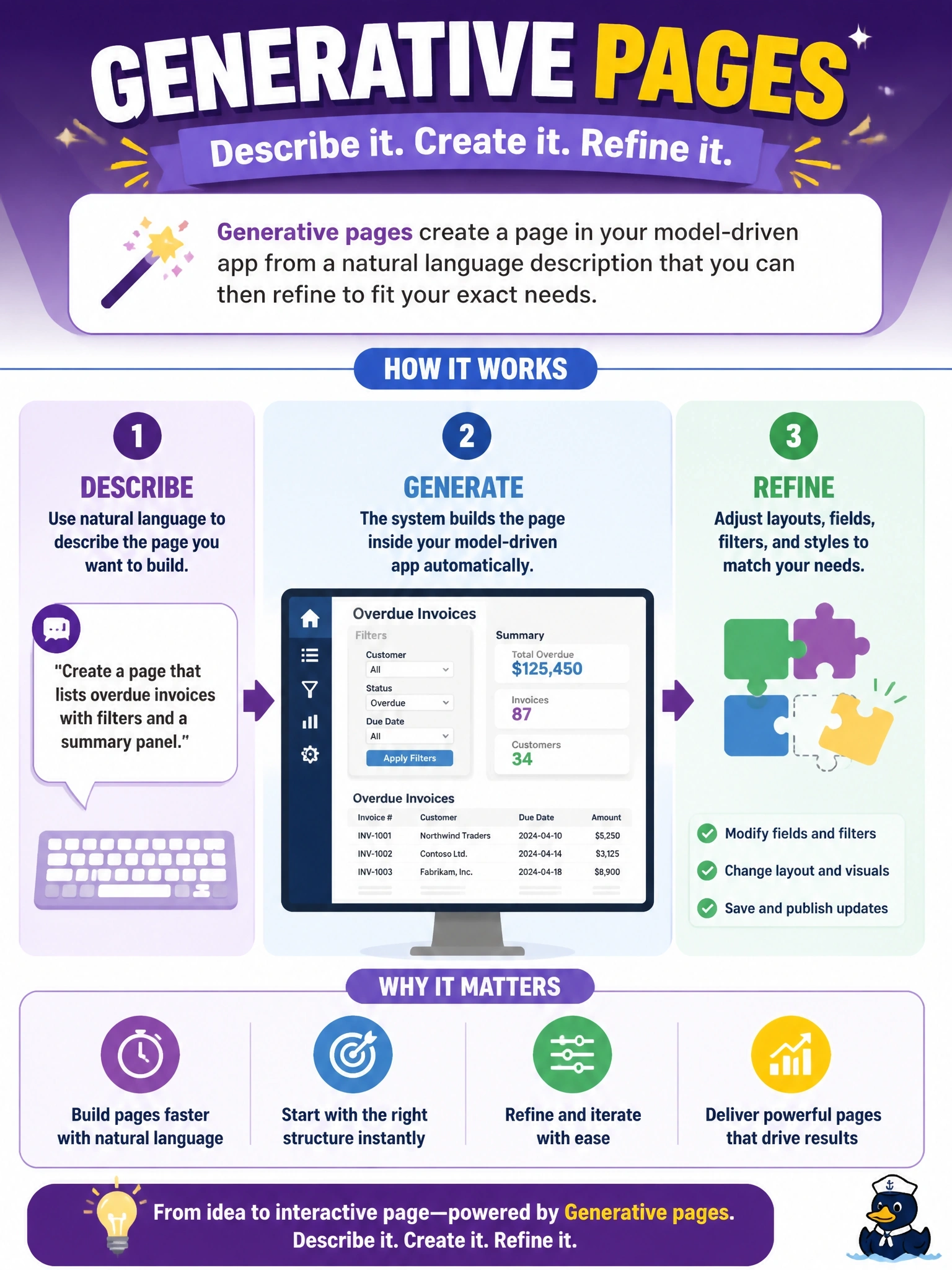
A maker wants to describe a complete page in natural language, for example a page that lists overdue invoices with filters and a summary panel, and have Power Apps produce that page inside an existing model-driven app for further refinement. Which capability matches this request?
Select an answer to reveal the explanation.
Short Explanation
Think of generative pages as describing the room you want and having it built right inside your house. You say what the page should show and you get a page in your model-driven app that you can keep refining. The trap is the code app, which is a whole separate house.
Full Explanation
Generative pages let makers create a page in a model-driven app by describing it in natural language, and the generated page is then refined through further prompts or by editing what was produced. The output is a page in the app's navigation that works with the app's Dataverse data, which matches a request for a complete overdue-invoice page with filters and a summary inside an existing app. A code app is a separate application built in a code-first IDE; it suits pro developers with their own toolchain and does not generate a page within the model-driven app from a prompt. A PCF dataset component is a reusable control written in TypeScript and placed on forms or views; nothing generates one from a sentence, and a control is narrower than a page. A Copilot Studio agent in the side pane provides a conversational experience for questions; it does not create a structured page with filters and panels. Exam caveat: choose the user-experience technology by scope and by who builds it: generative pages for whole pages built by describing them, PCF for controls, code apps for full code-first applications, and agents for conversational tasks. Operational check: generate the page, confirm it appears in the app's navigation, and verify it reads the expected invoice rows.