
A manufacturer streams device telemetry into Dataverse, producing millions of short-lived rows per day. Ingestion must scale horizontally without slowing the transactional tables, and each row must disappear automatically a set number of days after its last change, without any scheduled cleanup job. Which table design fits?
Select an answer to reveal the explanation.
Short Explanation
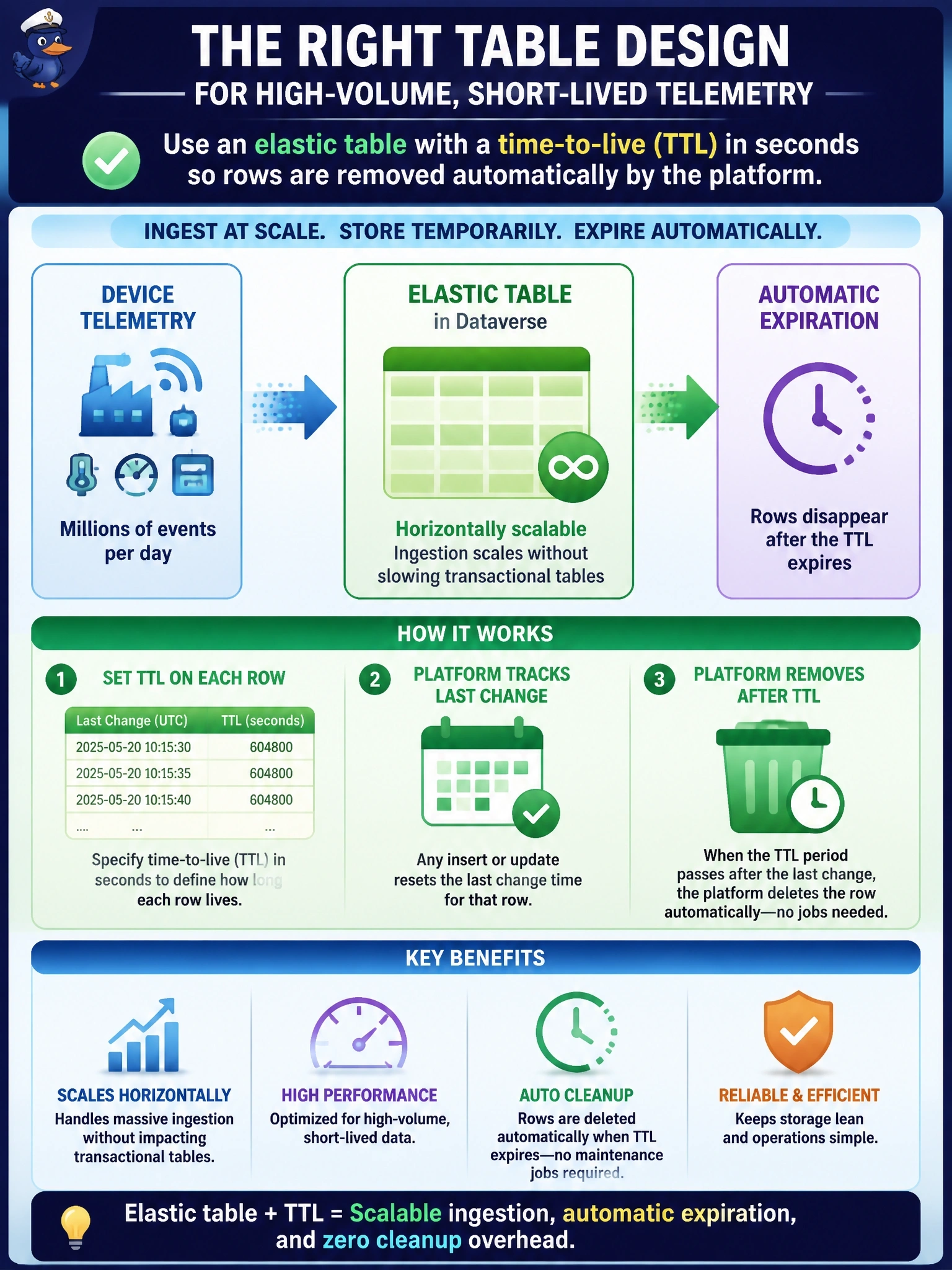
Think of an elastic table's time-to-live like a parking meter: each row gets its own countdown, and when it runs out the row's gone, no tow truck needed. You get Cosmos DB scale for the firehose and no nightly cleanup job. The trap is the standard table with bulk delete, which the stem rules out.
Full Explanation
Elastic tables are Dataverse tables powered by Azure Cosmos DB and designed for very high read and write volumes with automatic horizontal scaling. Because they are isolated from standard tables, heavy ingestion does not degrade transactional tables. They also include a time-to-live column: a value in seconds set on a row, interpreted from the time the row was last modified, after which the platform removes the row automatically. That combination meets both stated requirements. Change tracking records which rows changed so that synchronization clients can request deltas; it never deletes data. A virtual table leaves data in the source system, which contradicts the requirement to store the telemetry in Dataverse, and many telemetry APIs are not built for the query patterns that virtual tables issue. A standard table with nightly bulk delete jobs is exactly the scheduled cleanup the stem prohibits, and millions of daily writes on a standard table compete with transactional workloads. Exam caveat: elastic tables trade away features such as multi-record transactions, business rules, rollup columns and alternate keys, so they suit append-heavy data rather than core business records. Operational check: create a test row with a short time-to-live, update it, and confirm it disappears the expected time after the update rather than after creation.