
A consultant is extending the Sales Qualification Agent so that, before qualifying a lead, it retrieves a real-time credit risk score from an external Azure Function that is not exposed as a Dataverse table or standard connector. (Select TWO.) Which two actions are required to let the Sales Qualification Agent call this function as part of its qualification logic?
Select all correct answers, then click Submit.
Short Explanation
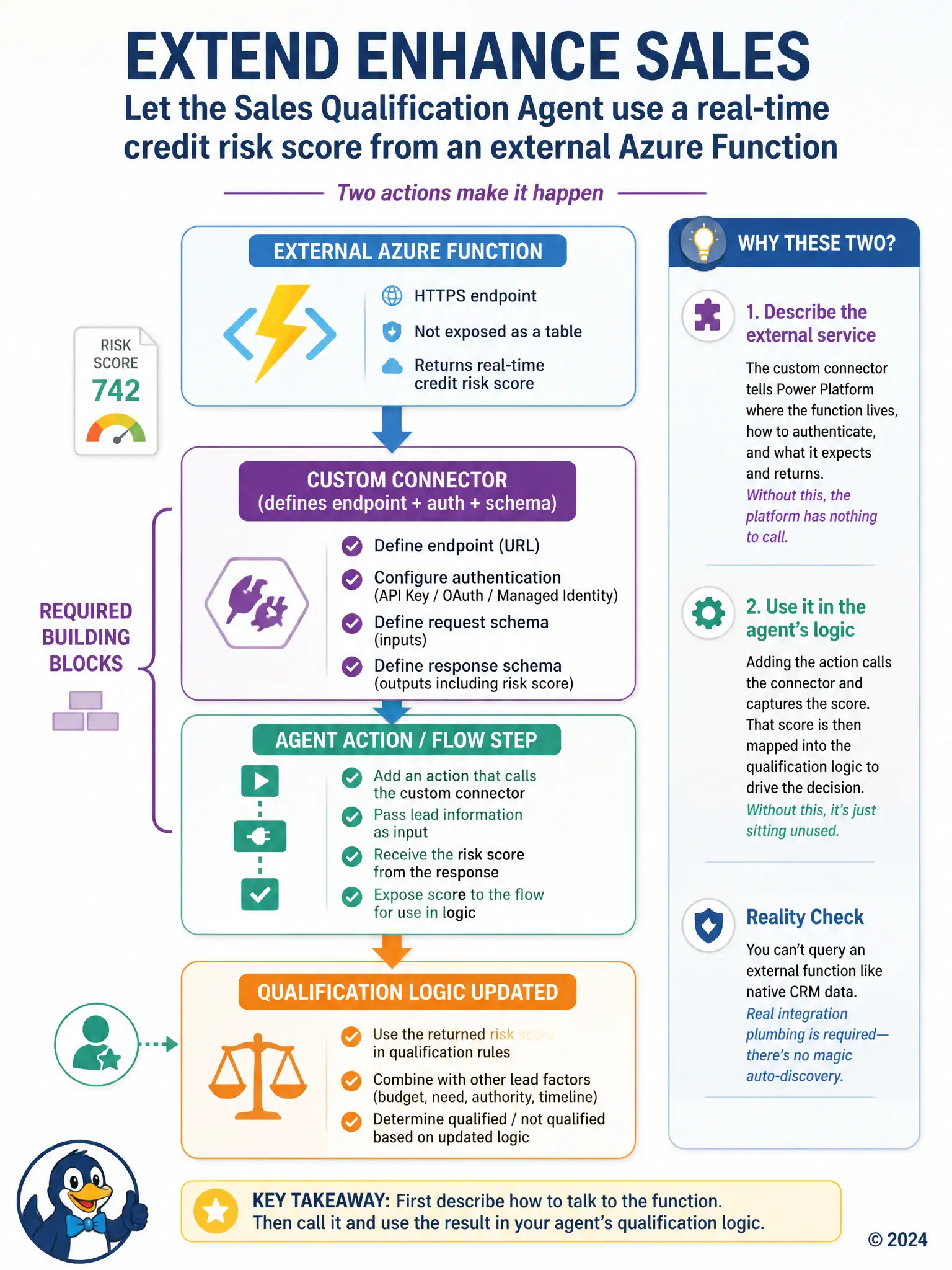
When an AI agent needs to reach a custom Azure Function outside Dynamics 365, you need to register a custom connector that defines the endpoint, authentication, and request/response schema, then add an action in the agent's flow that calls it and maps the score into qualification logic. Skip either piece and nothing works.
Full Explanation
Calling an external Azure Function that is not exposed through Dataverse or a standard connector requires two pieces: registering a custom connector in Power Platform that defines the function's endpoint, authentication, and request and response schema, and adding an action to the agent's flow that invokes the custom connector and maps the returned score into the qualification logic. Neither step alone is sufficient — the custom connector defines how to reach the function, and the flow action determines when and how the result is used. Creating a new Dataverse virtual table pointing at the Azure Function is incorrect because a Dataverse virtual table requires a data provider that understands the target system's query model; an arbitrary Azure Function endpoint cannot simply be pointed at as a virtual table without that provider layer, making it an unreliable and unsupported shortcut for this scenario. Enabling an 'external API' toggle in the Sales Qualification Agent's admin settings to auto-discover any Azure Function in the same subscription is incorrect because Copilot Studio and the Sales Qualification Agent have no auto-discovery mechanism that scans an Azure subscription for callable functions; every external call must be explicitly registered and wired, so relying on automatic discovery would leave the integration nonfunctional.