
A consultant validated a client's predictive opportunity scoring model eighteen months ago before rollout, confirming enough historical closed opportunities existed to train a reliable model. Since then, a new competitor has entered the client's market and the sales team's typical objections and win patterns have visibly shifted, but no one has looked at the model again. A sales manager asks whether the original validation still applies. What should the consultant recommend?
Select an answer to reveal the explanation.
Short Explanation
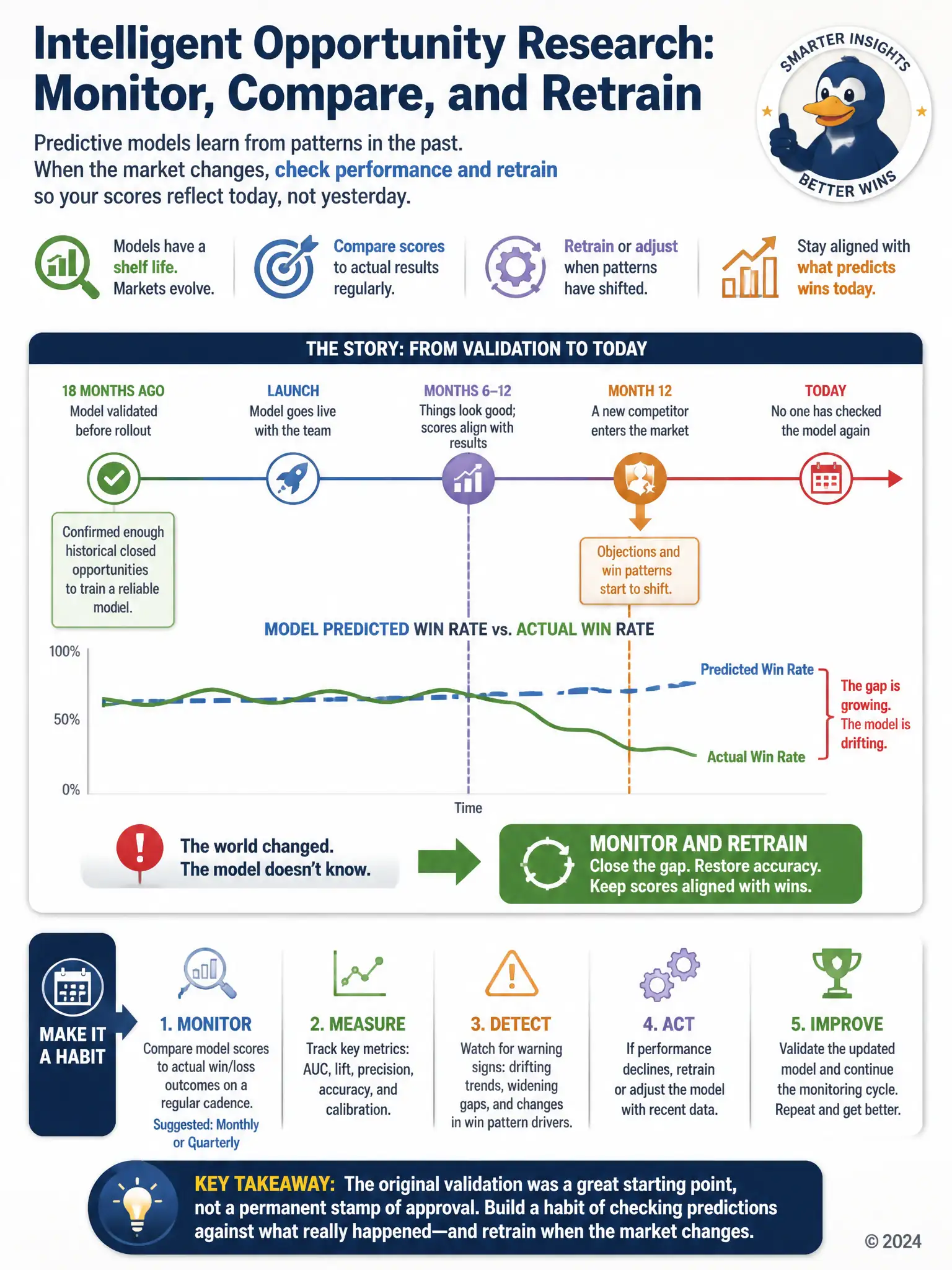
A predictive model is only as good as the patterns it learned, and those patterns have a shelf life. You should periodically compare the model's scores against actual win and loss outcomes and retrain or adjust it if the market shift changed what predicts a win. Treat the original validation as a starting point, not a permanent stamp of approval.
Full Explanation
The correct recommendation is to periodically compare the model's scores against actual win and loss outcomes and retrain or adjust it if the shifting market has changed what predicts a win, rather than relying on the original one-time validation. A predictive opportunity scoring model is trained on historical patterns, and those patterns can go stale as the market changes; a new competitor shifting typical objections and win rates is exactly the kind of drift a one-time pre-rollout validation cannot catch on its own. The right response is ongoing monitoring, comparing predicted scores against actual outcomes over time, and retraining or adjusting the model when the data shows its predictions no longer track reality, rather than treating the original validation as a permanent guarantee. The recommendation that the model remains valid indefinitely because the initial data-volume check passed is incorrect because passing a data-volume check before rollout only confirms the model had enough history to train on at that point; it says nothing about whether the patterns it learned still hold eighteen months and a market shift later. The recommendation to disable predictive scoring altogether is incorrect because it overreacts: a shifting market is a reason to monitor and refresh a model, not to abandon a working tool entirely, especially without evidence the model's predictions have actually degraded. The recommendation that reps manually add a fixed point adjustment to any score they suspect is affected by the new competitor is incorrect because it pushes the fix onto individual reps making ad hoc manual adjustments to scores, which creates inconsistency across the team and does nothing to correct the underlying model everyone else still relies on. Ongoing governance, not a single validation, is what keeps a predictive model trustworthy.