
A consultant reviews an AI-driven lead scoring model for a software company. The model was trained primarily on data from won deals and now assigns high scores to leads that closely resemble those wins, but sellers report that many high-scoring leads are quietly going cold instead of losing outright, wasting effort. The consultant discovers many closed-lost opportunities were never marked with a lost reason, leaving that data effectively unused. What should the consultant do to improve scoring accuracy?
Select an answer to reveal the explanation.
Short Explanation
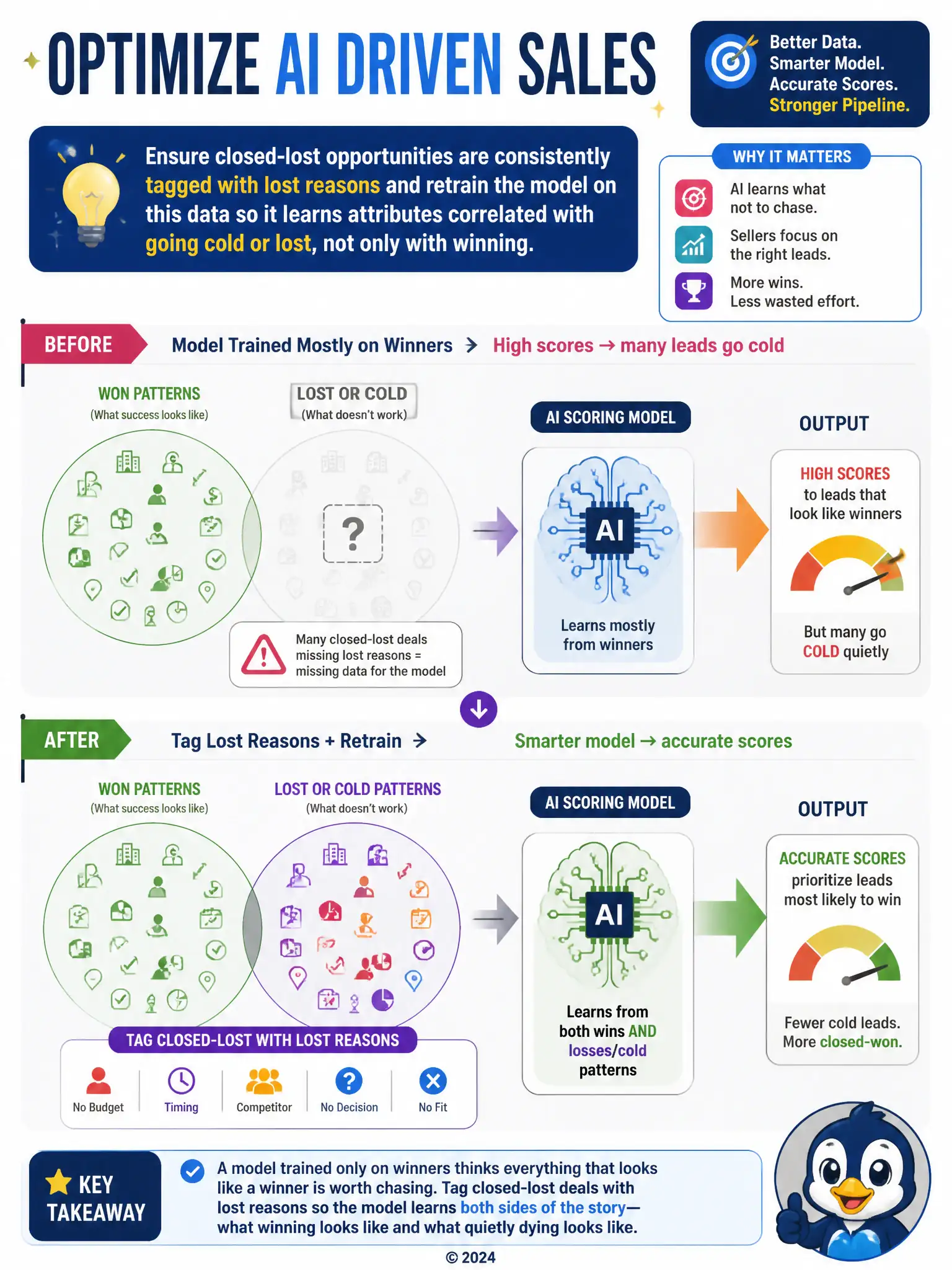
A model trained mostly on winners thinks anything that looks like a win is worth chasing, but it never learned what a quiet fade looks like. You need to tag closed-lost opportunities with lost reasons and retrain so it learns both winning and losing patterns. Raising the threshold, dropping lost data, or hand-overriding scores just dodges the real gap.
Full Explanation
The correct approach is to ensure closed-lost opportunities are consistently tagged with lost reasons and retrain the model on this data so it learns attributes correlated with going cold or lost, not only with winning. A lead scoring model trained mostly on won-deal patterns learns what winning leads look like but has little basis for recognizing patterns that precede a deal going cold or lost, which explains why high-scoring leads are quietly stalling instead of closing. Consistently tagging closed-lost opportunities with lost reasons gives the model the missing half of the picture, so retraining on that fuller dataset lets it learn attributes correlated with both outcomes rather than only winning. The threshold-raising approach is incorrect because raising the qualification threshold filters more aggressively on the same biased signal rather than correcting what the model has learned, so the same blind spot persists at a smaller scale. The closed-lost exclusion approach is incorrect because excluding closed-lost data entirely removes the exact information needed to balance the model and makes the existing bias toward win-pattern resemblance worse, not better. The manual override approach is incorrect because manually overriding scores for leads that resemble a pattern a person happens to notice does not scale across the pipeline and leaves the systemic training gap unaddressed for every future lead.