
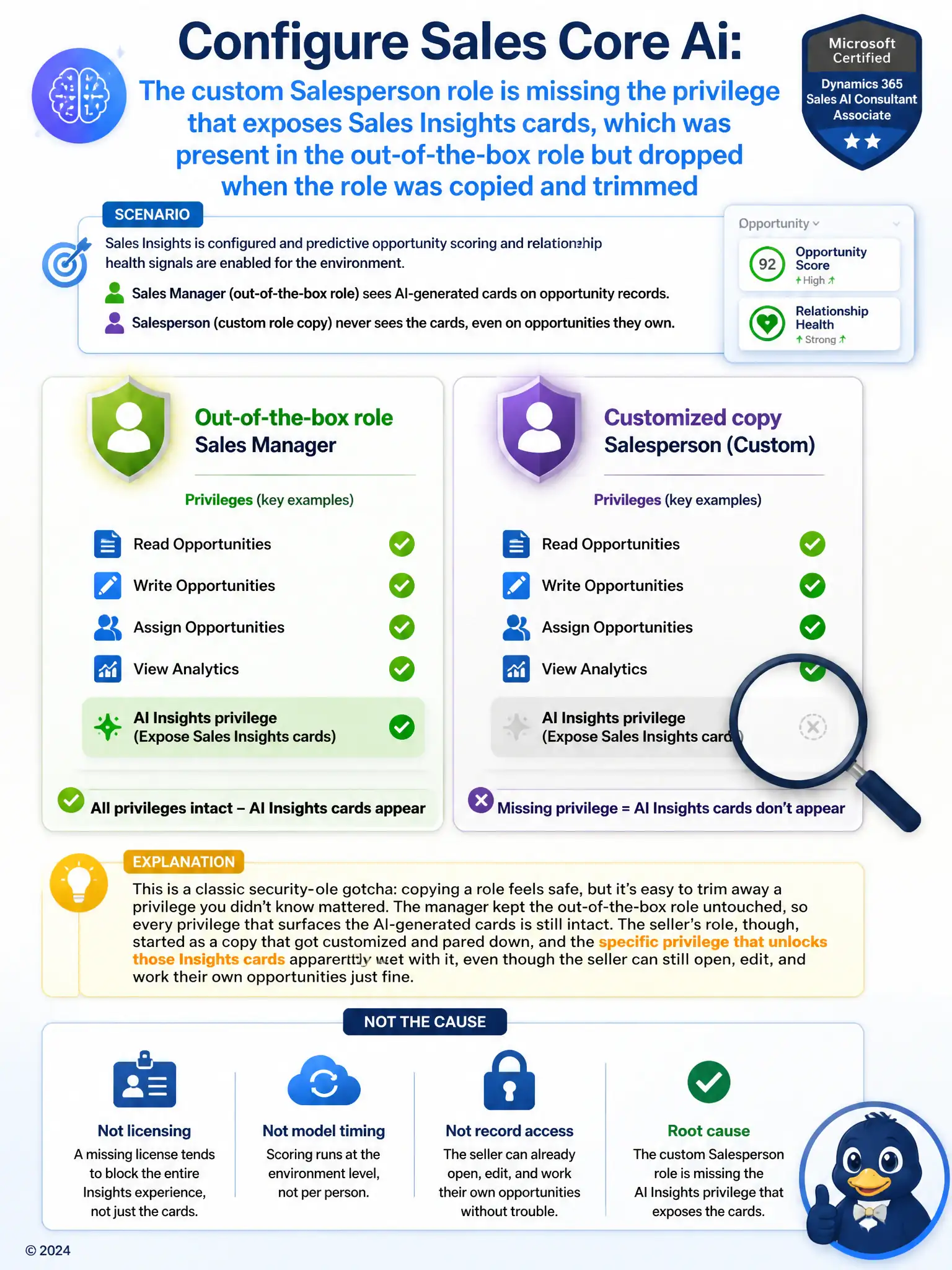
A consultant configures Sales Insights for a client and confirms predictive opportunity scoring and relationship health signals are enabled for the environment. A sales manager using the out-of-the-box Sales Manager role sees the AI-generated cards on opportunity records, but a seller using a heavily customized copy of the Salesperson role reports the same cards never appear on any opportunity, even ones the seller owns. What is the most likely cause?
Select an answer to reveal the explanation.
Short Explanation
This is a classic security-role gotcha: copying a role feels safe, but it's easy to trim away a privilege you didn't know mattered. You kept the manager's out-of-the-box role untouched, so the privilege that surfaces the AI cards is still there. The seller's customized role likely lost that privilege, even though the seller can still open and edit their own opportunities.
Full Explanation
The correct answer is the custom Salesperson role missing the privilege that exposes Sales Insights cards, which was present in the out-of-the-box role but dropped when the role was copied and trimmed. Sales Insights cards such as predictive opportunity scoring and relationship health are exposed through privileges that ship with the out-of-the-box security roles, including Sales Manager. When a role like Salesperson is copied and then trimmed down to remove privileges considered unnecessary, it is easy to remove the specific privilege that renders those Insights cards without affecting the seller's core ability to read and update their own opportunities, which is exactly the symptom described. The fix is to compare the custom role's privileges against the out-of-the-box role and restore what is missing. The licensing explanation is incorrect because a missing Dynamics 365 Sales Premium license would typically block the seller from the Sales Insights experience broadly rather than leaving normal opportunity access fully functional while only the cards disappear. The model-training explanation is incorrect because predictive opportunity scoring trains at the organization or environment level using aggregate historical data, not per individual seller, so one seller's data being unprocessed would not produce this pattern. The opportunity-read explanation is incorrect because the seller can already open and work opportunities they own, which confirms Opportunity table read privilege is present; the gap is specific to the privilege that exposes Insights cards.