
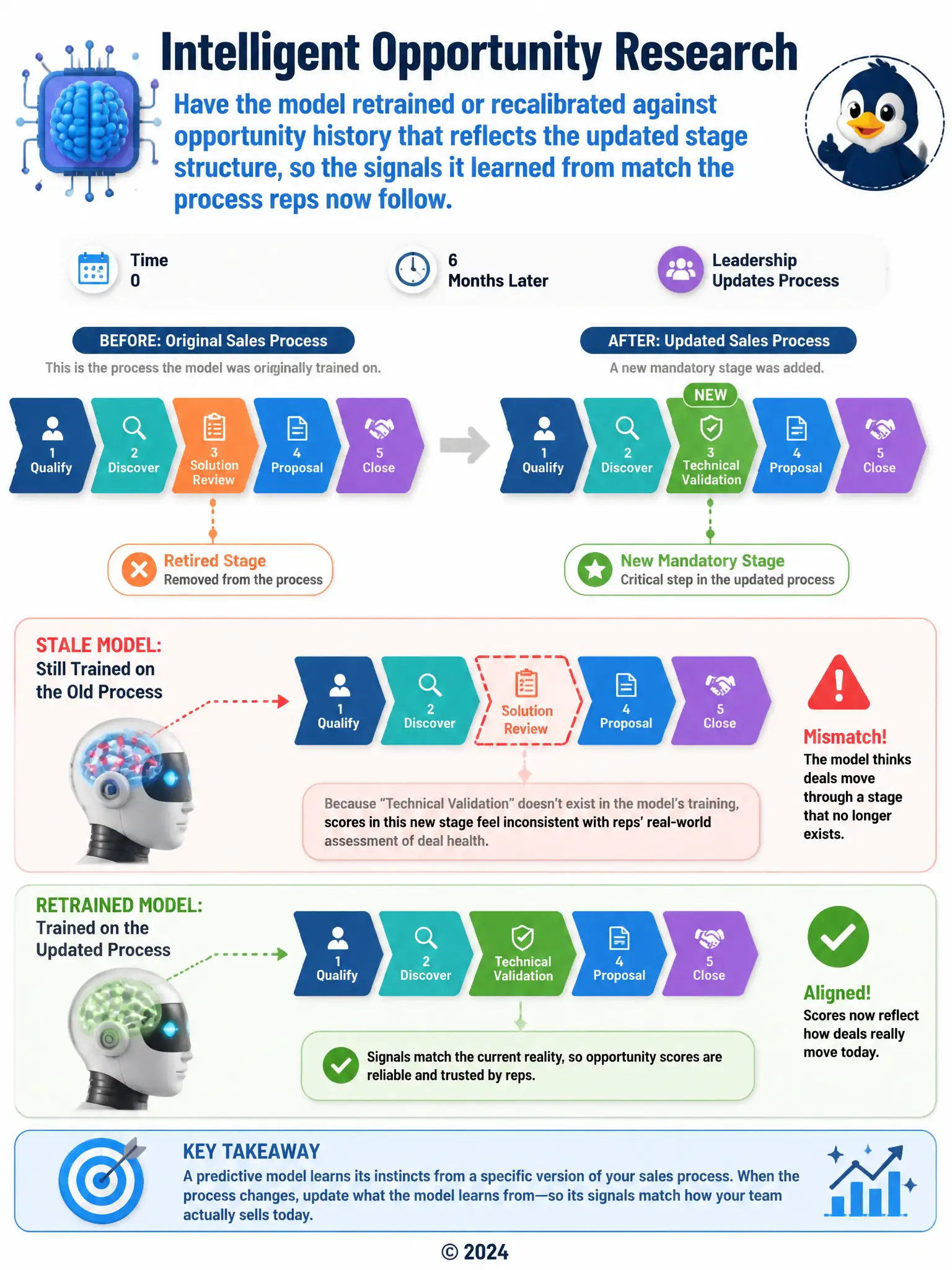
Six months after a client turned on predictive opportunity scoring, sales leadership adds a new mandatory technical-validation stage to the sales process and retires an older stage that used to sit between qualification and proposal. A consultant reviewing the model afterward finds that scores for opportunities in the new stage look inconsistent with reps' own assessment of deal health. What should the consultant recommend?
Select an answer to reveal the explanation.
Short Explanation
Predictive scoring learns from the sales process as it was built. When you add a new technical-validation stage, its signals can fall behind reality. You need to retrain or recalibrate it against opportunity history that matches the updated stage structure, so the scores reflect how reps actually sell now.
Full Explanation
The correct recommendation is to have the model retrained or recalibrated against opportunity history that reflects the updated stage structure, so the signals it learned from match the process reps now follow. Predictive scoring learns patterns from historical opportunity data tied to the stages that existed when it was trained, so when the stage structure itself changes, the model needs to be retrained or recalibrated on data that reflects the new process before its output for the new stage can be trusted again. The recommendation to disable predictive scoring permanently is incorrect because a process change is a solvable data problem, not a reason to abandon the capability entirely; permanently disabling it discards a tool that works fine for stages that did not change. The recommendation to leave the model as-is is incorrect because it treats a one-time training event as permanent, when in reality the model's usefulness depends on its training data continuing to match the current sales process; a stage restructuring is exactly the kind of change that requires updating it. The recommendation to instruct reps to manually override the score for any opportunity in the new stage until the next scheduled quarterly business review is incorrect because manual overrides are a stopgap that masks the underlying misalignment rather than fixing it, and waiting until the next quarterly review delays a correction that affects every opportunity moving through the new stage in the meantime, not just the ones reps happen to notice.