
A consultant is scoping predictive lead scoring for a two-year-old specialty retailer whose Dynamics 365 Sales environment holds only 18 closed leads total, most of them closed within the last six weeks after a recent one-time sales push. What should the consultant tell the client about enabling predictive lead scoring right now?
Select an answer to reveal the explanation.
Short Explanation
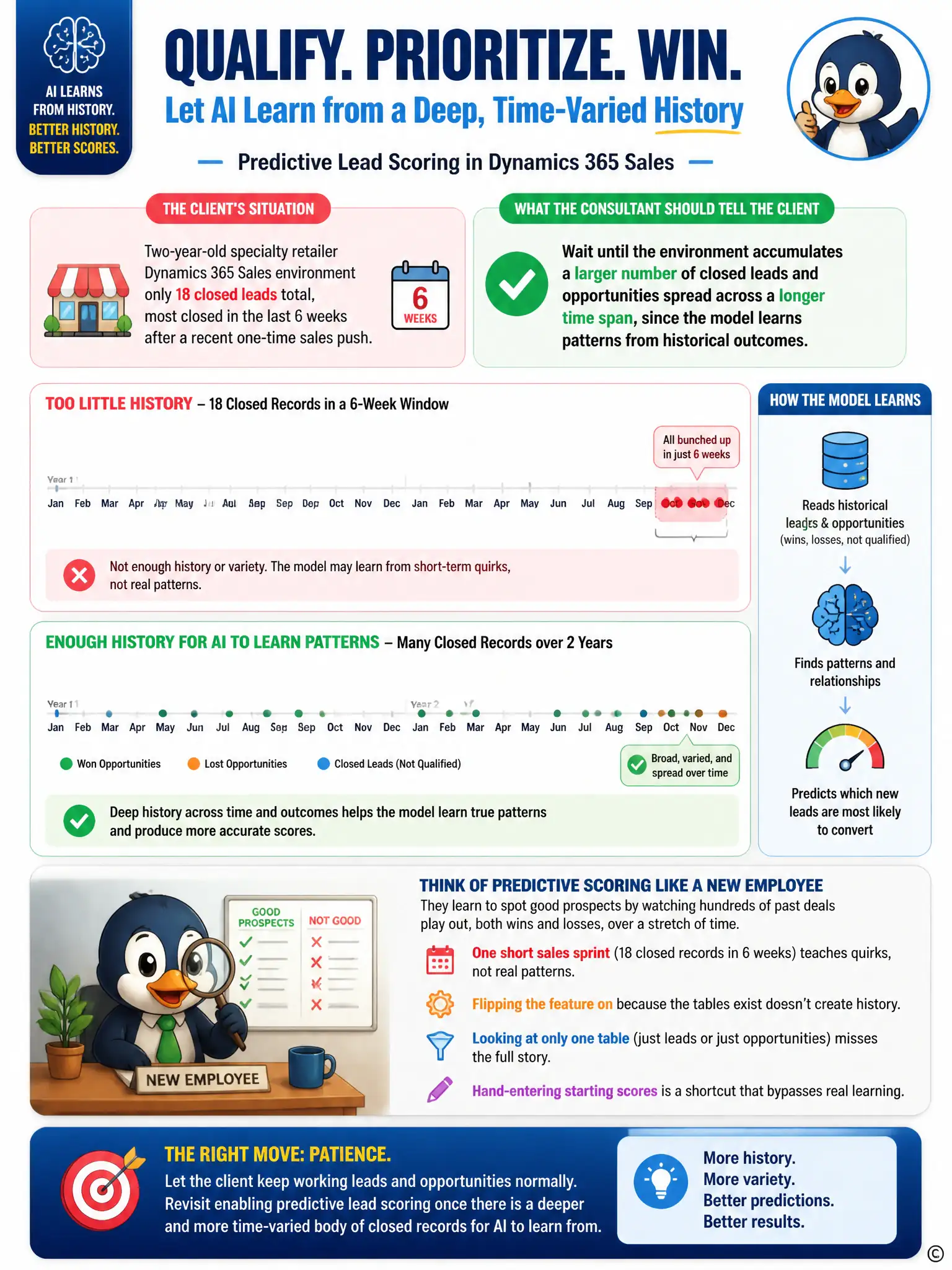
Predictive lead scoring needs enough closed wins and losses over time to learn real patterns, not just a table or a few recent records. With only 18 closed leads crammed into six weeks, you should wait until more closed leads and opportunities build up across a longer period before turning it on.
Full Explanation
Predictive lead scoring learns to distinguish likely winners from likely losers by studying a body of closed records, and a model trained on 18 records clustered into a six-week window has neither enough volume nor enough time span to capture real patterns rather than noise from one campaign. The consultant should recommend waiting until closed leads and opportunities accumulate across a longer, more representative period. The option to enable it immediately because the Leads table exists is incorrect because the model's value comes specifically from learning against historical closed outcomes, not merely from the Leads table existing. The option to enable it now but scope it to the Opportunities table only is incorrect because it understates the requirement on both sides: opportunities also need a meaningful body of closed history, and skipping leads entirely does not solve the underlying data-volume problem the client actually has. The option to enable it now and manually assign scores to the 18 existing records is incorrect because there is no mechanism for manually assigning scores to bootstrap the predictive model; scores are computed by the trained model itself, and manually entering values would not train anything or persist once real scoring runs.