
A consultant reviews a strategic account in Dynamics 365 Sales where the AI-driven relationship health score is rated 'Healthy.' A sales director points out that the primary economic buyer has not opened an email or accepted a meeting in four months, while three junior stakeholders remain highly engaged, and asks why the score does not reflect this risk. How should the consultant respond?
Select an answer to reveal the explanation.
Short Explanation
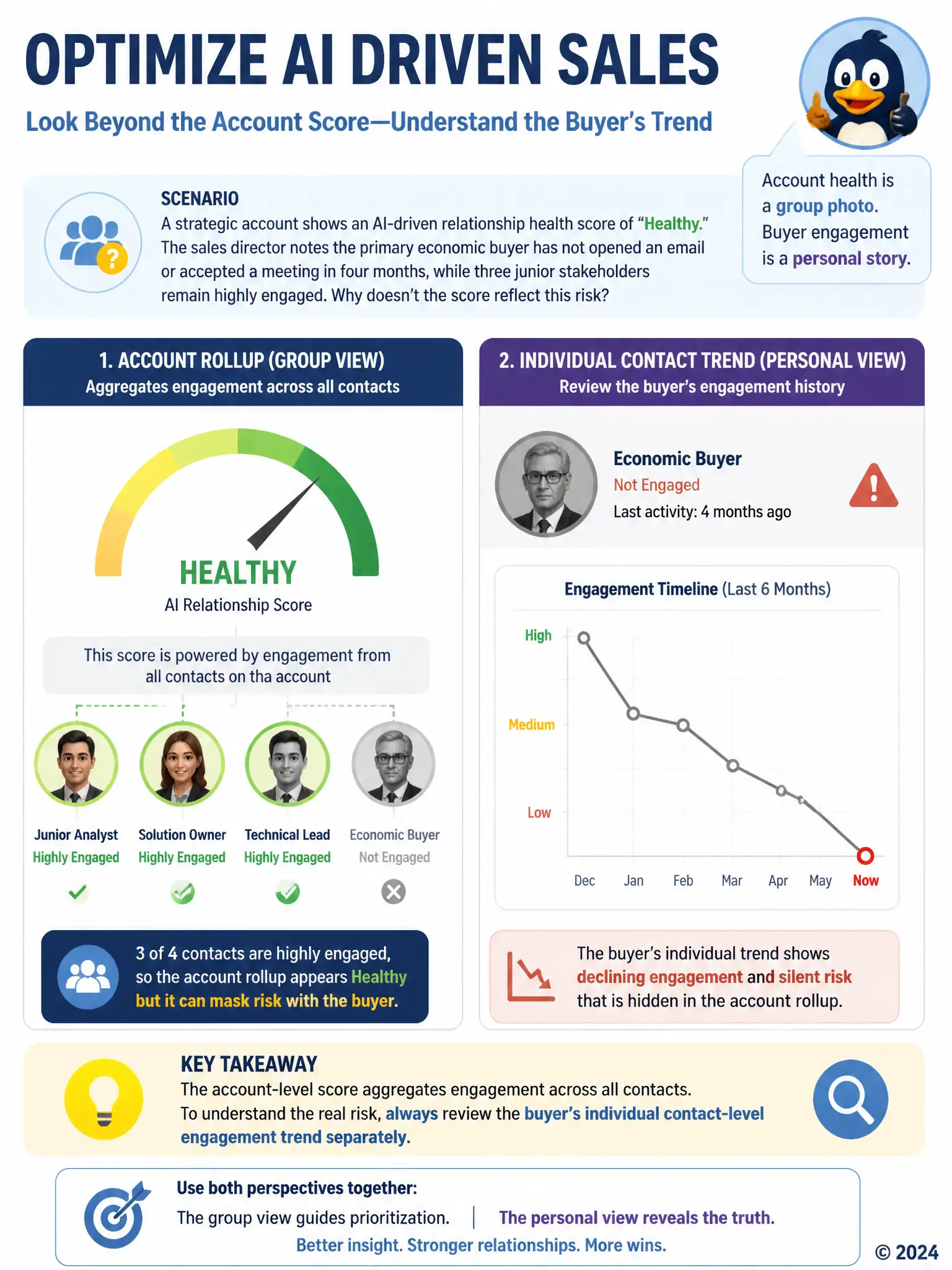
The account score is a group photo, not a portrait of one person. It blends engagement from every contact, so engaged junior stakeholders can mask a senior buyer who's gone quiet. You need to review that buyer's individual contact-level engagement trend separately.
Full Explanation
The correct response is to explain that an account-level relationship health score summarizes engagement signals, such as email responsiveness and meeting activity, across every contact tied to the account, so strong activity from several engaged stakeholders can offset a single disengaged contact and keep the overall label at Healthy. To see the risk the sales director is describing, the consultant should look at the individual contact's own engagement trend rather than the blended account figure, since the two are measuring different things. Concluding that the scoring model is malfunctioning and scheduling it for retraining is incorrect because the discrepancy is an expected consequence of how an aggregate score is calculated, not evidence that the model is producing faulty predictions. Recommending that relationship health scoring be disabled because it lacks any contact-level granularity is incorrect because contact-level engagement data already exists and can be reviewed; disabling the feature entirely discards a useful account-level signal instead of supplementing it with the missing granularity. Assuming the economic buyer's activity is being logged against a different, duplicate account record is incorrect because it assumes a data-quality error such as duplicate or misattributed records, when nothing in the scenario suggests the buyer's activity is being logged incorrectly, only that it is being diluted by other contacts' engagement in the rollup.