
An organization piloting an autonomous AI seller agent wants it to negotiate small renewal discounts with customers directly, but leadership is concerned about uncontrolled margin erosion and wants guardrails in place before expanding the pilot. (Select TWO.) Which two configurations should the consultant implement?
Select all correct answers, then click Submit.
Short Explanation
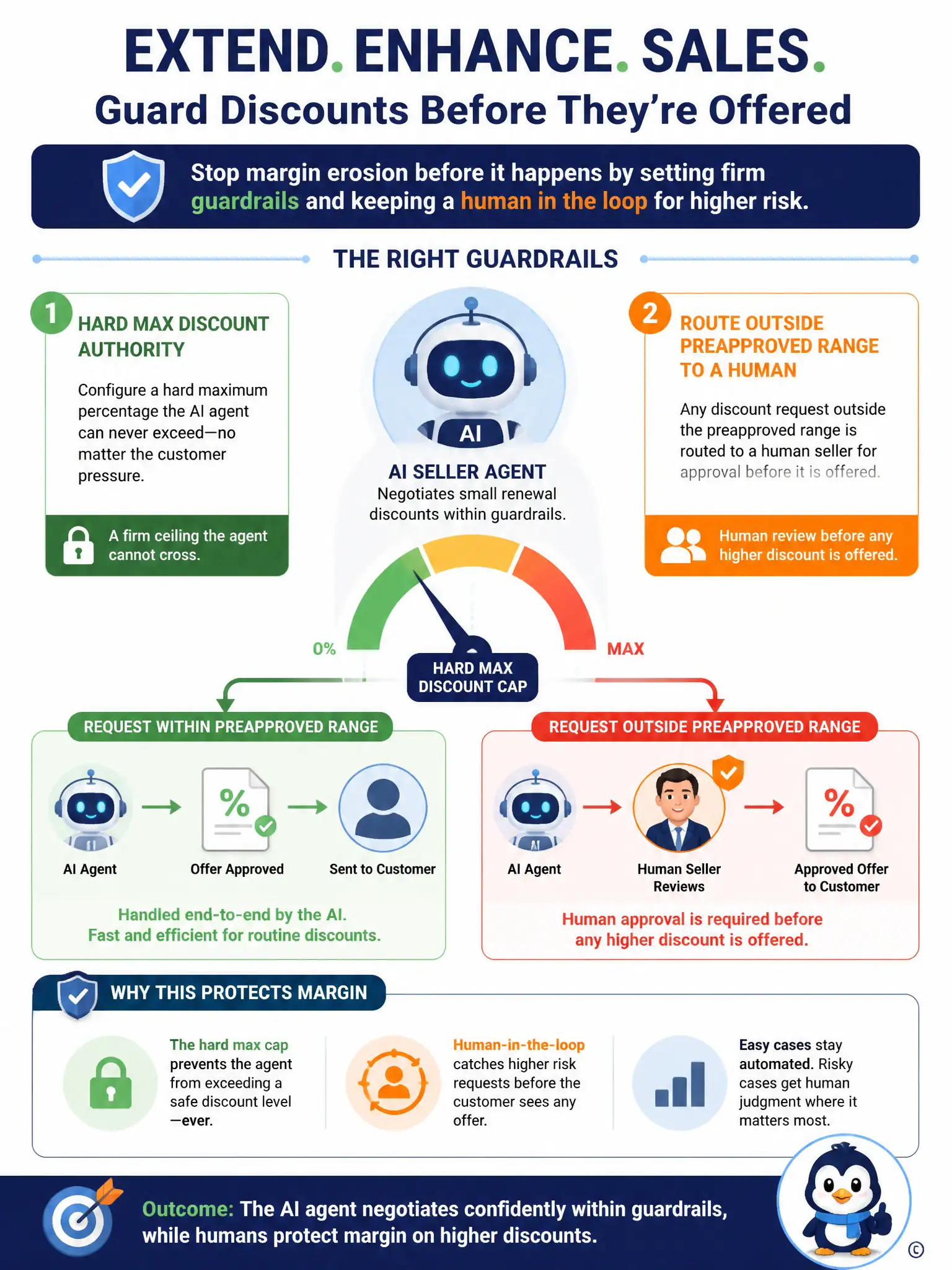
You need guardrails that stop bad discounts before customers hear them. Set a hard maximum discount percentage the agent can't cross, and route any request outside the preapproved range to a human seller for approval first.
Full Explanation
The hard maximum percentage the agent cannot exceed caps how far the agent can go on its own, and routing any discount request outside the preapproved range to a human seller for approval ensures exceptions get reviewed before a customer hears them. Together, these two controls prevent margin erosion while still letting the agent handle routine, low-risk negotiations autonomously. The configuration that allows unlimited discounts as long as every offer is logged is incorrect because logging offers only creates a record after the discount has already been extended to the customer; an audit trail does not stop the erosion from happening, it merely documents it after the fact, which does not satisfy leadership's concern about controlling outcomes in advance. The configuration that removes the agent's ability to see the account's contract value is incorrect because hiding contract value does not limit the size of a discount the agent can offer, it only removes context the agent could otherwise use to negotiate more appropriately, and it does nothing to prevent the agent from offering an oversized discount on a small deal or an undersized one on a large deal; it addresses a different concern than margin control. The combination of a firm ceiling and mandatory human review for exceptions is what actually constrains the agent's behavior before an offer reaches the customer.