
A consultant is configuring relationship analytics for an enterprise accounts team that has repeatedly lost late-stage deals after their single primary contact left the customer's organization. The team wants the system to flag opportunities where meaningful engagement, such as emails and meeting attendance, exists with only one contact at the account, so reps are prompted to build relationships with additional stakeholders earlier. Which relationship analytics capability should the consultant configure?
Select an answer to reveal the explanation.
Short Explanation
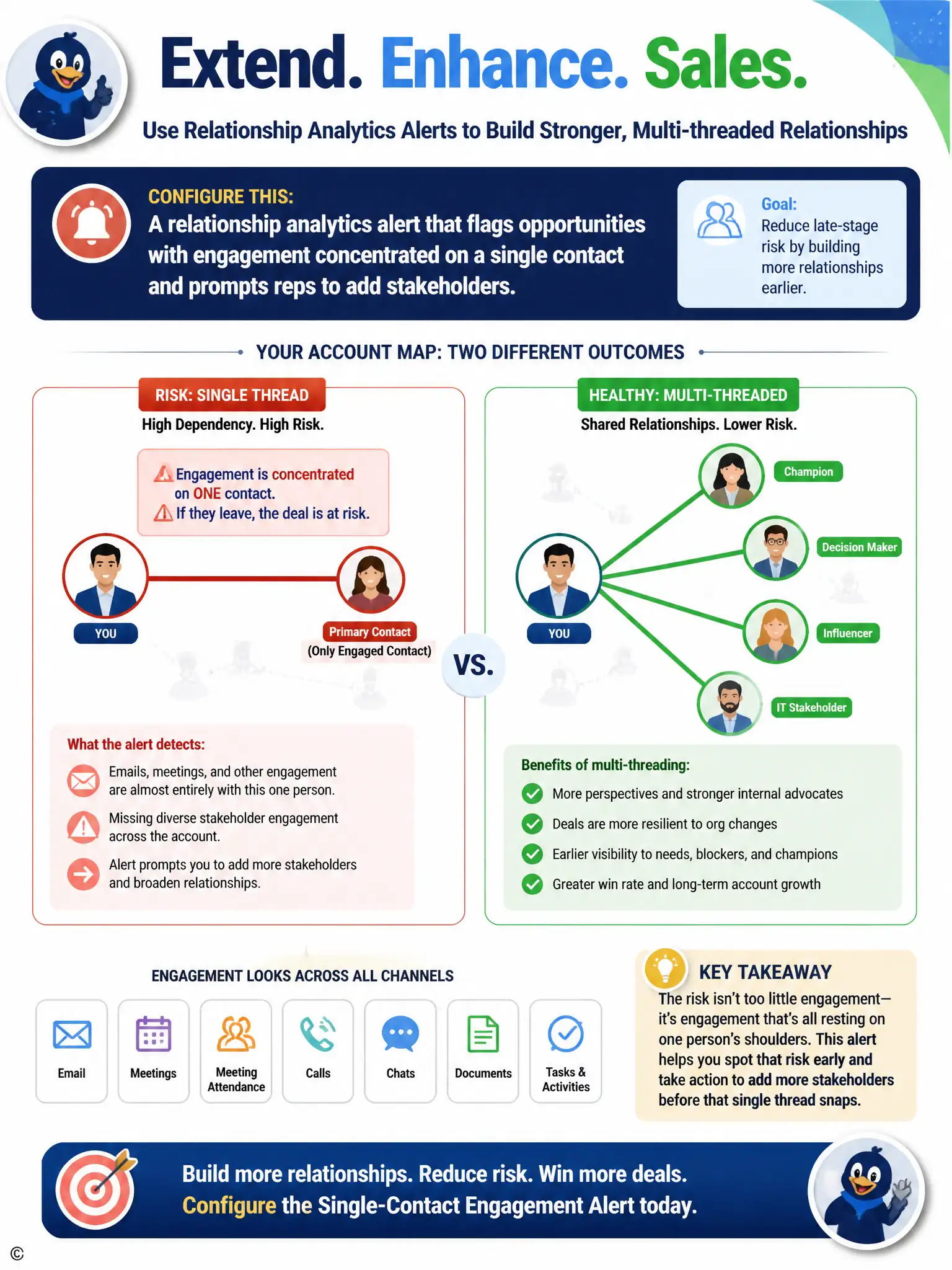
The real risk isn't too little engagement; it's all your engagement resting on one person. Configure an alert that spots when emails, meetings, and other activity concentrate on a single contact, then nudges reps to add stakeholders before that relationship snaps.
Full Explanation
The correct answer is the relationship analytics alert that flags opportunities with engagement concentrated on a single contact and prompts reps to add stakeholders. The team's problem is a lack of multi-threading: meaningful engagement is happening, but it is concentrated on one person, so the needed capability is an alert built specifically to detect that concentration pattern across all engagement types and prompt reps to broaden it. The relationship health score based only on the frequency of emails with the primary contact is incorrect because a score based purely on email frequency with the primary contact would rise as engagement with that one contact increases, rewarding exactly the narrow pattern the team wants flagged rather than warning against it. The whitespace analysis comparing purchased products to the account's industry peers is incorrect because whitespace analysis identifies cross-sell and upsell opportunities based on product gaps relative to peer accounts; it has nothing to do with how many people at an account are engaged. The Conversation Intelligence tracker that counts how many people join each recorded call is incorrect because a call-attendee tracker only reflects who joined recorded meetings, missing email engagement entirely, and it merely counts participants rather than generating a proactive alert that prompts reps to multi-thread. Only an alert purpose-built to detect single-contact concentration across engagement channels and nudge reps toward broader outreach addresses the risk the team experienced when their sole contact departed.