
A sales operations lead configures four Sales Accelerator segments for a 40-person team, each with its own filter criteria, ordered from most specific to most general. After go-live, leads generated by a new marketing campaign consistently fail to appear in any seller's work queue, even though the leads match the criteria of the last, most general segment. What is the most likely cause?
Select an answer to reveal the explanation.
Short Explanation
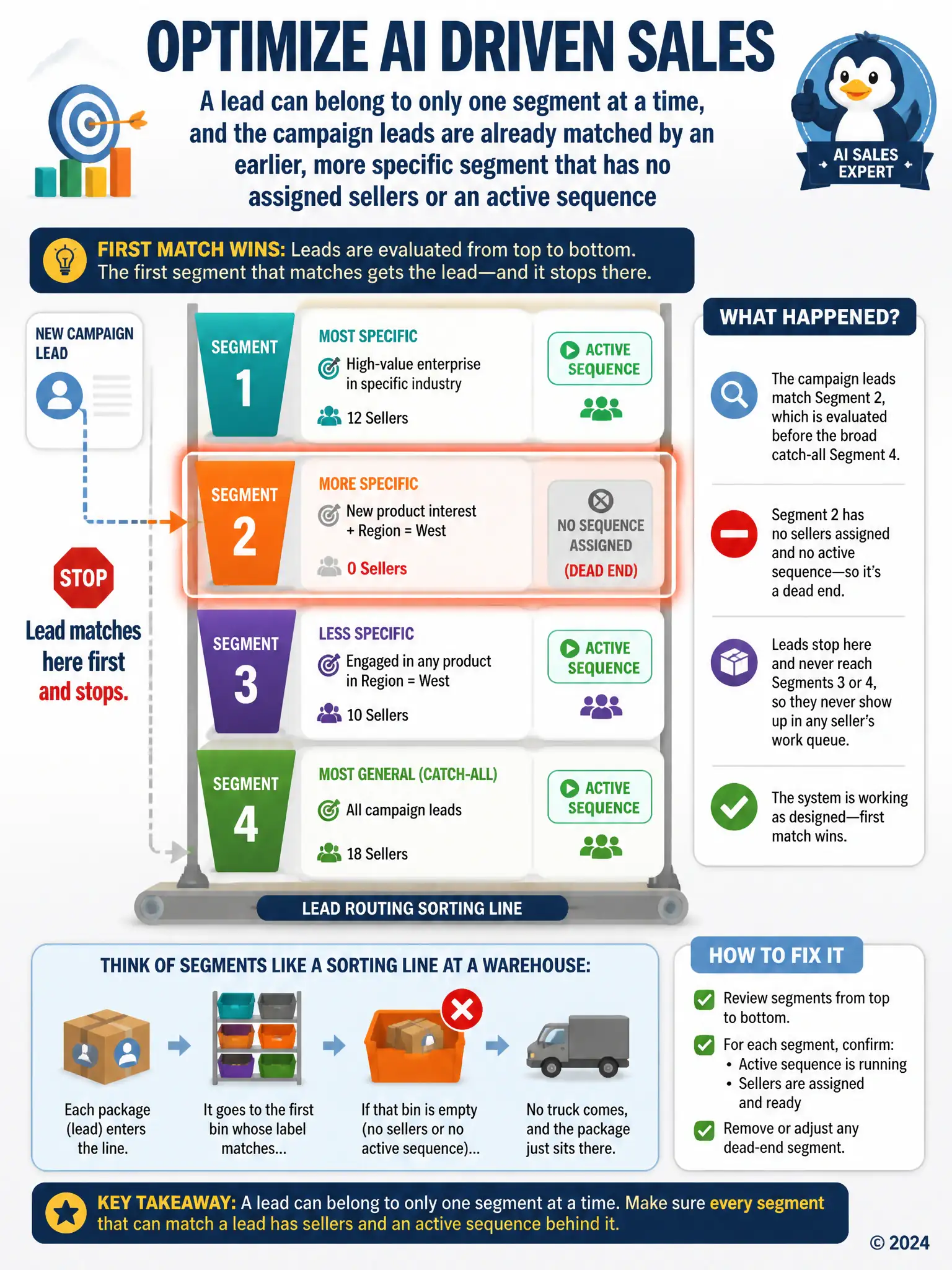
Think of segments like a warehouse sorting line: each lead goes to the first matching segment and stops there. If that earlier segment has no sellers or no active sequence, the lead sits there and never reaches the broad catch-all segment. Walk your segment list top to bottom and make sure every matching segment has people and a running sequence.
Full Explanation
The most likely cause is that a lead can belong to only one segment at a time, and the campaign leads are already matched by an earlier, more specific segment that has no assigned sellers or an active sequence. Sales Accelerator evaluates segments in order and assigns each record to the first segment it matches; once matched, a lead does not fall through to later, more general segments. If the campaign leads are being caught by an earlier, more specific segment that lacks an assigned seller pool or an active sequence, those leads are effectively parked with no work generated, and they never reach the general segment that would otherwise have picked them up. The fix is to audit segment order and confirm every segment a record could match actually has sellers and an active sequence attached. The claim that segments are evaluated in reverse alphabetical order regardless of the configured sequence is incorrect because segment evaluation follows the administrator-defined order, not alphabetical order, and no such reversal exists. The claim that Sales Accelerator segments only evaluate opportunity records, not leads, is incorrect because Sales Accelerator segments support lead records as well as opportunities; restricting matching to opportunities only is not how the feature works. The claim that the general segment's sequence has reached its maximum enrollment capacity for the day and is silently rejecting new records is incorrect because segments and sequences do not enforce a daily enrollment cap that silently rejects records; if a real limit existed, it would surface as a configuration or licensing error rather than silent disappearance.