
An account team working a strategic renewal has a documented stakeholder list, but a rep reviewing the opportunity notices, through relationship insights, that a person outside that formal list has exchanged several emails with and accepted a meeting from the champion, activity the rep had not been tracking manually. Which Dynamics 365 Sales AI capability most directly surfaced this person's involvement?
Select an answer to reveal the explanation.
Short Explanation
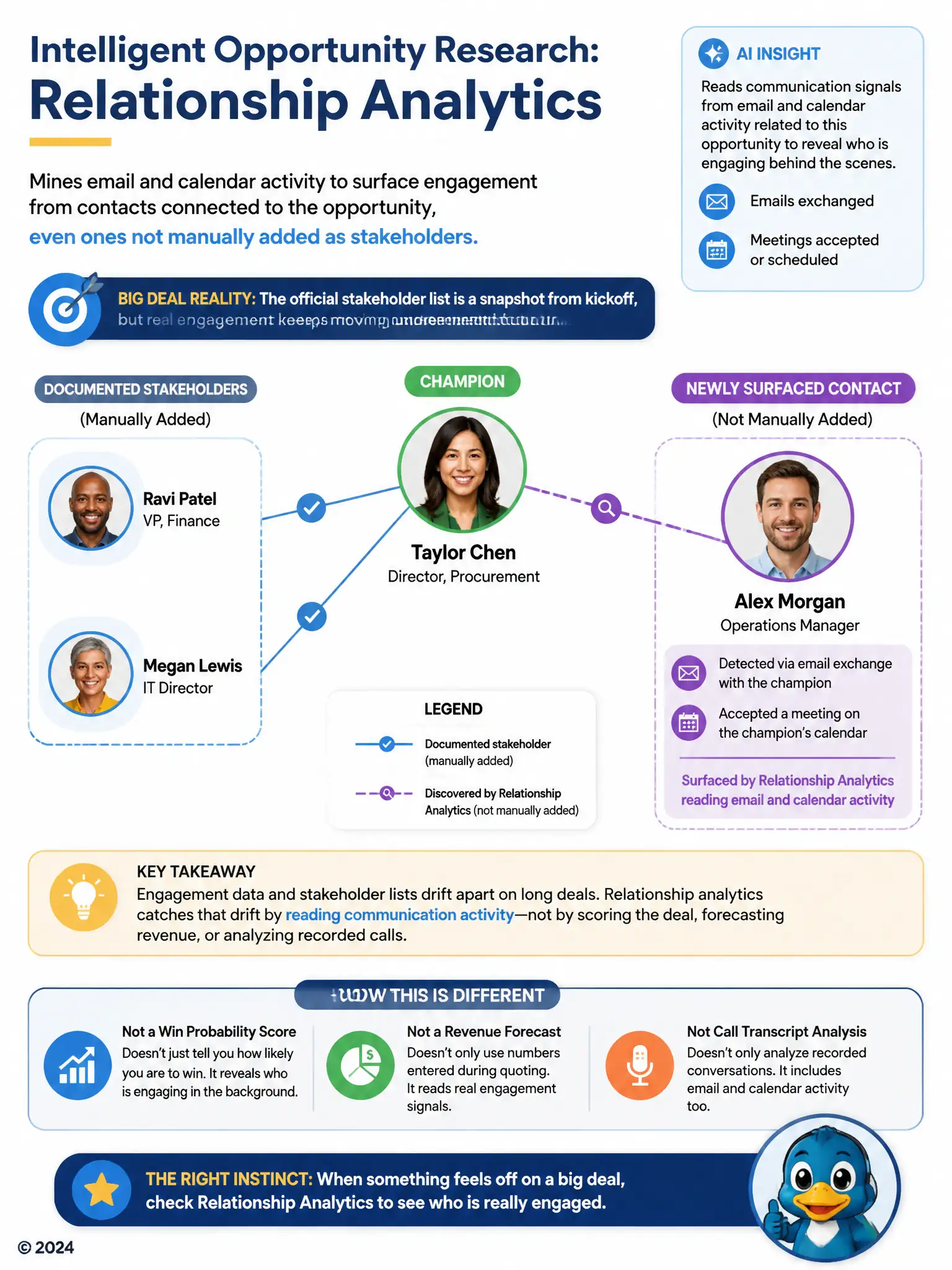
On big deals, the official stakeholder list goes stale fast. You need the capability that reads email and calendar activity tied to the opportunity and flags someone engaging with the champion even if you never added them. That’s relationship analytics, not scoring, forecasting, or call-transcript tagging.
Full Explanation
The capability that directly surfaced this person's involvement is relationship analytics that mines email and calendar activity to surface engagement from contacts connected to the opportunity, even ones not manually added as stakeholders. It continuously mines communication signals such as email exchanges and calendar activity tied to an opportunity, which lets it surface engagement from people connected to the deal even when a rep has not manually added them to the stakeholder list. That is exactly how an untracked contact's emails and accepted meeting became visible without the rep entering that data by hand. The predictive opportunity scoring capability that recalculates win likelihood whenever a new contact record is created is incorrect because it produces a likelihood-to-win estimate; it does not scan for or surface individual people's engagement, and it is not triggered by contact record creation in the way described. The recurring revenue forecast model that tracks only stakeholders entered by the rep during the quote stage is incorrect because forecasting models project recurring revenue from stage and value data entered during the sales process, not from unstructured communication activity, so it would not detect an unlisted contact's emails. The conversation intelligence transcript tagging capability that analyzes recorded calls but not email or calendar activity is incorrect because it is scoped to recorded call transcripts; it would not pick up activity that occurred only through email and calendar invitations rather than a recorded conversation. For account teams managing multi-stakeholder deals, relationship analytics is the capability that fills the gap between what reps manually document and who is actually engaging behind the scenes.