
A sales operations lead wants to give account teams two separate AI-driven signals for spotting opportunities that are quietly losing momentum: one based on how stakeholders are engaging over time, and one based on how quickly the account is responding to outreach. (Select TWO.) Which two capabilities should the lead configure to deliver these signals?
Select all correct answers, then click Submit.
Short Explanation
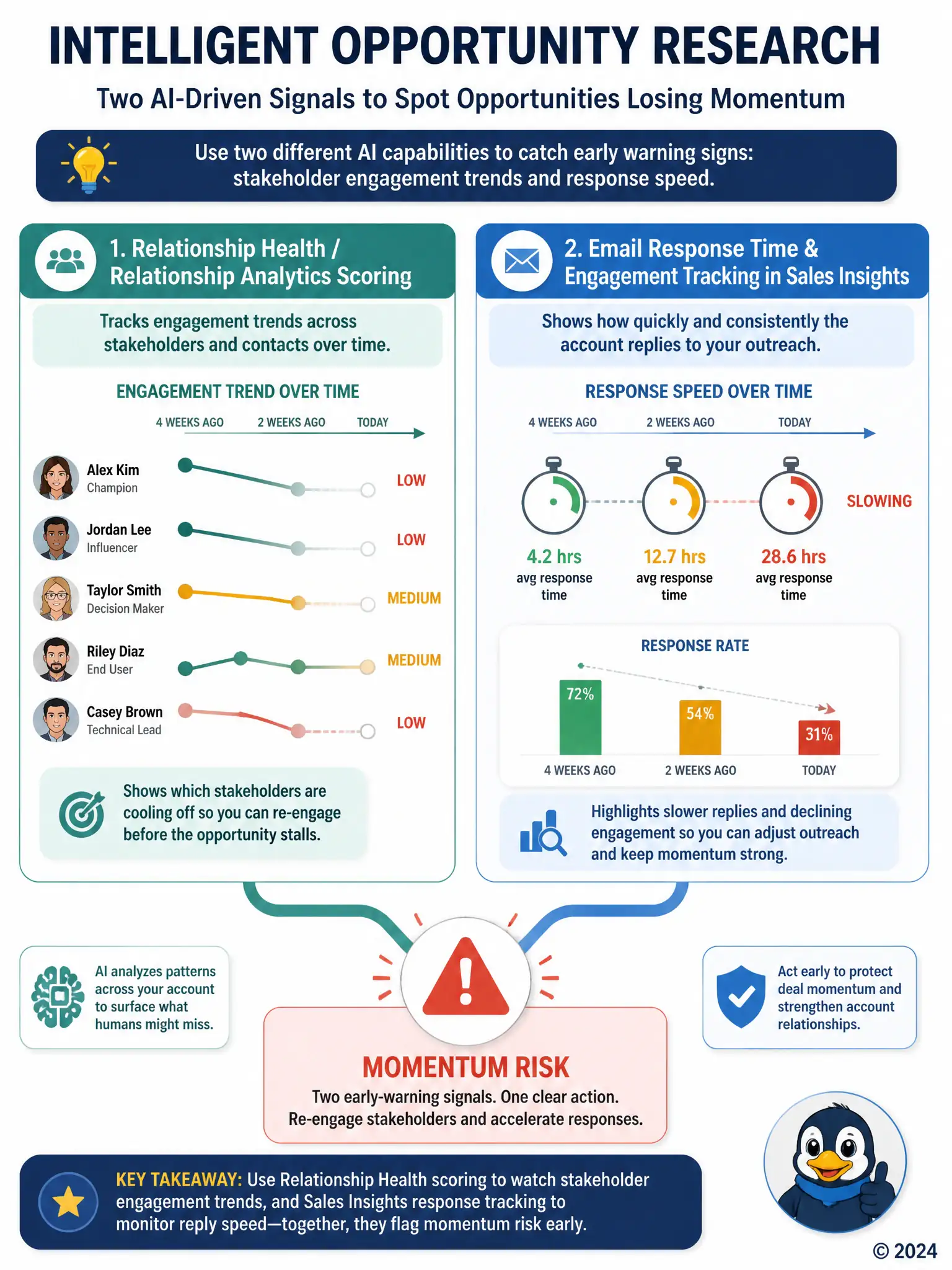
You need two early-warning signals, so you pair relationship health scoring to watch stakeholder engagement trends over time with Sales Insights email response-time tracking to see if replies are slowing down. Territory rules and predictive lead scoring don’t measure an open account’s momentum.
Full Explanation
Relationship health or relationship analytics scoring is the right capability for the first signal because it tracks how engagement with stakeholders and contacts on an account is trending over time, surfacing whether the buying group as a whole is disengaging. Email response time and engagement tracking surfaced through Sales Insights is the right capability for the second signal because it shows how quickly and consistently contacts are replying to outreach, giving an early indicator of slowing or inconsistent replies and stalling momentum. The territory management rules capability is wrong because it assigns accounts to reps based on geography and industry segmentation; it is an operational routing decision and does not measure stakeholder engagement or response velocity. The predictive lead scoring capability is wrong because it ranks inbound leads by likelihood to convert before they become qualified opportunities, so it does not measure ongoing engagement on an account that already has an open deal in progress.