
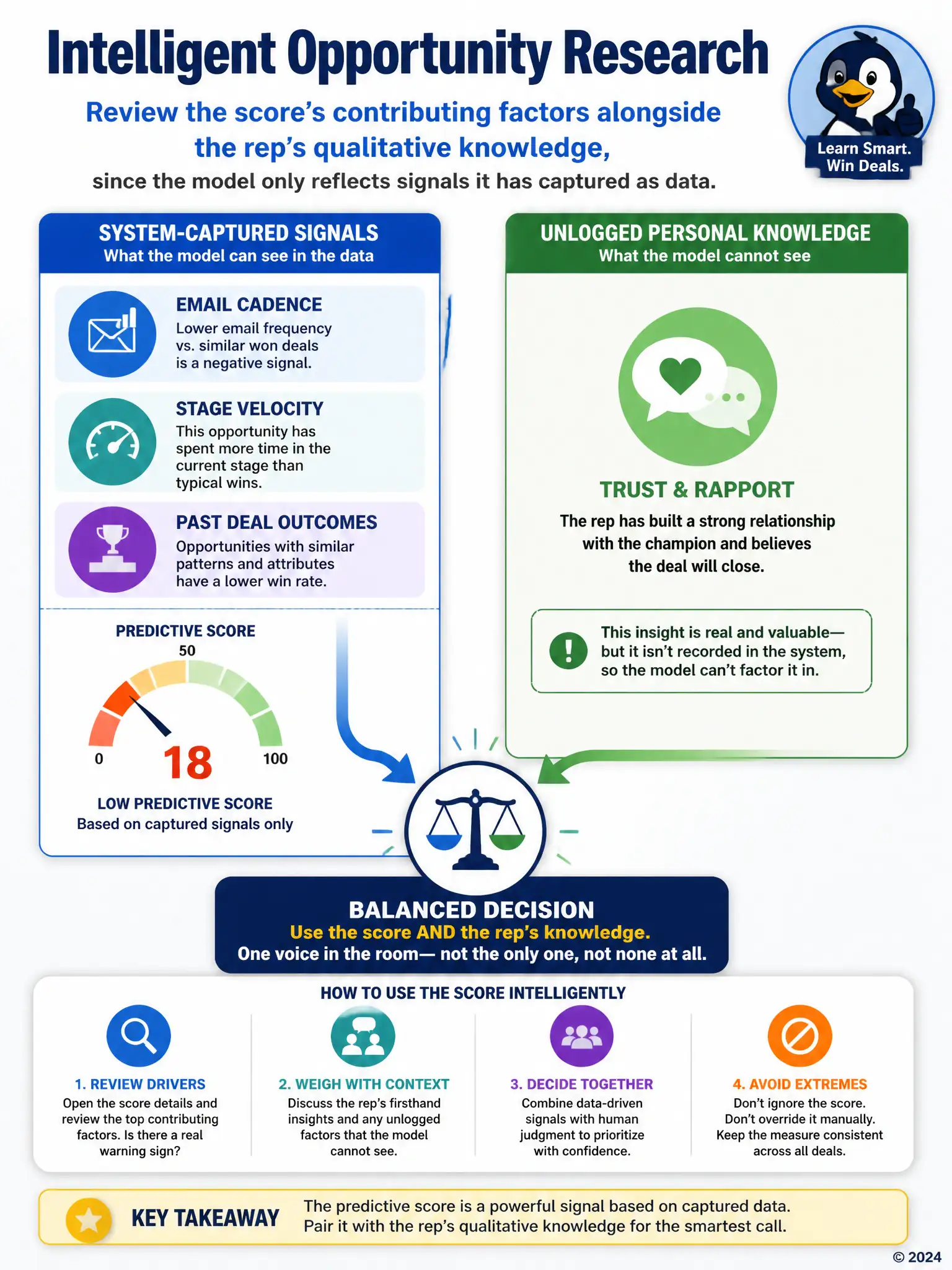
A sales manager reviews the pipeline dashboard and sees a large opportunity has a low predictive score, and decides to deprioritize it in the weekly forecast call. The rep pushes back, saying they have built a strong relationship with the champion and believe the deal will close, but that relationship strength has never been logged as structured data anywhere in Dynamics 365 Sales. What is the most appropriate way for the consultant to advise the manager to use the predictive score in this situation?
Select an answer to reveal the explanation.
Short Explanation
Don't treat the predictive score as gospel, and don't trash it just because it missed an unlogged relationship. Check what's driving the score, then weigh those signals against what the rep knows firsthand. The model can only judge the data it has, so use it as one input, not the whole decision.
Full Explanation
A predictive score is only as complete as the data feeding it; it reflects patterns in activity, engagement, and historical outcomes that the system has actually captured, so a relationship strength that was never logged simply cannot be weighed by the model. The appropriate advice is to review the score's contributing factors alongside the rep's qualitative knowledge, treating the score as one directional input, examining it for anything genuinely concerning, and combining that with firsthand knowledge before deciding how to prioritize the deal. Treating the score as the deciding factor is incorrect because it ignores that the model can only reason about data it has, not context that lives only in the rep's head. Disregarding the score entirely is incorrect because it discards real signals the model may be capturing correctly, such as a slowing cadence of engagement, that are worth investigating rather than ignoring. Asking the rep to manually override the score value is incorrect because the predictive score is a system-calculated field meant to reflect consistent, model-driven analysis; manually overriding it to match a personal belief undermines the integrity and comparability of scores across the whole pipeline.