
A veteran sales operations analyst proposes replacing Dynamics 365 Sales predictive lead scoring with a simple manual formula that adds points for job title seniority, company size, and how recently the lead was created, arguing it will be more transparent than the AI model. Which limitation of the analyst's proposed manual formula should the consultant raise?
Select an answer to reveal the explanation.
Short Explanation
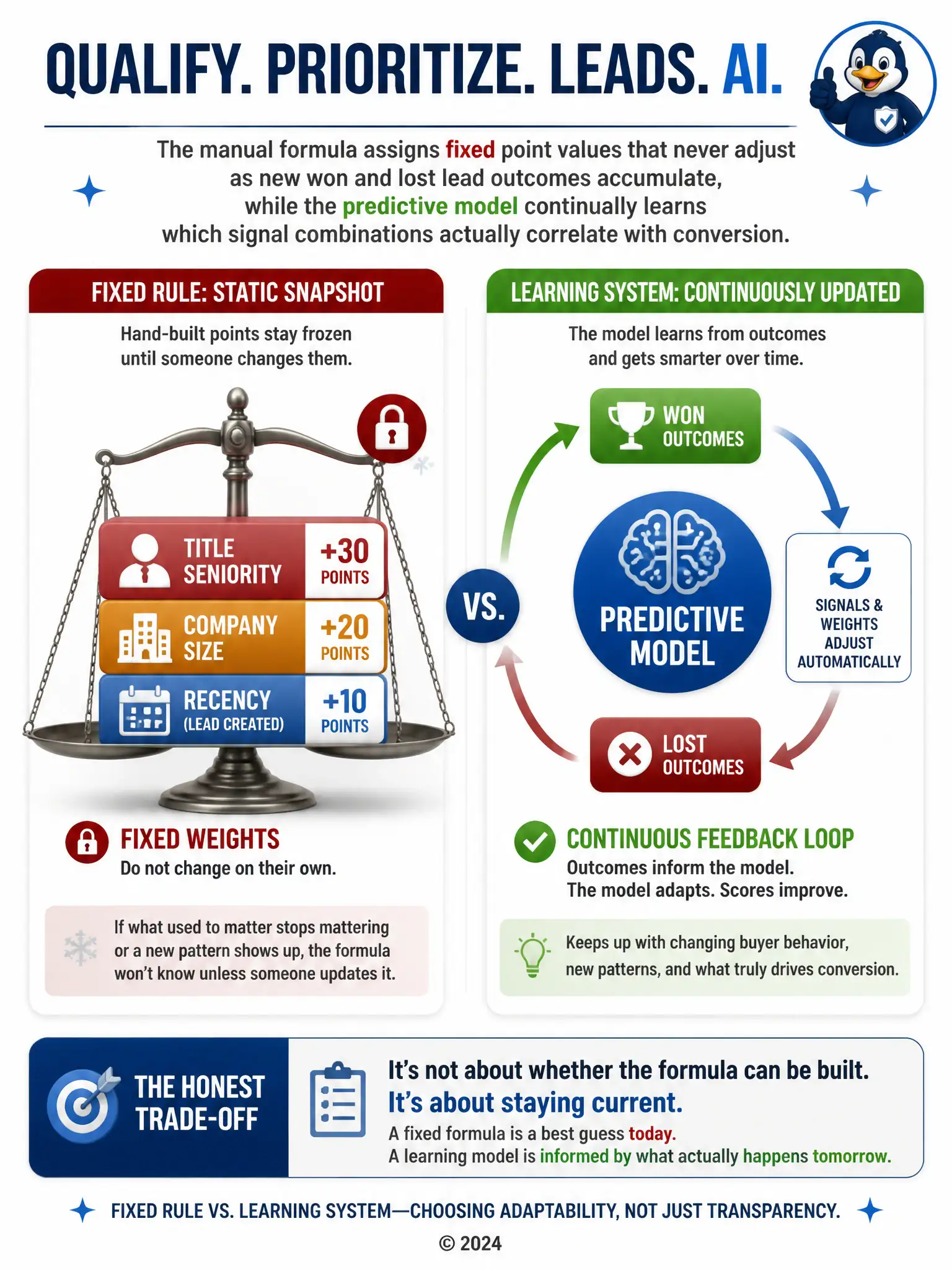
Hand-built point systems freeze somebody's best guess about what a good lead looks like. You get transparency, but the score won't learn from new won and lost outcomes. The predictive model keeps adjusting as real results show which signal combinations actually convert.
Full Explanation
The limitation to raise is that the manual formula assigns fixed point values that never adjust as new won and lost lead outcomes accumulate, while the predictive model continually learns which signal combinations actually correlate with conversion. The analyst's fixed-point formula bakes in static judgment about which signals matter and by how much, and that judgment never updates itself as the business's actual pattern of wins and losses shifts, whereas predictive scoring is continually refreshed against real outcomes and can pick up signal combinations human would not think to weight by hand. The claim that manual formulas cannot be displayed anywhere on the lead form is incorrect because manually calculated fields can absolutely be surfaced on the lead form like other fields; the transparency the analyst wants is achievable, it just does not fix the formula's underlying rigidity. The claim that Dynamics 365 Sales does not expose job title or company size on the Leads table is incorrect because job title and company size are ordinary fields already available on or related to the Leads table, so there is no technical barrier to referencing them in calculations. The claim that custom fields cannot be added to the Leads table at all is incorrect because Dynamics 365 Sales fully supports adding custom and calculated fields to the Leads table, so the formula is implementable; the objection to raise is about how well it adapts over time, not whether it can be built at all. The real trade-off is adaptability, not feasibility or visibility.