
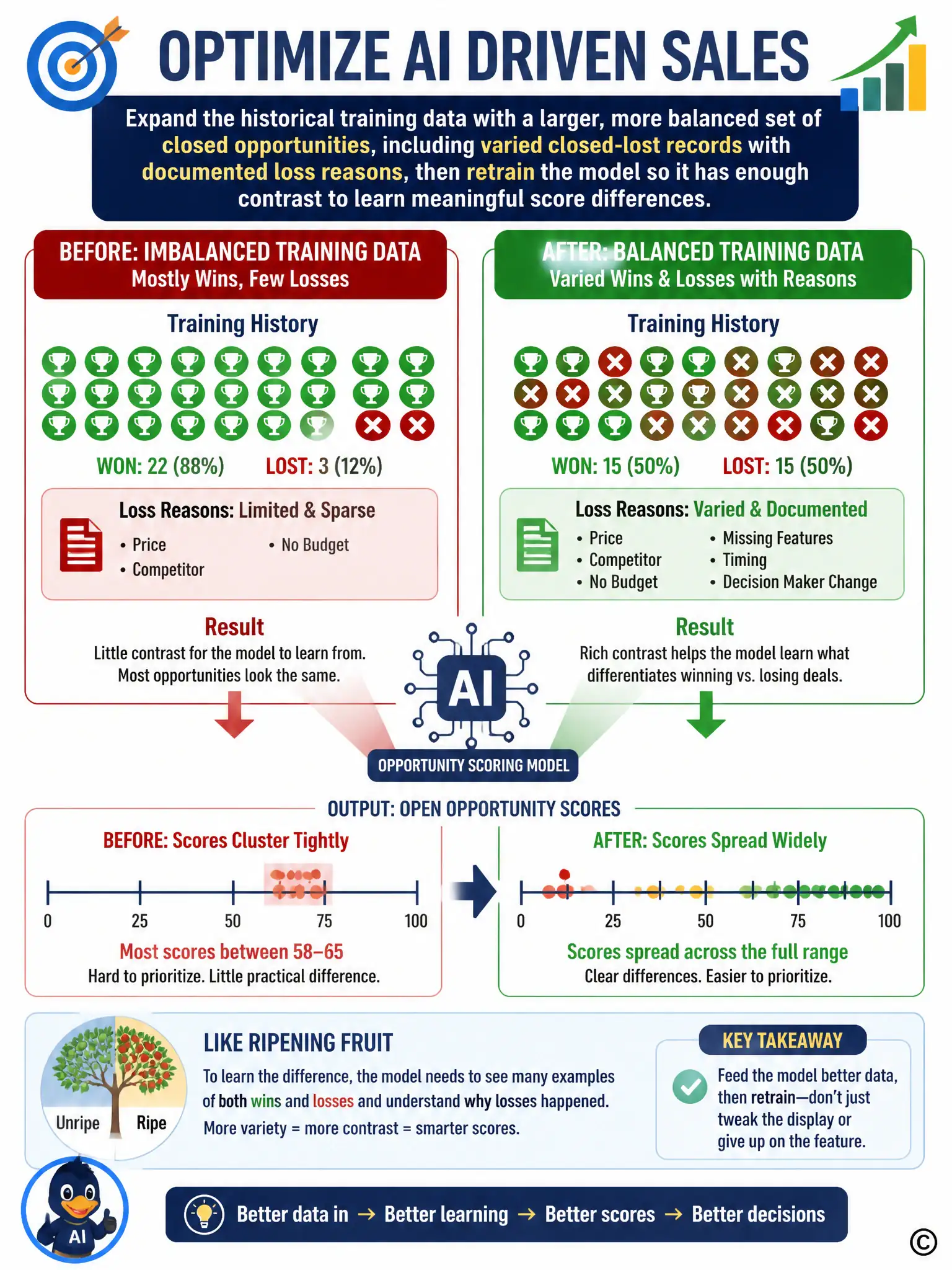
Six months after enabling AI-driven opportunity scoring, a consultant reviewing the pipeline notices that most open opportunities cluster tightly between scores of 58 and 65, giving sellers little practical way to tell which deals deserve priority attention. Investigation shows the model was trained on a modest set of historical opportunities, most of which are closed-won, with very few closed-lost records and little variation in recorded loss reasons or deal attributes. What should the consultant recommend?
Select an answer to reveal the explanation.
Short Explanation
You need to give the model more real contrast to learn from. If its history is mostly closed-won with few closed-lost examples and weak loss reasons, it can’t tell good deals from weak ones. Feed it a larger, more balanced set of closed opportunities with documented loss reasons, then retrain it.
Full Explanation
The correct recommendation is to expand the historical training data with a larger, more balanced set of closed opportunities, including varied closed-lost records with documented loss reasons, then retrain the model so it has enough contrast to learn meaningful score differences. A predictive scoring model learns to differentiate outcomes by finding patterns that separate wins from losses across a wide range of historical examples. When the training set is small and dominated by closed-won records with little variety in closed-lost outcomes or documented loss reasons, the model has almost no contrast to learn from, so it produces scores that cluster together rather than spreading opportunities across a meaningful range. Enlarging and balancing the historical dataset, then retraining, gives the model the variation it needs to produce scores sellers can actually act on. The option to adjust the score display to round more aggressively so differences between opportunities appear more distinct to sellers is incorrect because changing how scores are rounded or displayed is a cosmetic adjustment that does not address the underlying lack of model discrimination; the scores themselves remain uninformative. The option to increase how frequently the scoring model recalculates against live pipeline data so scores update in near real time is incorrect because refresh frequency controls how current the scores are, not how well the model distinguishes strong deals from weak ones, so recalculating more often would just produce the same clustered scores more frequently. The option to turn off AI-driven scoring and have sales managers assign priority manually using their own judgment is incorrect because abandoning AI scoring discards a capability that could work well once properly trained, and reverts the team to the inconsistent manual prioritization the feature was meant to improve.