
A consultant is helping a sales team decide which AI-driven scoring capability to apply at two different points in their pipeline: prioritizing hundreds of new inbound leads each week, and flagging established opportunities that are quietly losing momentum. The team currently applies a single scoring model to both situations and gets poor results at one of the two stages.
Select an answer to reveal the explanation.
Short Explanation
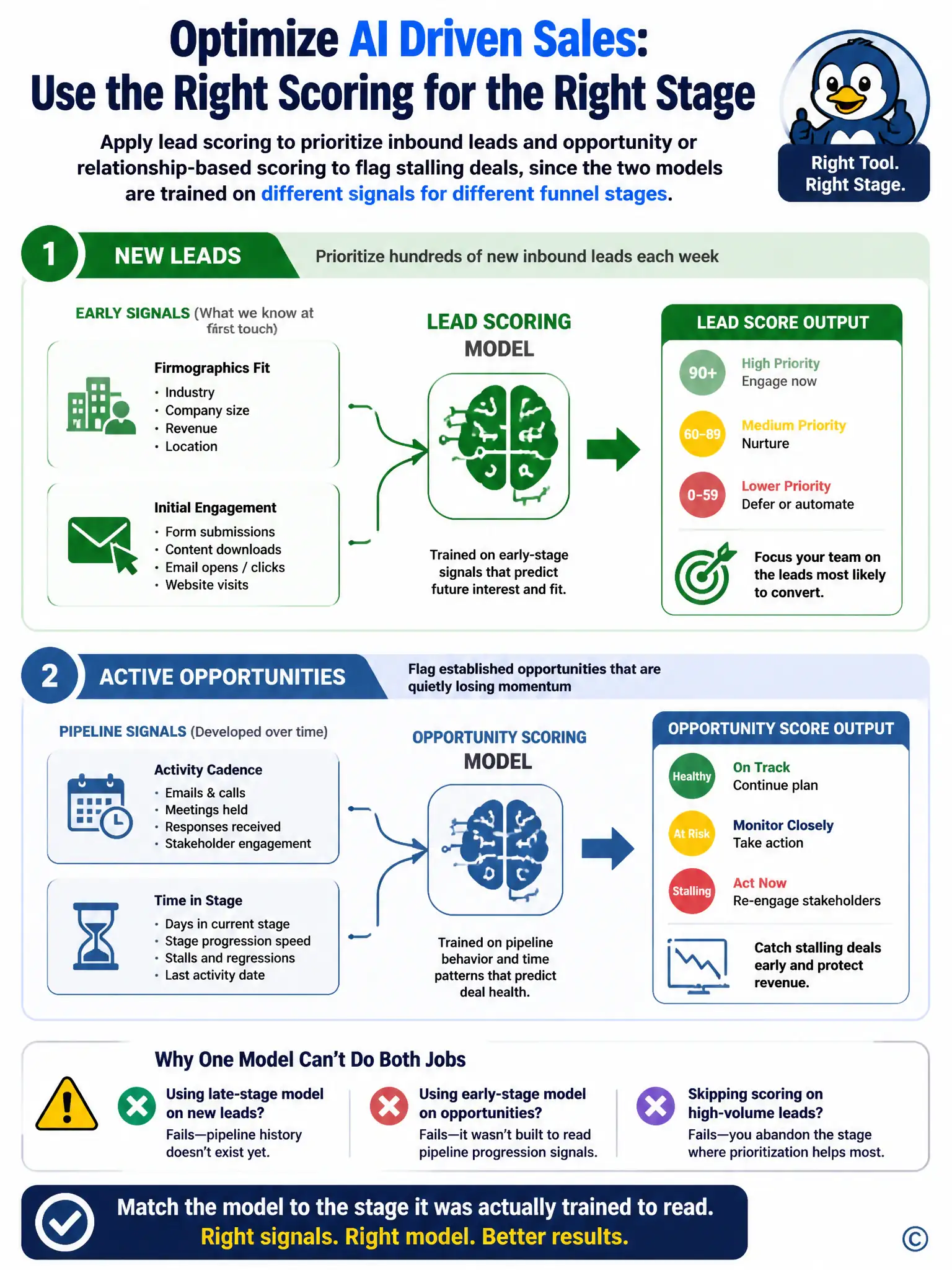
You need to match the scoring model to the stage it was trained to read. Use lead scoring to sort new inbound leads, then use opportunity or relationship-based scoring to catch deals that are stalling. One model can't read both early-funnel signals and pipeline-progression signals.
Full Explanation
Lead scoring is built on early-funnel signals available at first contact, such as firmographic fit and initial engagement, making it suited to prioritizing a high volume of new inbound leads, while opportunity or relationship-based scoring draws on pipeline progression signals like activity cadence and stage duration, which is what is needed to detect an established deal quietly stalling. Using the model matched to each stage's available data is why splitting them produces better results than forcing one model to do both jobs. Applying opportunity scoring to both leads and opportunities is incorrect because opportunity scoring depends on pipeline history and stage progression data that a brand-new lead simply does not have yet, so applying it to leads would produce unreliable or meaningless scores despite the appeal of consistency. Applying lead scoring to both leads and opportunities is incorrect because lead data, while collected early, lacks the stage-duration and activity-cadence signals that stalling detection depends on, so it cannot substitute for opportunity-stage scoring regardless of how complete it seems at intake. Disabling scoring on leads entirely and relying on manual triage, reserving automated scoring only for late-stage opportunities, is incorrect because it discards a usable automated scoring signal at the lead stage, where the team is already struggling with high volume, in favor of manual triage, which is the exact bottleneck the team is trying to relieve. Matching each model to the funnel stage whose data it was built to interpret is the underlying decision a consultant needs to get right here.