
Sellers at a mid-size distributor use the Copilot chat panel in Dynamics 365 Sales to ask questions like 'what were the last three interactions with this account.' During a pilot, several sellers report the chat sometimes returns interaction details that do not match anything in the account's actual activity history. A consultant is asked to reduce these incorrect answers before the pilot expands.
Select an answer to reveal the explanation.
Short Explanation
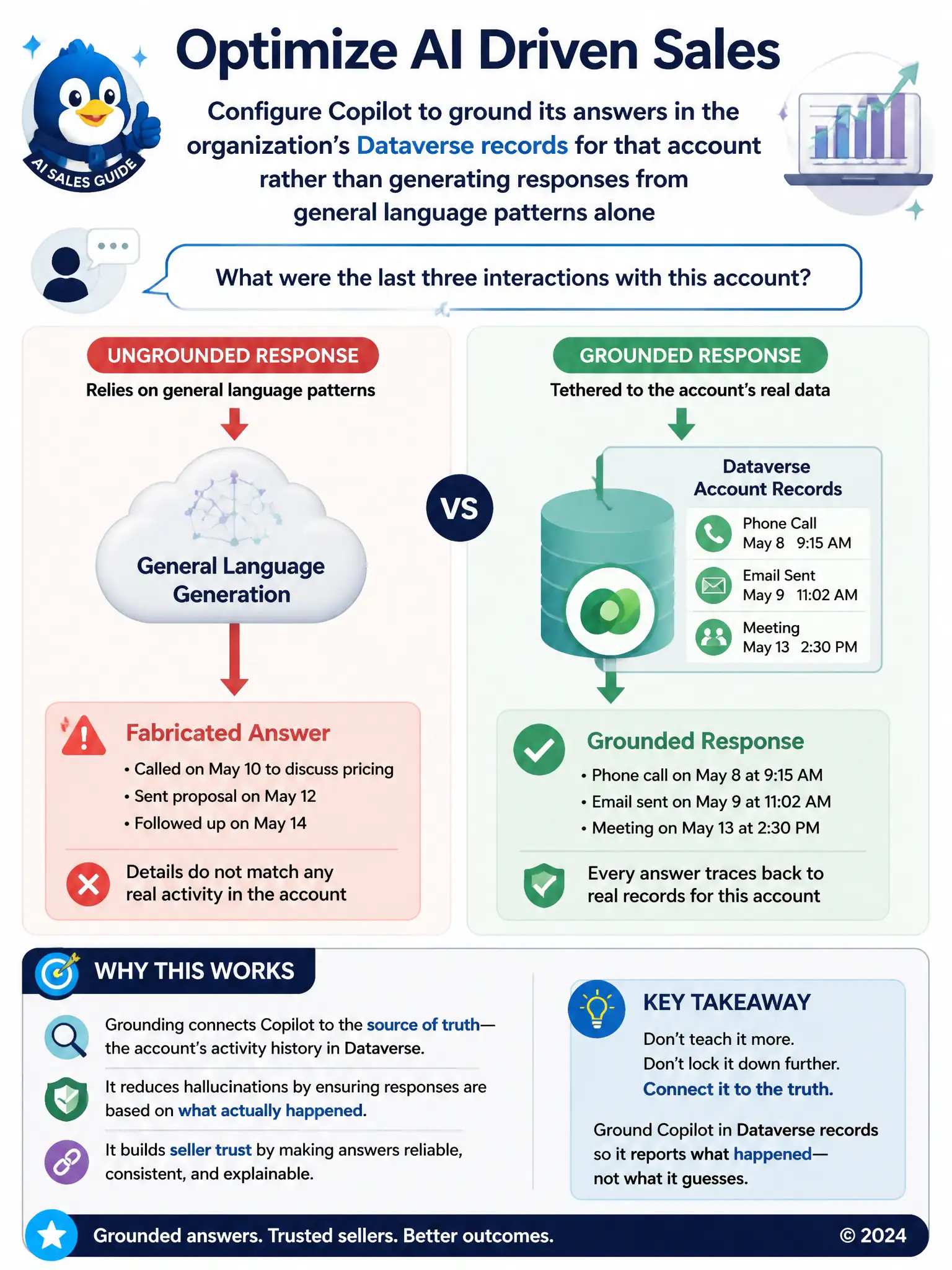
When Copilot starts making up interactions, you don't need more model training or broader access—you need it grounded in the account's real Dataverse activity records. That way it reports what actually happened instead of guessing at a plausible-sounding pattern.
Full Explanation
The correct approach is to configure Copilot to ground its answers in the organization's Dataverse records for that account rather than generating responses from general language patterns alone. When Copilot answers are not grounded in the organization's own Dataverse records, it can generate plausible-sounding but fabricated details instead of pulling actual logged activities, which explains why sellers are seeing interaction summaries that do not match reality. Configuring grounding so Copilot retrieves and cites the account's real activity records addresses the root cause directly. Retraining the underlying large language model on the company's historical email archive is incorrect because tenant consultants and admins do not retrain the foundation large language model; that is not an available or appropriate configuration lever for this problem. Increasing the sellers' security role privileges so Copilot can access additional account-related tables is incorrect because expanding security role privileges changes what data a seller can see, not whether Copilot's answers are anchored to real records versus generated text, so it would not fix fabricated content. Disabling the artificial-intelligence features until the next platform update is released is incorrect because pausing the feature avoids the pilot's immediate risk but does not solve the underlying grounding gap, and the same inaccuracy would resurface whenever the feature is re-enabled without configuration changes. For a consultant, the key distinction is that answer accuracy in this scenario is a data-grounding configuration problem, not a model-training, permissions, or availability problem, and treating it as the wrong type of problem wastes rollout time without fixing the sellers' actual complaint.