
A sales director reviews a $2 million opportunity in Dynamics 365 Sales and notices the AI-generated estimated close date is six weeks later than the seller's manually entered close date. The director asks a consultant to explain what the AI prediction is actually based on before deciding which date to trust for the quarterly forecast rollup.
Select an answer to reveal the explanation.
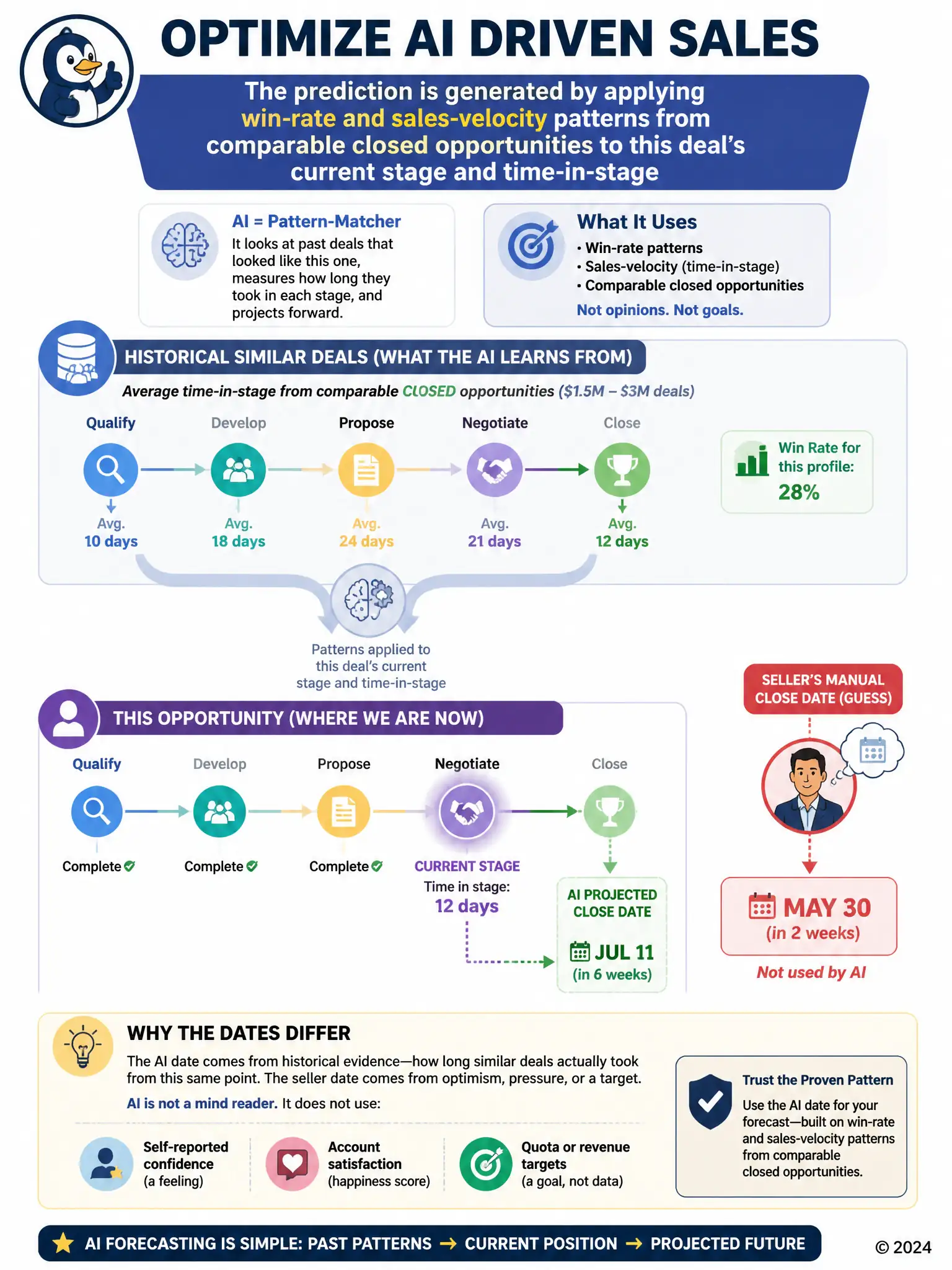
Short Explanation
Think of the AI close-date estimate as a pattern-matcher, not a mind reader. It looks at comparable closed opportunities, sees how long deals like this one typically sat in each stage, and projects forward from the current stage and time-in-stage. So when the AI date and the seller's date disagree, you are seeing historical evidence versus a person's optimism or quota pressure.
Full Explanation
The correct explanation is the prediction generated by applying win-rate and sales-velocity patterns from comparable closed opportunities to this deal's current stage and time-in-stage. Dynamics 365 Sales AI-driven close date predictions are built by analyzing historical patterns from closed opportunities that resemble the current deal, including how long similar deals spent in each stage and their eventual win rates, then projecting a likely close date from where this opportunity currently sits. That is why it can diverge from a seller's manual entry, which is often optimistic or anchored to a quota deadline rather than pipeline history. The prediction reflecting the confidence score the seller manually entered on the opportunity record is incorrect because a seller's self-reported confidence score is a subjective manual input, not a signal the prediction model consumes. The prediction derived from the account's customer satisfaction survey scores is incorrect because satisfaction survey data reflects customer sentiment, not sales-cycle timing, and is not part of this prediction's input set. The prediction set to align with the sales manager's quota target for the period is incorrect because quota targets are business goals set by management; the AI model has no awareness of them and does not adjust predictions to match a manager's desired outcome. Understanding this distinction matters for a consultant advising the director, since it clarifies that the AI date is an evidence-based estimate drawn from comparable deal history, while the seller's date may simply express hope or pressure to hit a target, and the two should be reconciled rather than one being assumed correct by default.