
An implementation team is configuring the Sales Order Agent so it can accurately convert emailed purchase orders into Dynamics 365 Sales order records for a distributor with unusual SKU naming conventions, while still requiring a human to approve any order exceeding $10,000 before it posts. (Select TWO.)
Select all correct answers, then click Submit.
Short Explanation
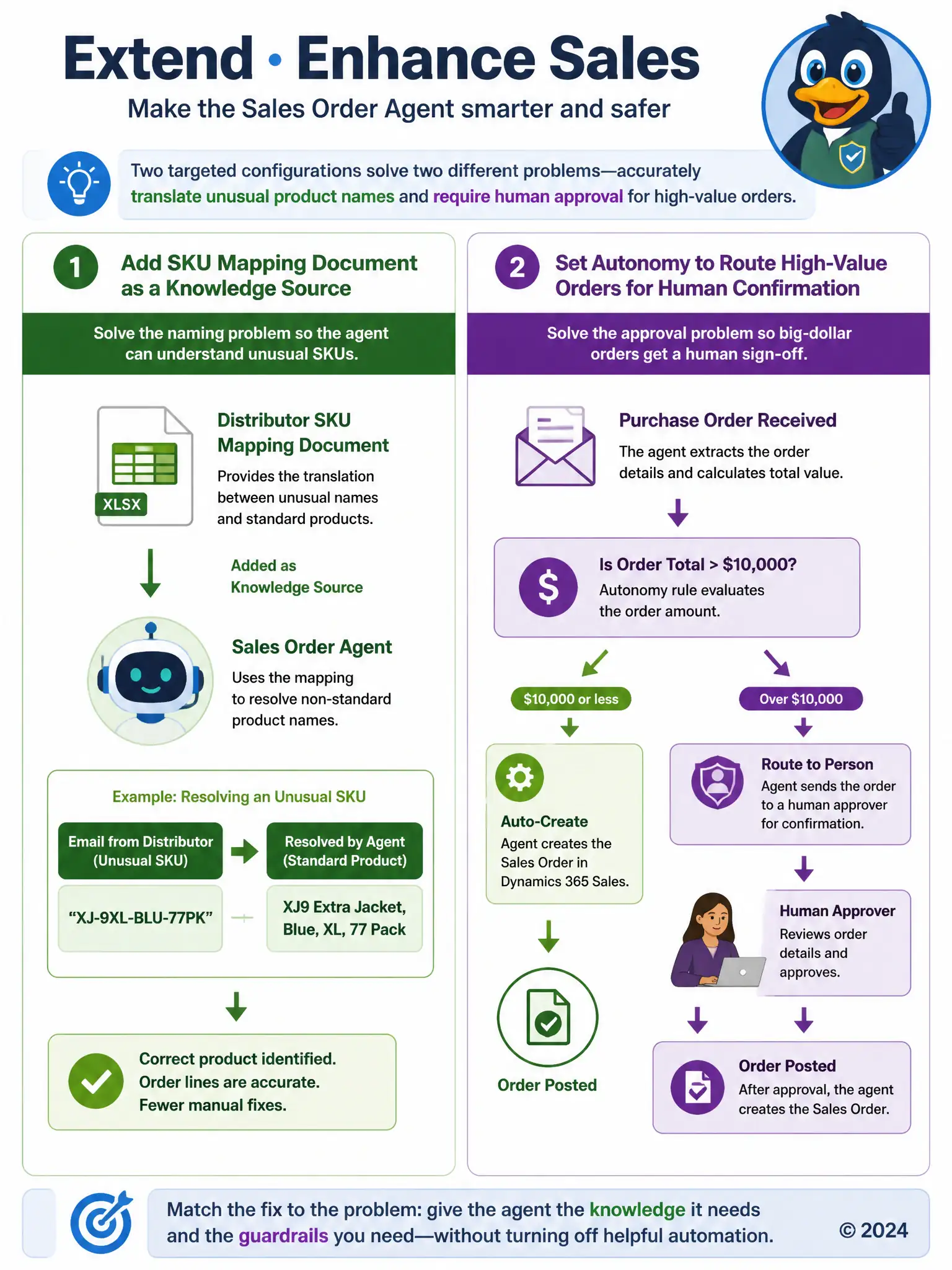
You have two jobs here: teach the agent this distributor's odd SKU names, and keep a human in the loop for big orders. Add the SKU mapping document as a knowledge source, then set the autonomy threshold so orders over $10,000 go to a person before posting. That fixes the accuracy issue without killing automation or weakening review.
Full Explanation
The correct choices are adding the distributor's SKU mapping document as a knowledge source and setting the agent's autonomy configuration so orders above the $10,000 threshold route to a person for confirmation before creation. Adding the distributor's SKU mapping document as a knowledge source gives the agent the reference it needs to resolve the distributor's unusual product names into the correct catalog items, directly addressing the accuracy problem. Setting the agent's autonomy configuration to route orders above $10,000 to a person for confirmation satisfies the requirement that large orders get human approval before posting, without turning off automation for smaller orders or changing how the agent handles everything else. Disabling the agent's product matching entirely and requiring reps to manually select every line item is incorrect because it removes the automation for every line item on every order from this distributor, which overcorrects far beyond the stated need and defeats the purpose of using the agent at all. Lowering the agent's confidence threshold to the minimum setting so more orders are auto-created without review is incorrect because it causes more orders to be auto-created with less scrutiny, which is the opposite of what is needed when the team specifically wants high-value orders held for human review. Together, a targeted knowledge source and a deliberate autonomy threshold solve both the accuracy problem and the oversight requirement, while the other two options either remove needed automation or remove needed oversight.