
A regional sales director notices that Copilot's deal-risk narratives on the forecast page never mention a recent contract-renewal clause type that historically correlates with slippage in this business unit. The director wants future narratives to weigh that clause type without disabling the built-in forecasting model. Which extension is appropriate?
Select an answer to reveal the explanation.
Short Explanation
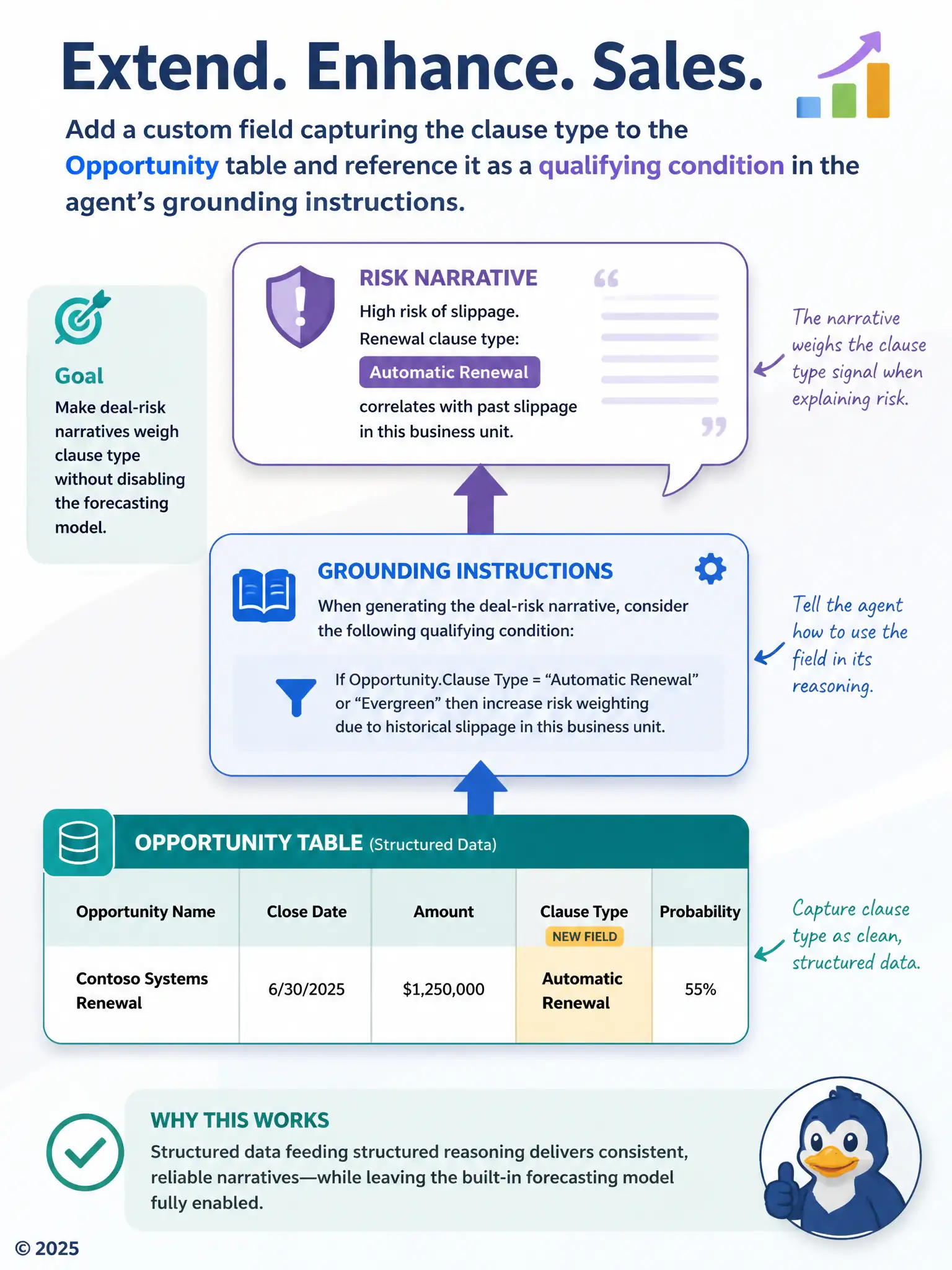
When you need a Copilot narrative to weigh a new signal, give it a clean field to read and point the grounding instructions at that field. That folds the clause type into the narrative without turning off the forecasting model. Don't rely on notes or separate reports, because those don't make the narrative consistently use the signal.
Full Explanation
The appropriate extension is adding a custom field capturing the clause type to the opportunity table and referencing it as a qualifying condition in the agent's grounding instructions. This gives the narrative a reliable, queryable signal to weigh consistently, which is exactly what the director wants without touching the underlying forecasting model. Turning off Copilot's forecast narrative feature and replacing it with a manually written summary each week is incorrect because it removes the automation entirely, contradicting the requirement to keep the built-in model running. Asking reps to mention the clause type in the opportunity's free-text notes so Copilot picks it up whenever it happens to scan notes is incorrect because free-text notes are unstructured and inconsistently populated by reps, so Copilot may or may not surface the clause type depending on wording and whether it scans that note at all, which is not a dependable signal. Creating a Power BI report showing clause type separately from the forecast page so the director can cross-reference it manually is incorrect because it requires the director to manually compare two different places instead of having the risk narrative itself account for the clause type, so it does not actually extend the narrative's reasoning. Structured grounding data is the only path that makes the signal consistently available to the narrative generation itself.