
A consultant is preparing to enable predictive opportunity scoring for a division whose Dynamics 365 Sales instance has been live for two years. (Select TWO.) Which two actions should the consultant take before turning the model on?
Select all correct answers, then click Submit.
Short Explanation
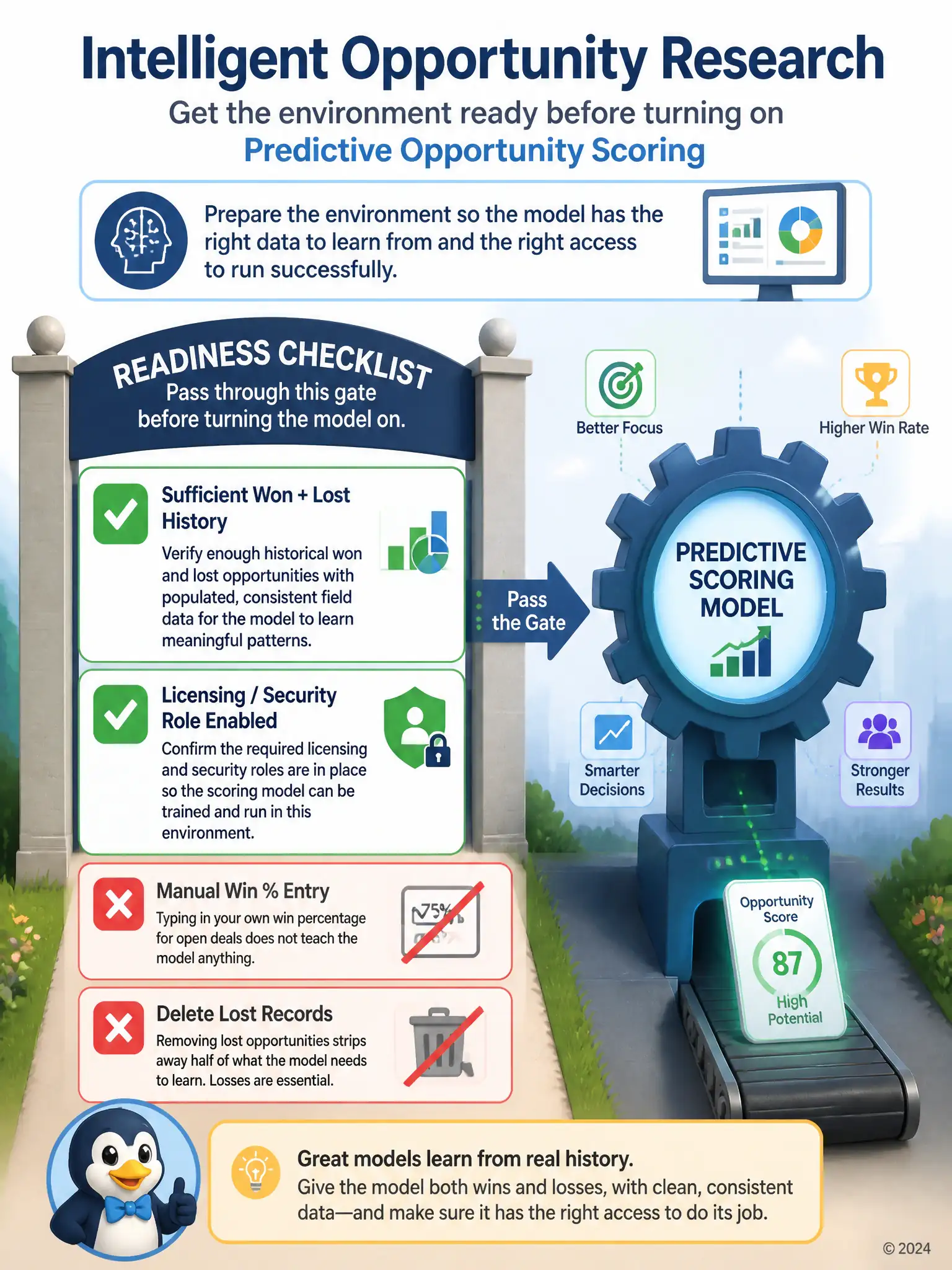
Before you turn on predictive opportunity scoring, make sure you've got enough clean historical won and lost opportunity data for the model to learn from, and make sure the right licensing and security roles are already in place. If you don't have both, the model won't have the training material or the access it needs to run.
Full Explanation
The correct actions are verifying that the environment has enough historical won and lost opportunity records with populated, consistent field data for the model to learn meaningful patterns, and confirming that the required licensing and security roles for the scoring model are in place so it can be trained and run in this environment. Predictive opportunity scoring needs a sufficient body of historical won and lost opportunities with clean, consistently populated fields to learn real patterns, so verifying data volume and quality is a necessary pre-check. It also depends on the appropriate licensing and security roles being provisioned in the environment so the model can actually be trained and executed; without that access in place, the feature cannot be turned on regardless of how good the data looks. Manually assigning a win-probability percentage to every currently open opportunity so the model has a baseline figure to compare its own output against is incorrect because manually assigning probability numbers to open opportunities does not create a training baseline for the model; the model trains from historical closed outcomes, not from estimates a person types into open records. Deleting every opportunity record marked as Lost so the model trains only on the organization's successful, won outcomes is incorrect because deleting every lost opportunity would remove exactly the negative examples the model needs to learn what a losing deal looks like, leaving it unable to distinguish winning patterns from losing ones and severely degrading its accuracy rather than improving it. The two genuinely necessary preparatory steps are validating the historical data and confirming the licensing and access are configured.