
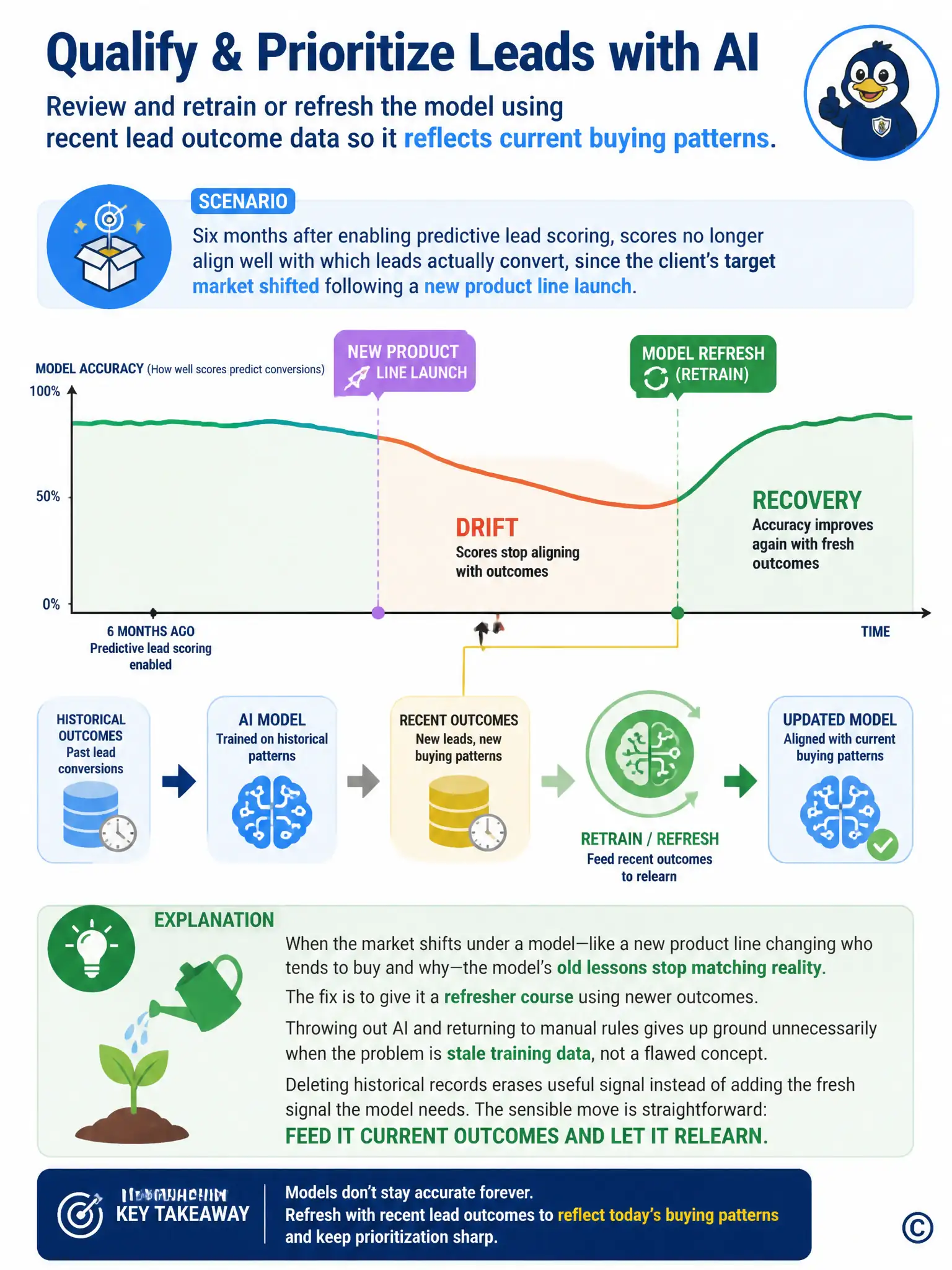
Six months after enabling predictive lead scoring, a consultant notices that scores no longer align well with which leads actually convert, since the client's target market shifted following a new product line launch. What should the consultant recommend?
Select an answer to reveal the explanation.
Short Explanation
When the market shifts underneath your model, like a new product line changing who buys and why, its old lessons stop matching reality. You need to review and retrain or refresh it with recent lead outcomes so it learns the current buying patterns. Don't ditch predictive scoring or wipe out history; give it fresh signal.
Full Explanation
Predictive models reflect the patterns present in the data they were trained on, and when the underlying buying patterns shift, such as after a new product line changes who converts and why, the model's accuracy will drift unless it is reviewed and retrained or refreshed using more recent outcome data that captures the new patterns. Leaving the model exactly as configured is incorrect because it rests on a false premise; models are not permanently fixed and do require periodic review as business conditions evolve, otherwise their recommendations grow stale and misleading. Switching the organization entirely to manually maintained scoring rules is incorrect because it discards a working, learnable capability over one accuracy issue, when retraining directly addresses the root cause without losing the benefits of the AI-driven approach. Deleting all historical lead records is incorrect because it destroys valuable training data, including patterns that may still be relevant, and does nothing on its own to incorporate the newer post-launch outcomes the model actually needs to realign its predictions.