
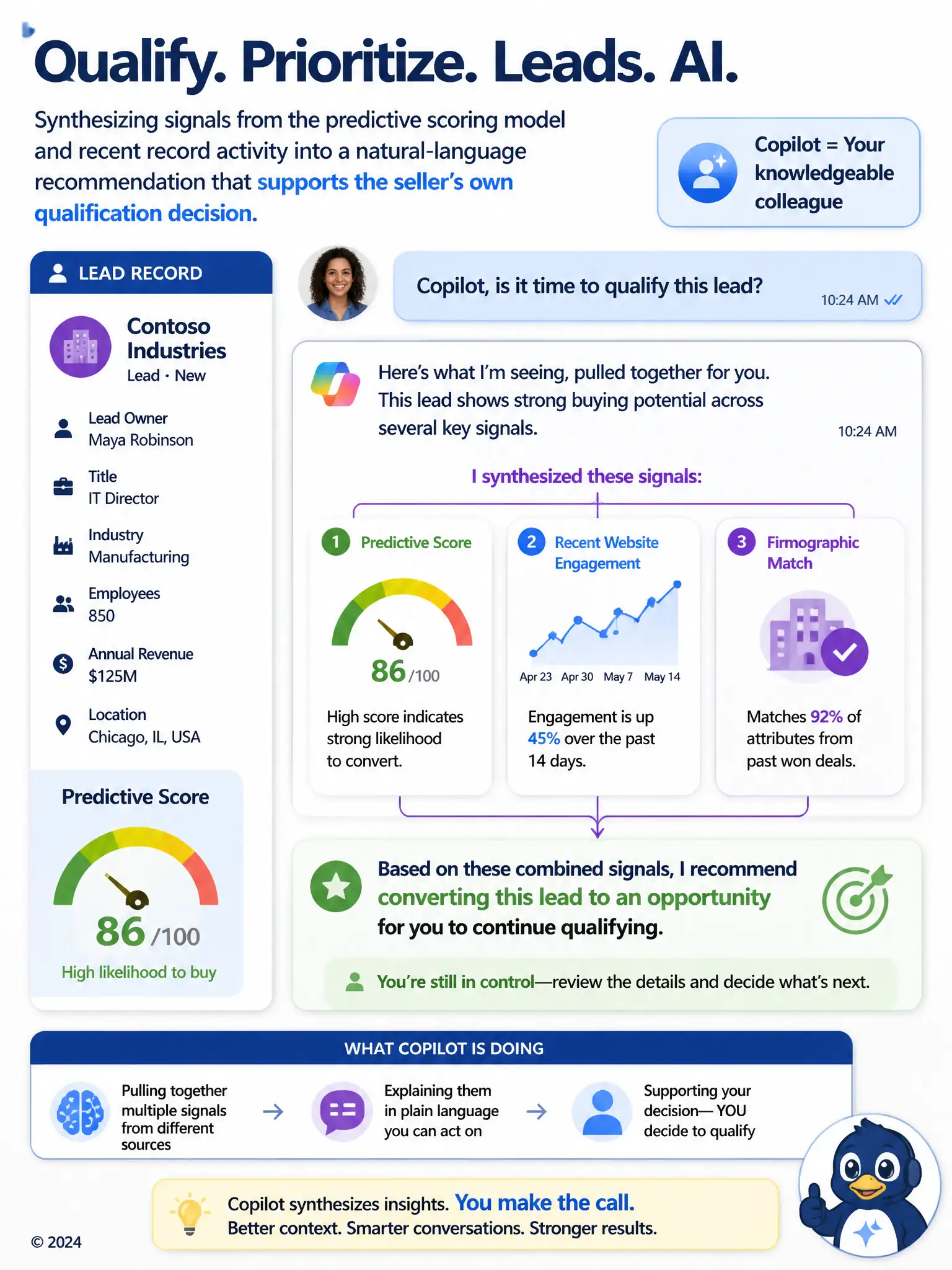
While reviewing an assigned lead, a seller asks Copilot whether it is time to qualify this lead. Copilot responds by citing the lead's high predictive score, recent website engagement, and a firmographic profile matching past won deals, then recommends converting it to an opportunity. What is Copilot doing in this exchange?
Select an answer to reveal the explanation.
Short Explanation
Copilot is acting like a sharp colleague giving you a second opinion. It pulls the predictive score, recent engagement, and firmographic match into a plain recommendation, but you still make the qualification call. It isn’t converting the lead for you, running a scheduled sweep, or replacing the scoring model.
Full Explanation
The correct answer is the choice describing Copilot synthesizing signals from the predictive scoring model and recent record activity into a natural-language recommendation that supports the seller's own qualification decision. In this scenario, Copilot is pulling together multiple existing signals—the predictive score, recent engagement activity, and firmographic similarity to past wins—and expressing them as a coherent, plain-language recommendation that helps the seller make an informed qualification decision; the seller still chooses whether and when to act. The choice describing automatic conversion of the lead to an opportunity without any seller action is incorrect because Copilot is described as making a recommendation in response to a question, not silently converting the record, and qualification remains a seller-driven action in this exchange. The choice describing a scheduled background workflow that qualifies every lead crossing a preset score threshold is incorrect because nothing in the scenario describes an automated, scheduled process running in the background across all leads; this is a conversational, on-demand response to a specific seller's question about a specific lead. The choice describing replacement of the predictive lead scoring model with a fixed, static rule going forward is incorrect because Copilot is drawing on the predictive model's output as one input to its explanation, not replacing that model with a fixed rule; the underlying scoring mechanism continues operating independently of this conversational assistance.