
A sales operations lead at a mid-size manufacturer wants to enable predictive lead scoring in Dynamics 365 Sales, but the organization has only about 5,000 closed leads with recorded outcomes from the last six months, well below the volume needed to train a reliable org-specific model. What should the consultant expect to happen when the feature is turned on?
Select an answer to reveal the explanation.
Short Explanation
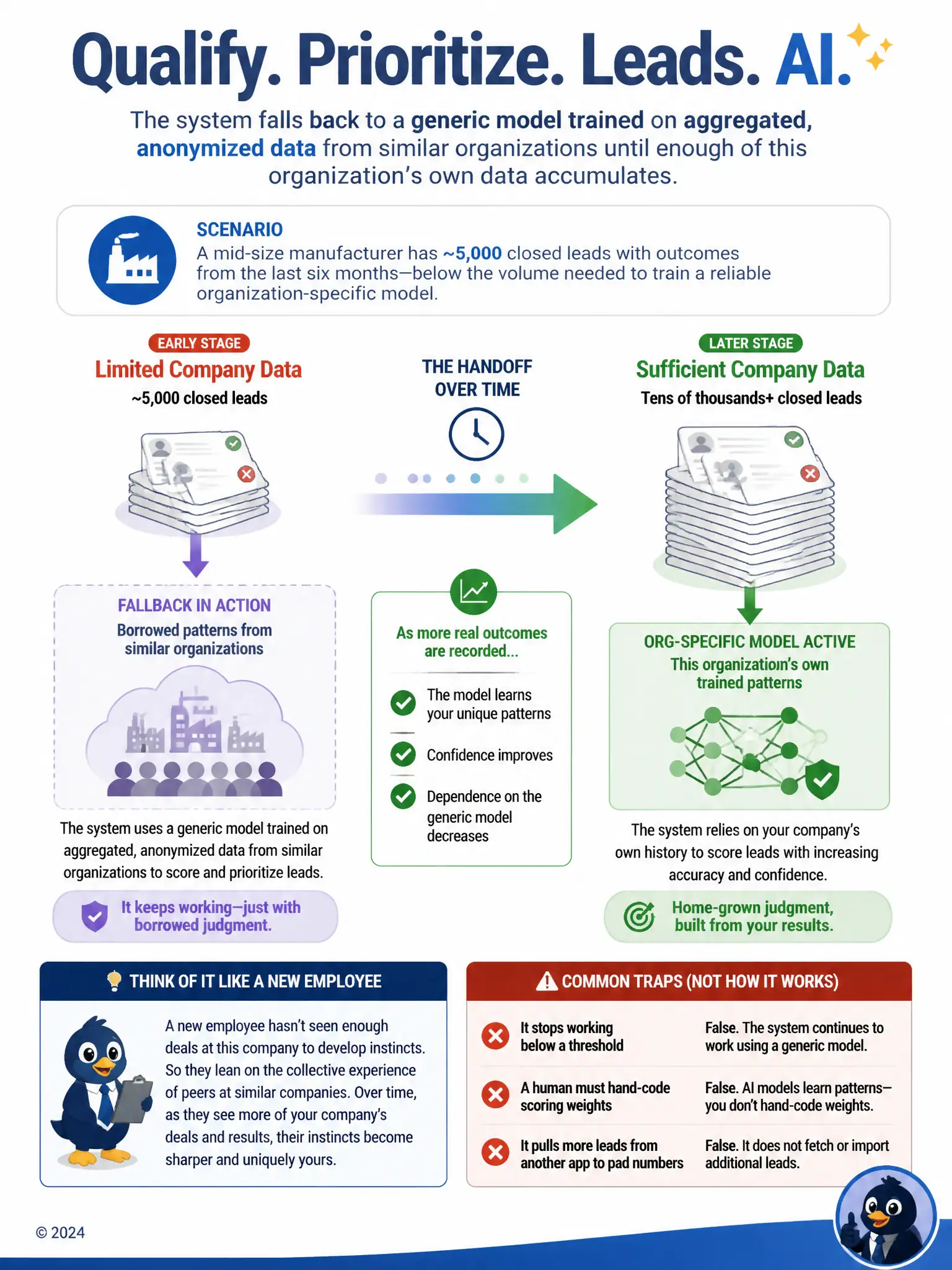
You don't need a mountain of company-specific closed outcomes before predictive lead scoring starts. If your org's own history is too thin, Dynamics 365 Sales uses a generic model trained on aggregated, anonymized data from similar organizations, then shifts to your own patterns as more outcomes pile up.
Full Explanation
Predictive lead scoring does not require an organization to have massive historical volume before it can be used at all. When an organization's own qualified and disqualified lead history is too thin to train a dependable custom model, the feature uses a generic model built from pooled, anonymized patterns across comparable organizations, and it transitions toward an org-specific model as more of the client's own outcome data accumulates. The correct expectation is therefore the fallback to a generic model trained on aggregated, anonymized data from similar organizations. The refusal-to-enable position is incorrect because the feature is designed to remain usable below the ideal data threshold rather than blocking activation entirely. The manually configured weighting-rules position is incorrect because predictive lead scoring is a machine-learning capability that learns from outcome patterns; it is not a manual rule-weighting engine, which is a separate, rules-based approach used elsewhere in the platform. The automatic-import-from-Marketing position is incorrect because the platform does not automatically pull additional lead records from Dynamics 365 Marketing to artificially inflate the training set; data volume grows only through the organization's actual ongoing lead activity, and cross-application record importing is not part of how the scoring model sources its training data. Exam caveat: don't confuse insufficient data for a reliable org-specific model with a hard stop; the expected behavior is fallback to the generic model. Sources: https://learn.microsoft.com/en-us/dynamics365/sales/configure-predictive-lead-scoring, https://community.dynamics.com/blogs/post/?postid=5b09851f-65f1-4197-bae7-aa0f78795f30.