
Six months after enabling predictive opportunity scoring, a sales operations analyst notices that most opportunities imported during a recent CRM migration all display an identical predictive score, regardless of deal size, industry, or stage. Opportunities created natively in Dynamics 365 since go-live show varied, sensible scores that track with deal characteristics. What is the most likely explanation?
Select an answer to reveal the explanation.
Short Explanation
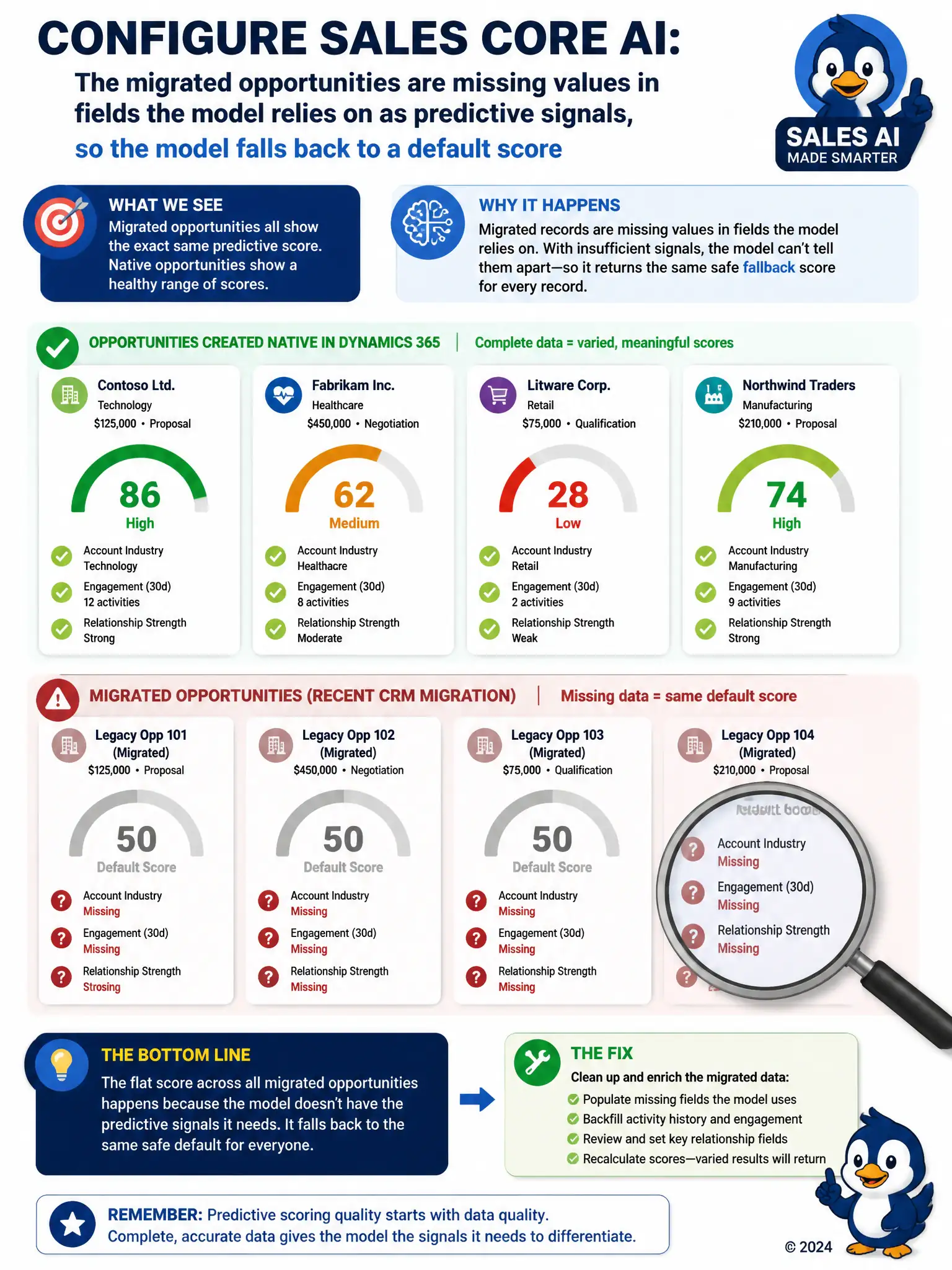
When a whole batch shows the same score while native records look normal, suspect the batch's data. Migrations often drop signals the model needs, so it falls back to the same default score. You need to fix the migrated data, not chase scoring rules or manual saves.
Full Explanation
The correct explanation is that the migrated opportunities are missing values in fields the model relies on as predictive signals, so the model falls back to a default score for those records. When records are brought in through a migration, fields the model depends on as predictive signals, such as activity history, industry, or engagement data, often do not carry over cleanly, leaving gaps the model cannot reason about. Faced with missing signal data, the model produces a uniform fallback result rather than a differentiated score, which matches exactly what the analyst observed: natively created records with complete data show varied, sensible scores, while migrated records with data gaps do not. The age-based explanation is incorrect because there is no rule that ages opportunities out of individualized scoring after six months; scoring behavior is driven by data quality and model configuration, not record age. The different-environment explanation is incorrect because the scenario describes the analyst comparing both sets of opportunities within what is clearly the same working environment; if they were in separate environments, the analyst would not be able to view and compare them side by side in the first place. The manual re-save explanation is incorrect because it invents a manual re-save requirement that is not how the scoring engine recalculates values; scores update based on data and scheduled processing, not a manual per-record save action. Data completeness at the point of migration is the real driver of the pattern described.