
An airline hotline tells callers the new gate after a gate change. Callers are on the phone, and the only fact required is the current gate record. Which design fits?
Select an answer to reveal the explanation.
Short Explanation
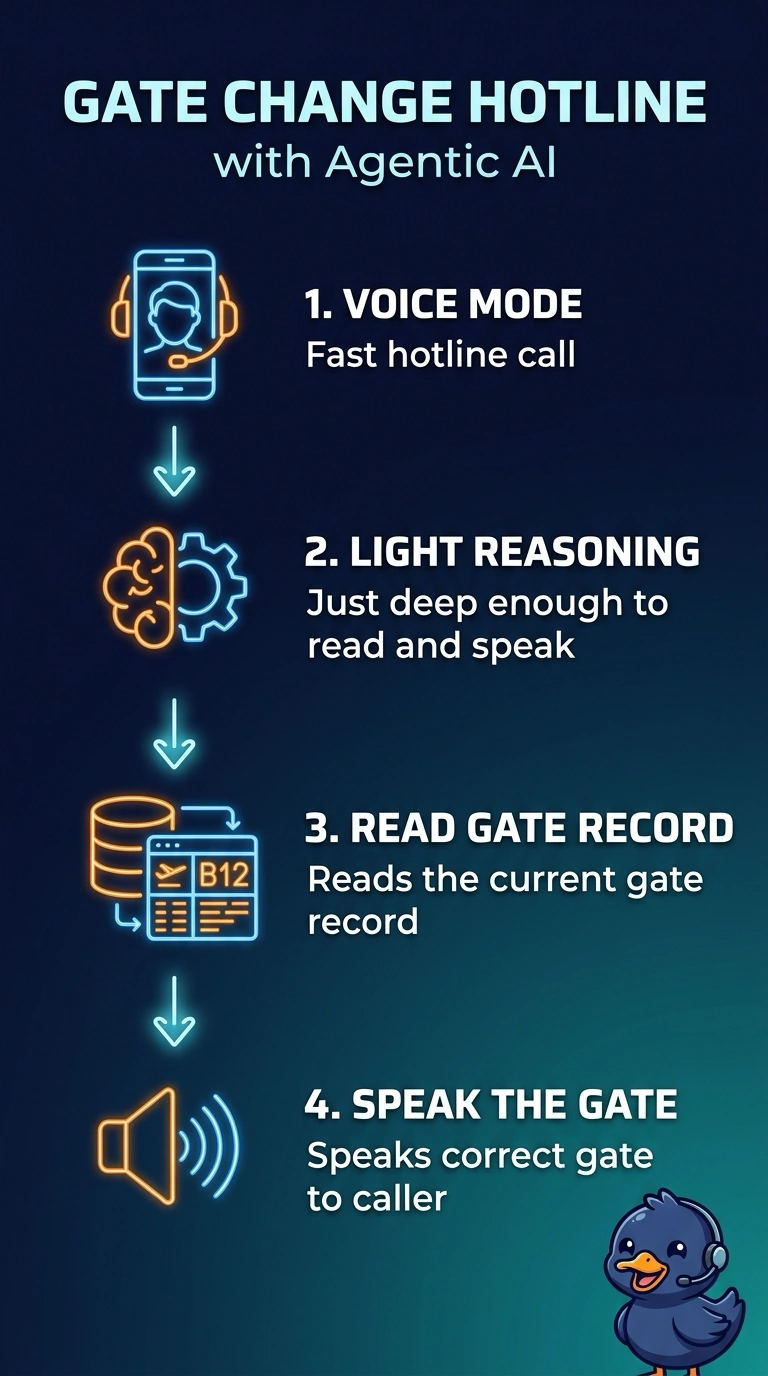
You need the new gate, not a flight redesign, and you’re already on the phone. Voice mode can read the current gate record and tell you the gate without extra work. That keeps you from waiting at the wrong door.
Full Explanation
Voice mode with reasoning only deep enough to read the current gate record and speak the gate fits a caller who is on the phone and needs a short spoken fact. The only fact required is the current gate, so the response can stay focused on that record. A text chat that asks the caller to type the flight number, seat, and original gate ignores the phone context and adds fields the announcement does not need. Voice mode that re-plans the flight, crew, and catering before stating the gate uses deep, slow work for a lookup and delays the one sentence the caller needs. A next-morning email of every gate change, with no phone path, misses someone already in the terminal when the gate changes. Gate changes are time-sensitive, and callers may be walking; extra planning can keep a passenger at the old gate. Exam caveat: reading the gate record is still grounding. Shallow reasoning does not mean announcing a gate from memory of yesterday’s board. Practical check: change a gate in a test flight record, call the hotline, and confirm the spoken gate matches the record without a crew or catering step in the trace.