
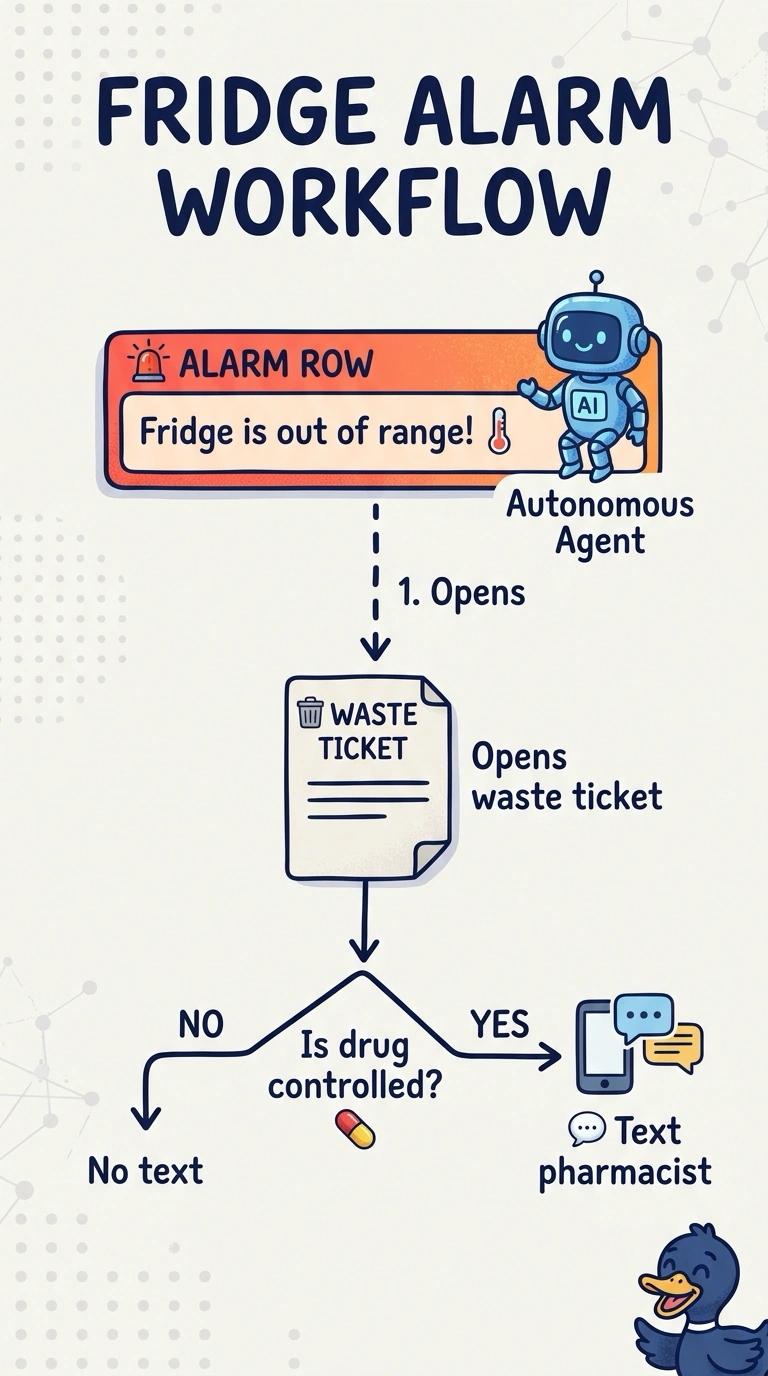
A pharmacy writes a refrigerator-alarm row when a drug fridge goes out of range. An agent should open a waste ticket from that row and text the pharmacist only if the drug is a controlled substance. Which design fits?
Select an answer to reveal the explanation.
Short Explanation
Think of the night pharmacist who starts the waste ticket the moment the fridge alarm prints, and who texts a person only for a controlled drug. You want an autonomous agent on that new alarm row. Waiting for someone to type a chat message leaves the warm fridge unlogged.
Full Explanation
An autonomous agent starts from an event, does the work, and involves a person only when a boundary is crossed. The refrigerator-alarm row is the event, the waste ticket is the action, and a controlled substance is the boundary that requires a text to the pharmacist. A prompt-and-response agent that opens a waste ticket only after a pharmacist types a request waits for a chat that may come too late, and the alarm row sits untouched. A topic that explains the alarm code when someone asks is a definition, and it does not open a ticket or send a text. A nightly export that ranks refrigerator alarms is a report after the fact, and it does not create a waste ticket for the fridge that just failed. The controlled-substance check has to be readable on the alarm row at runtime, so ordinary drugs still get a ticket with no text. Exam caveat: texting the pharmacist on the controlled path does not turn the agent into a chat bot. It is the safeguard on an event-driven action. Operational check: create one test alarm for an ordinary drug and one for a controlled substance, and confirm both open a ticket and only the controlled alarm sends a text.