
An airline records a crew timeout when a duty runs long. An agent should start the legal rest recalculation from that record and stop for a crew scheduler if the next duty would break the rest rule. Which design fits?
Select an answer to reveal the explanation.
Short Explanation
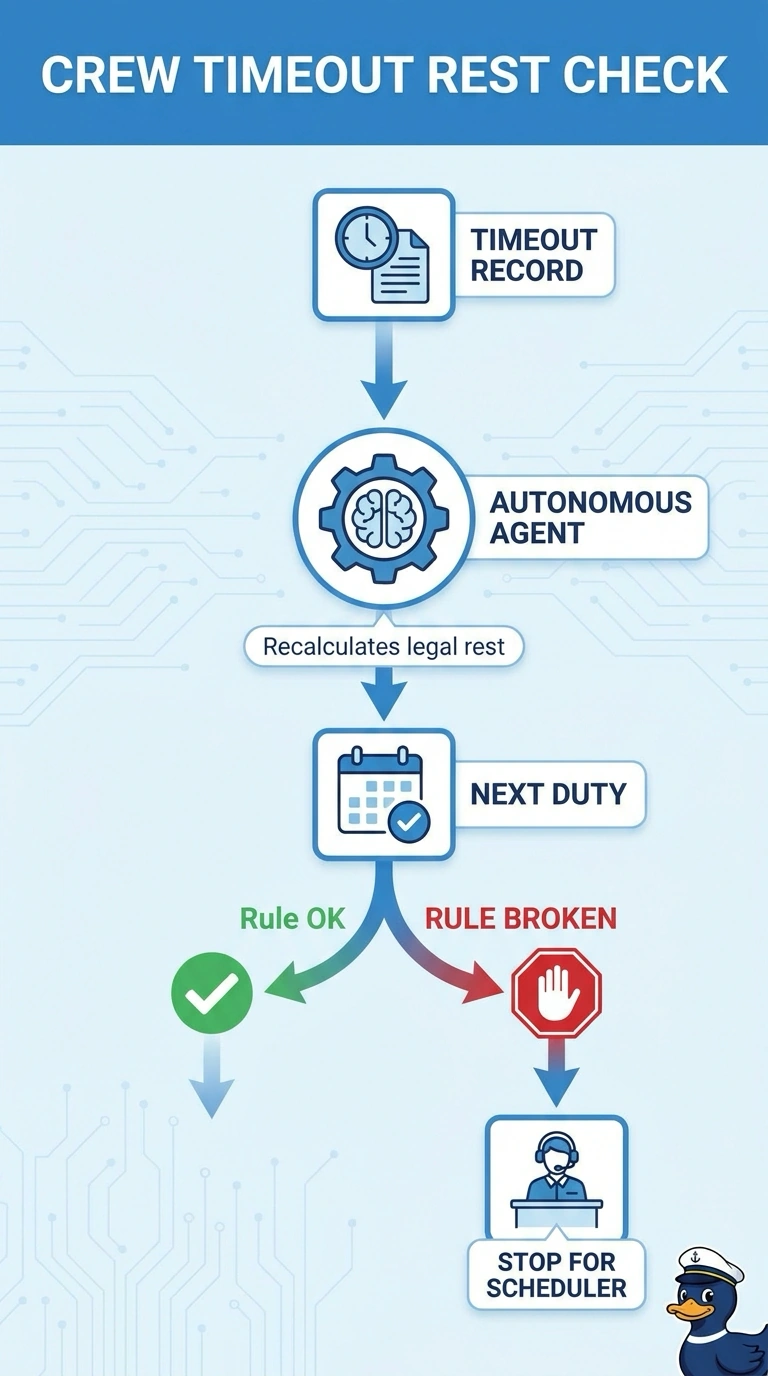
The timeout record is the bell that starts the rest math, and a person steps in only if the next duty would break the rule. You want an autonomous agent on that record. A weekly list of timeouts does not recalculate anyone's rest.
Full Explanation
An autonomous agent starts from an event and stops for a person when a boundary is crossed. The crew timeout record is the event, the legal rest recalculation is the action, and a next duty that would break the rest rule is the boundary that requires a crew scheduler. A prompt-and-response agent that recalculates rest only after a scheduler types a request waits for a chat, so the timeout sits until someone notices it. A topic that explains the rest rule when someone asks is a definition, and it does not recalculate the next duty. A weekly report that lists crew timeouts describes them after the fact and does not recalculate rest or contact a scheduler. The rest rule has to be something the agent can evaluate on the duty in front of it, so a duty that still fits the rule is recalculated without a person in the path. Exam caveat: stopping for the scheduler on a duty that would break the rule does not turn the agent into a chat bot. It is the safeguard on the autonomous run. Operational check: record one test timeout that fits the rest rule and one that would break it, and confirm only the second run waits for a scheduler.