
At a consultancy, every maker can open every client's grounding library, including libraries for clients they do not work with. What access change should the architect require?
Select an answer to reveal the explanation.
Short Explanation
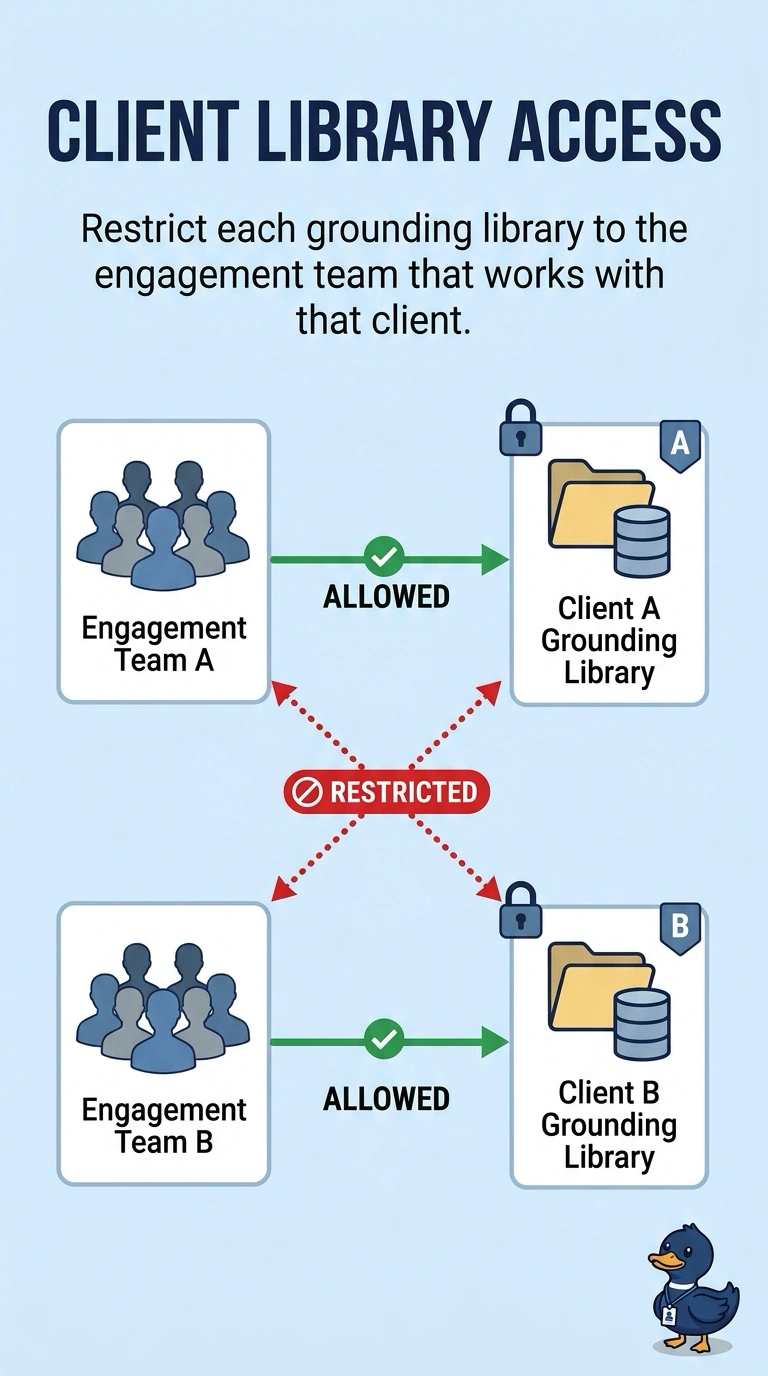
A key that opens every client's filing cabinet is not a convenience. You restrict each grounding library to the engagement team that works with that client. A shared pile of every client's files makes the wrong engagement the easy one to open.
Full Explanation
Grounding data is client content, and access follows the engagement that is allowed to use it. Makers who do not work a client have no need to open that client's library, so each library is limited to its engagement team. Leaving every library open treats another client's files as a spare parts bin, which is the exposure the architect was asked to close. Merging the libraries into one firm-wide workspace makes search broader and the boundary weaker, because a maker can still reach files from an engagement they are not on. Removing grounding and pasting files into chat drops the control without a library at all, and pasted text still sits in a conversation the wrong person may see. Exam caveat: the engagement team still needs enough access to keep the library current, and tightening the list is not an excuse to orphan the files. Operational check: sign in as a maker who is off a given engagement and confirm that client's library does not open, then sign in as a member of that team and confirm it does. Repeat the check for a second client so a broad security role is not mistaken for engagement access.