
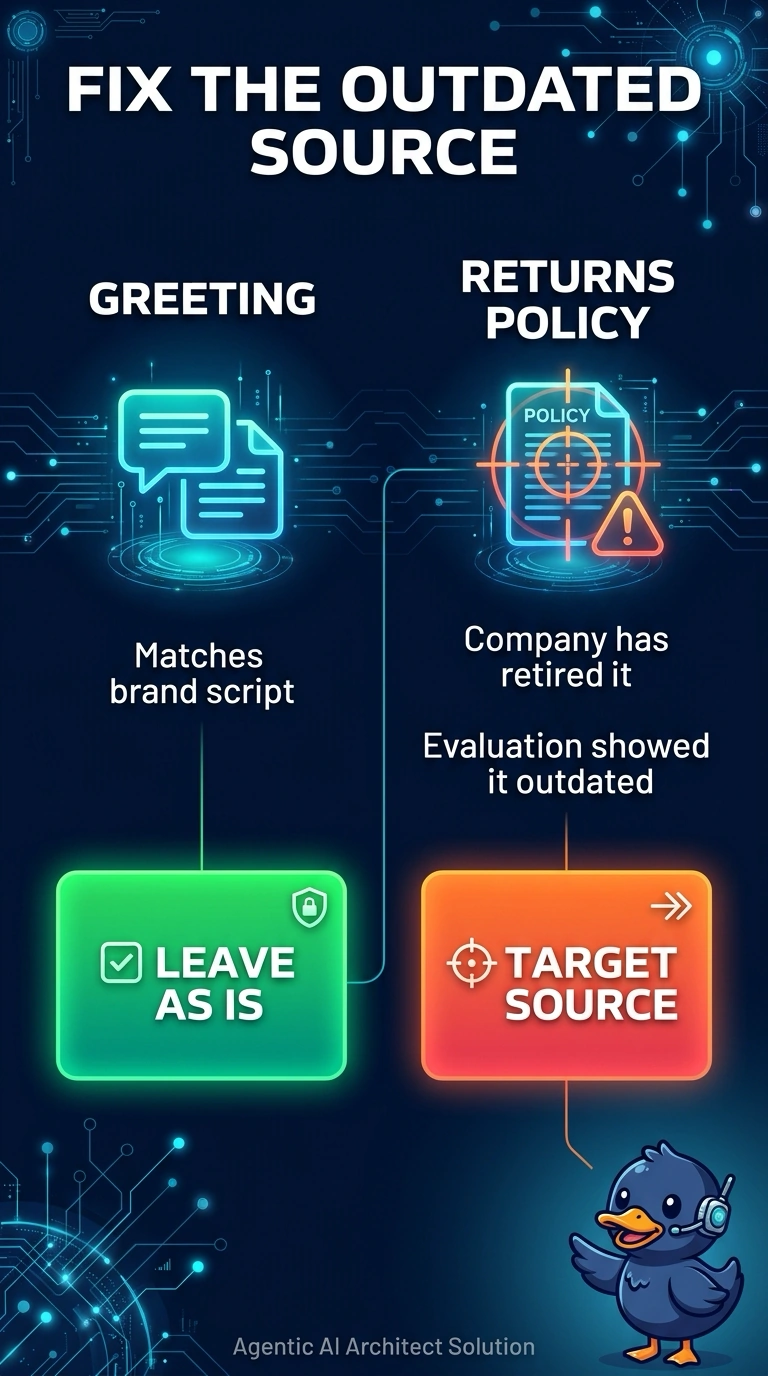
A retailer evaluates its returns agent. The greeting matches the brand script, and the following sentences cite a returns policy the company has retired. What should the architect change based on that evaluation?
Select an answer to reveal the explanation.
Short Explanation
A host can deliver the welcome perfectly and still hand you last year’s menu. You use the evaluation to target the retired policy source, leaving the greeting as it is; that is targeted correction. Rewriting the welcome leaves the outdated policy available to ground future answers.
Full Explanation
The evaluation separates a successful behavior from a failing one: the greeting matches the brand script, while the following sentences cite a retired returns policy. You should target the outdated policy source and leave the greeting as it is, because changing a step that passed does not address the stale information in the answer. Rewriting the greeting while leaving the retired policy in the grounding set would preserve the source of the error. Treating a high session count as the quality result also fails: usage volume does not show that the cited policy is current, and it does not resolve the evaluated defect. Sending the model to fine-tuning while setting aside the source misplaces the correction; the evaluation identifies the source as outdated, so the retired document should not remain available to ground responses. Exam caveat: a passing tone or greeting result does not establish that every other part of the reply is accurate; read each evaluated behavior separately. Practical check: replace the retired policy in a test index, run the same evaluation, and confirm that the greeting still matches the brand script while the answer cites the current returns policy. Record the policy citation as the failed behavior so the change can be verified against the evaluation.