
A security architect asks who scans MCP server code for vulnerabilities in the registry ecosystem. According to the registry documentation, what is the answer?
Select an answer to reveal the explanation.
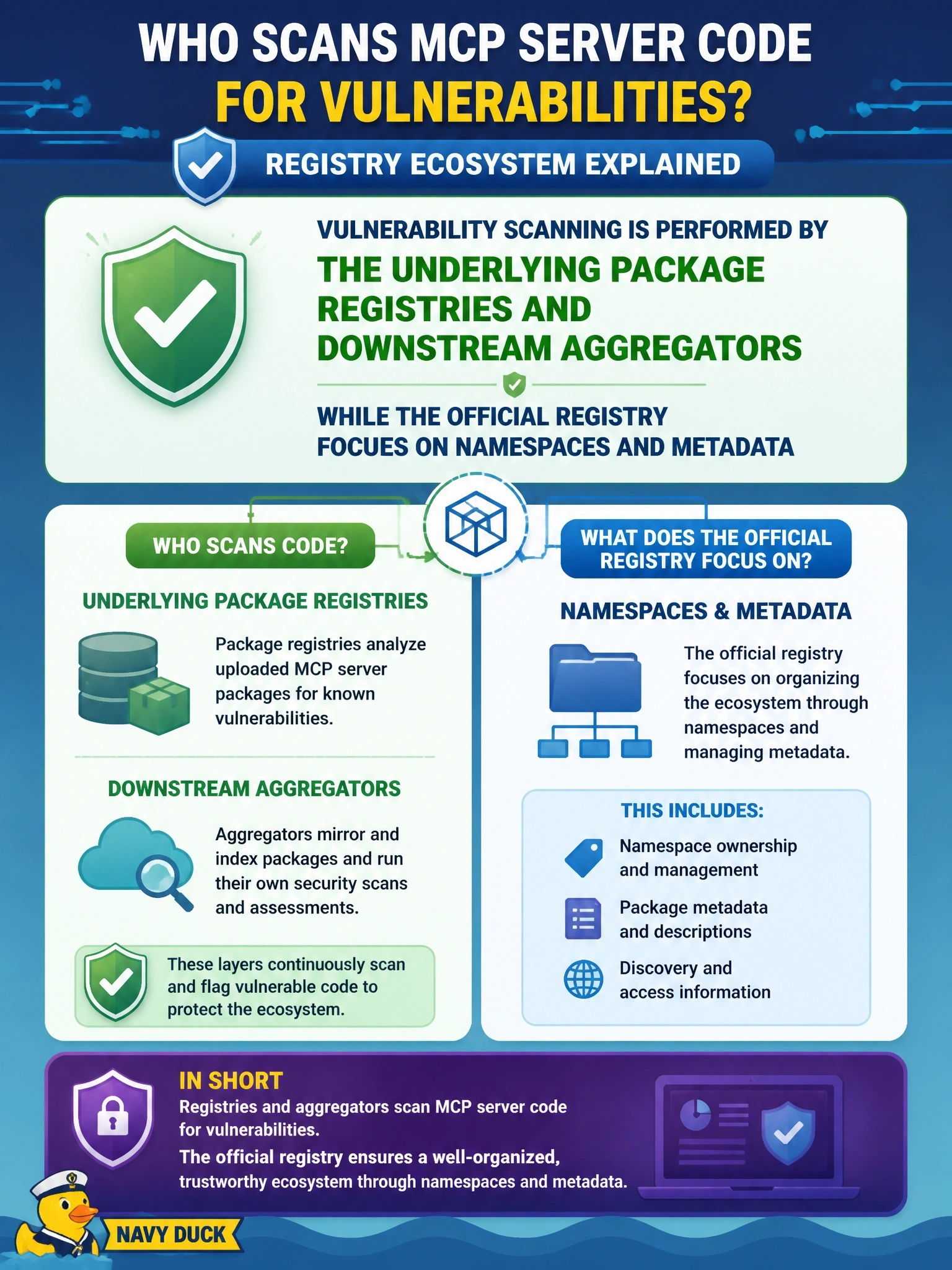
Short Explanation
The registry checks your ID at the door, but it doesn't X-ray your luggage; that job belongs to npm, PyPI, Docker Hub and the marketplaces. The trap is assuming a registry listing means the code was vetted.
Full Explanation
The registry documentation states that the MCP Registry delegates security scanning. Underlying package registries such as npm, PyPI and Docker Hub perform their own security scanning and vulnerability detection, and downstream aggregators and marketplaces can add further checks, ratings or curation. The official registry focuses on namespace authentication and metadata hosting and relies on the broader ecosystem for scanning actual server code. It therefore does not scan packages before accepting server.json, and a listing should not be read as a security endorsement. server/discover returns supported versions, capabilities and server information; a host receives no source code through it and cannot audit code that way. SEPs are specification enhancement proposals for changing the protocol or adding extensions; Core Maintainers do not review individual servers for listing, and listings do not go through governance. Exam caveat: the registry does prevent impersonation through namespace verification and can remove malicious servers through manual takedown, which complements but does not replace code scanning. Operational check: before approving a server, review the scan results from its package registry or a curated aggregator, pin the exact package version referenced in server.json, and repeat the review whenever that version changes.