
A developer sees MCP Registry server names such as io.github.alice/weather and com.example/billing and asks why they use this format. What is the reason?
Select an answer to reveal the explanation.
Short Explanation
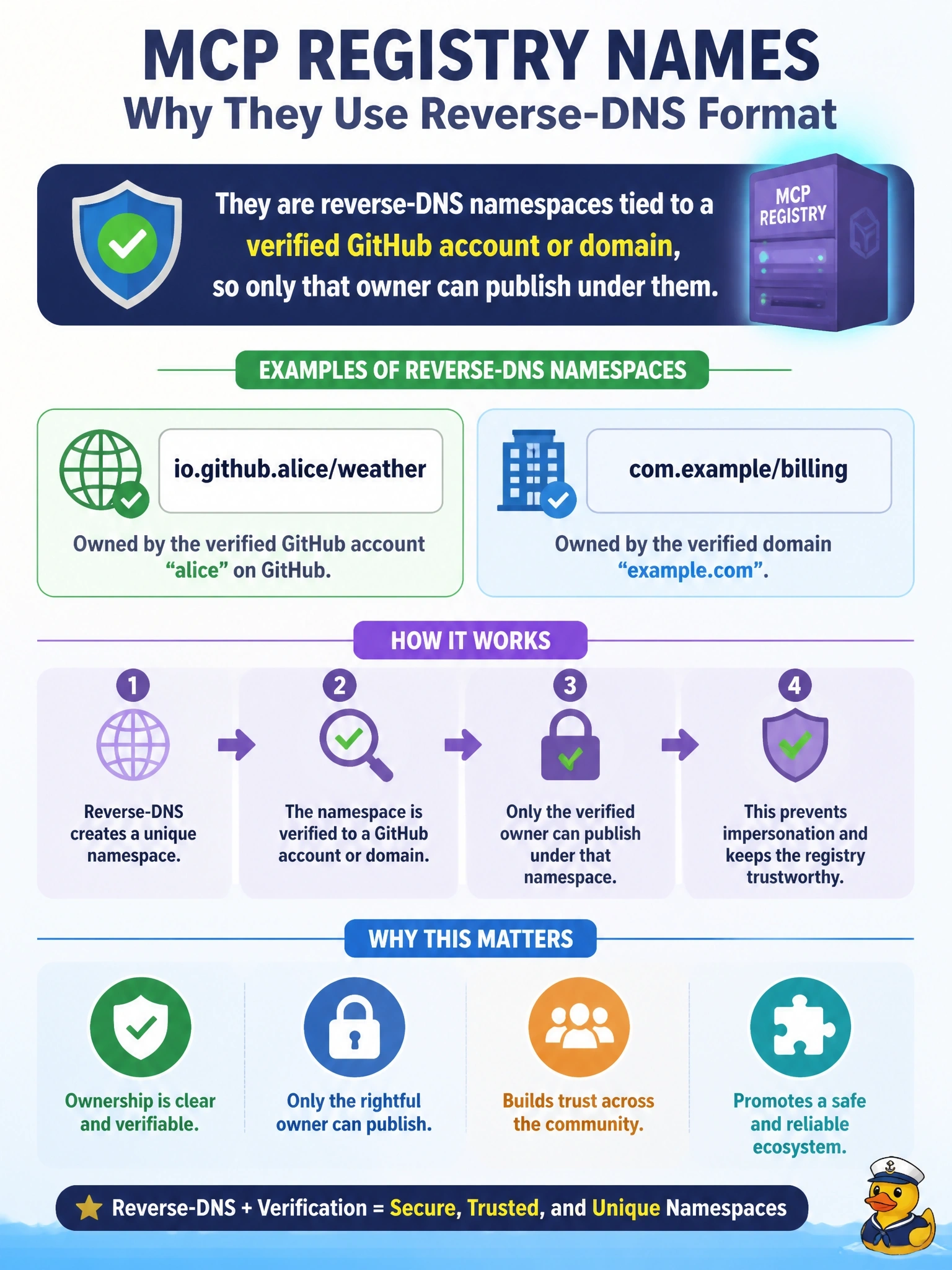
Think of it like a return address you can only use if you actually live there. The registry checks that you own the GitHub account or the domain, and the trap is believing anyone can grab an unused name first.
Full Explanation
The MCP Registry uses namespace authentication to ensure servers come from their claimed sources. Server names follow a reverse-DNS format such as io.github.username/server or com.example/server, and the namespace ties the name to a verified GitHub account or domain. Publishers prove ownership through GitHub, DNS or HTTP challenges, so only the legitimate owner of the account or domain can publish under that namespace, which gives the ecosystem accountability and also serves as a spam control. The namespace is not derived from an npm scope; package locations are recorded separately inside server.json, which remains the metadata source. Names say nothing about transport: whether a server runs locally over stdio or remotely over Streamable HTTP is described in its package or remote entries, not by its prefix. Names are not first-come claims either; an unverified publisher cannot take a prefix for a domain or account it does not control. Exam caveat: the same reverse-DNS convention appears elsewhere in MCP, for example in extension identifiers and _meta key prefixes, but registry names add the ownership verification step. Operational check: before publishing under a company domain, complete the DNS or HTTP verification for that domain and confirm the registry accepts the matching namespace.