
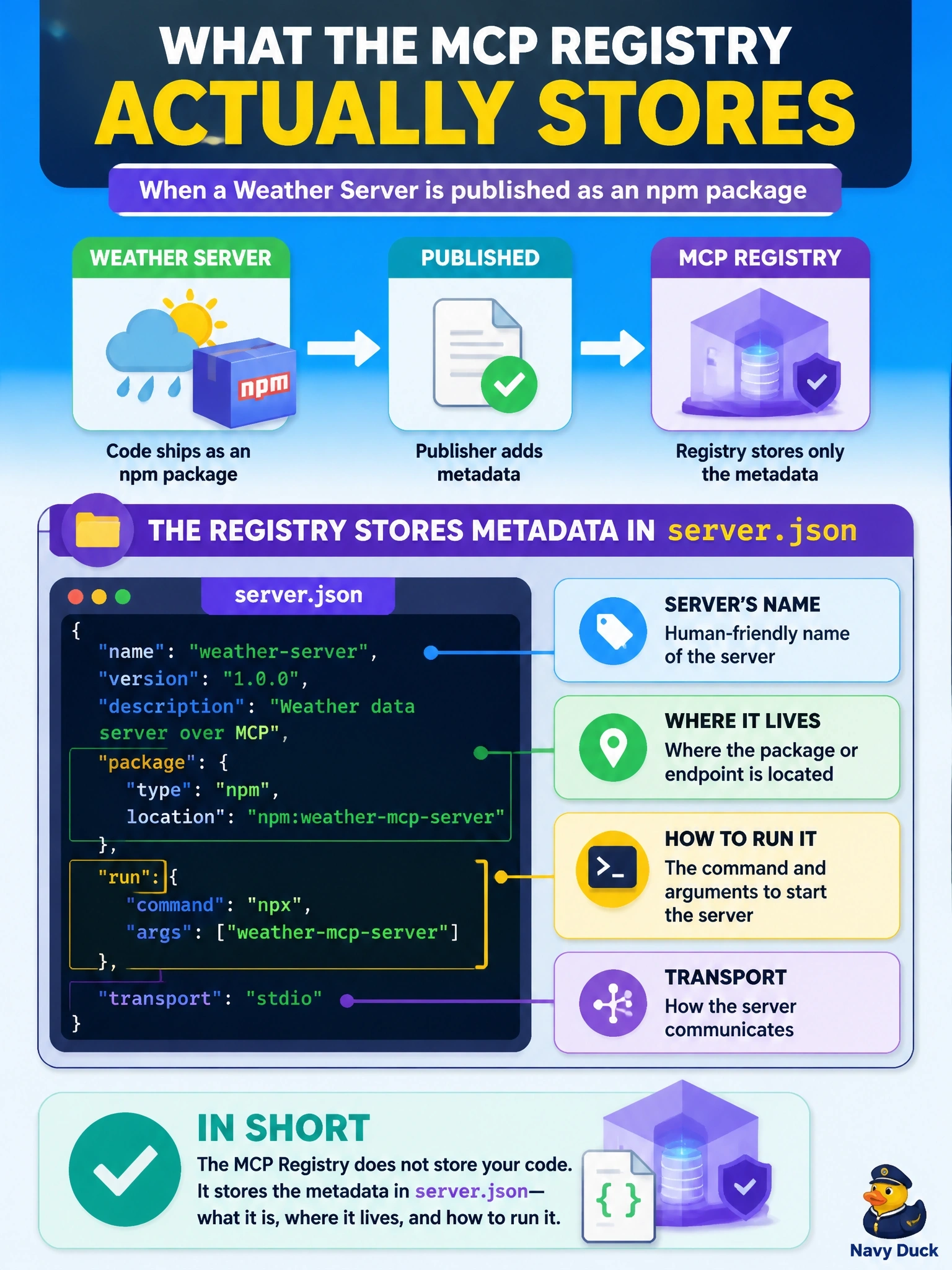
A platform engineer asks what the official MCP Registry actually stores when a developer publishes a weather server whose code ships as an npm package. What is the answer?
Select an answer to reveal the explanation.
Short Explanation
The registry is a phone book, not a warehouse: it tells you where to find the server, not the server itself. The trap is thinking it hosts packages or binaries, which stay on npm, PyPI or Docker Hub.
Full Explanation
The official MCP Registry is a centralized metadata repository. Publishers submit a server.json document containing the server's unique name, where to locate it, such as an npm package name or a remote server URL, execution instructions such as command-line arguments and environment variables, and other discovery data such as a description. Package registries such as npm, PyPI and Docker Hub host the actual packages with code and binaries; the MCP Registry hosts metadata that points to them, for example mapping a weather server version to an npm package. Copying npm packages into registry storage misdescribes the design, which deliberately leaves code with the package registries. The registry does not build or scan container images from source; security scanning is delegated to the underlying package registries and downstream aggregators. It also does not crawl servers by calling tools/list; capability information in server.json comes from the publisher, and downstream aggregators, not the registry, pull data on a regular schedule. Exam caveat: the registry is in preview, and breaking changes or data resets may occur before general availability. Operational check: look up a published entry through the registry API, confirm it references the package name and version, then confirm the package itself resolves from npm rather than from the registry.