
A user asks an assistant to list today's open support tickets, which requires live data from an MCP server. Which sequence describes the flow?
Select an answer to reveal the explanation.
Short Explanation
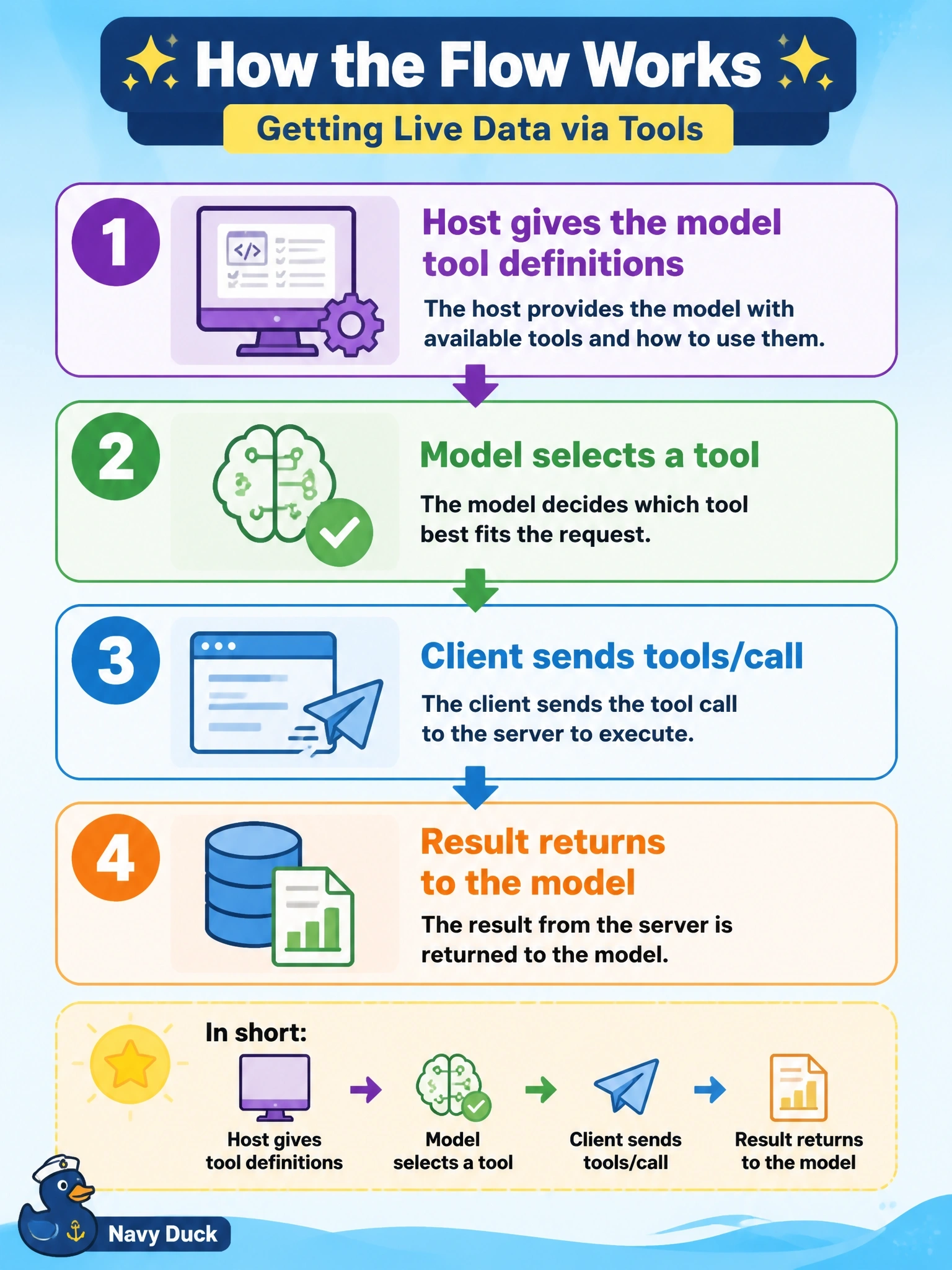
Picture a relay race: the host hands the model the tool list, the model picks one, the client runs to the server, and the result comes back to the model. You'll know a distractor is wrong when someone skips a leg.
Full Explanation
The tool flow begins with discovery: the client obtains tool definitions through tools/list, and the host makes them available to the model. When the model decides a tool is needed, it selects one; the host intercepts that choice and the client sends a tools/call request to the appropriate server. The server executes the tool and returns a result, which the client passes back so the model can process it and compose the answer. This matches the message flow diagram in the tools specification and the architecture overview's description of how AI applications route tool calls. The model never sends JSON-RPC itself, and servers return results to clients, not directly to users; the host remains in the loop throughout. Sending initialize is a legacy handshake removed in the stateless 2026-07-28 revision, and servers do not push ticket data unprompted; change notifications require an explicit subscriptions/listen stream and carry no ticket content. Servers no longer send their own JSON-RPC requests to clients; any need for input is returned inside a result as an InputRequiredResult. Exam caveat: hosts SHOULD keep a human in the loop who can deny tool invocations, so a confirmation step may sit between selection and tools/call. Operational check: trace one request and confirm the order tools/list, model selection, tools/call, result returned to the model.