
A chat application connects to three MCP servers on the user's behalf. Which participant holds the full conversation history?
Select an answer to reveal the explanation.
Short Explanation
The host is the keeper of your conversation, like the notebook on your own desk. Servers only see the pages you choose to show them. Clients are just messengers, not archivists.
Full Explanation
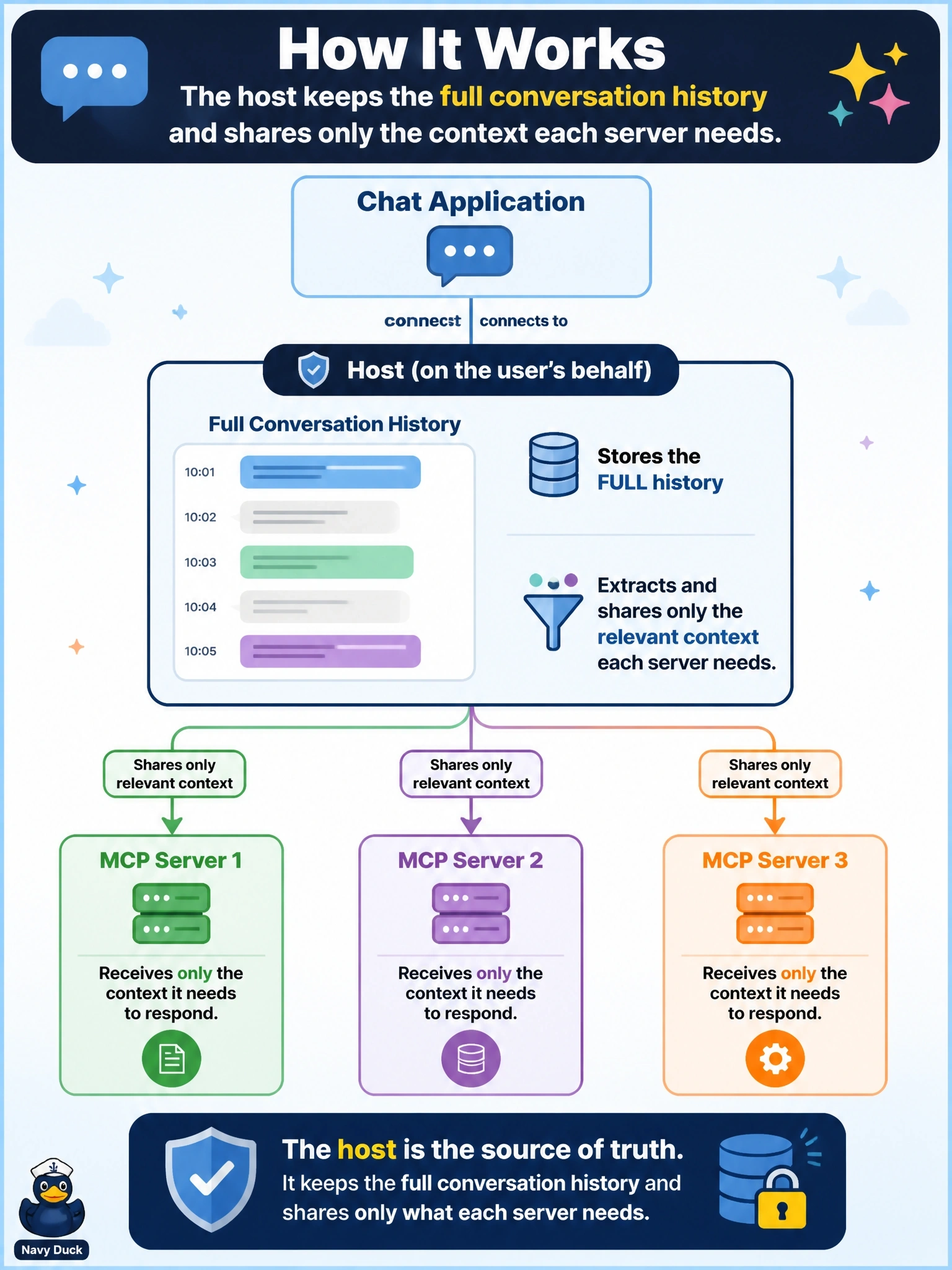
MCP's architecture places the conversation with the host. Among the design principles, the specification states that servers should not be able to read the whole conversation nor see into other servers: servers receive only necessary contextual information, the full conversation history stays with the host, and cross-server interactions are controlled by the host. The host also manages context aggregation across clients, which requires it to own the conversation in the first place. Clients are created by the host to communicate with exactly one server each; they route protocol messages and attach per-request metadata, but they do not hold the user's full dialogue. Servers see only the arguments and context sent to them in individual requests, and because the 2026-07-28 protocol is stateless, a server should infer nothing from previous requests, so it is not a reliable store of conversation history either. No server acts as coordinator for others, regardless of connection order, since servers operate independently and in isolation. Exam caveat: the deprecated sampling feature let servers ask for some context through includeContext, but the client could always restrict or ignore that request. Operational check: review what each tools/call carries and confirm it includes only tool arguments, while the conversation transcript is stored only within the host application.